BATMAN V SUPERMAN: DAWN OF JUSTICE
WISHLIST

Cut to the main lobby of what is later identified as LexCorp Research Park. People are chatting, dressed casually, and just look genuinely happy. Not to mention the interior basketball court that comes into view as the camera descends into the scene. Two senators, Barrows and Finch, are being led into the building by Mercy.
Following from the last scene, Batman Theme A continues few a few moments on piano before disappearing, possibly connecting Alfred’s monologue about how powerlessness turns good men cruel to Lex, whose abusive childhood made him the man he is today.
Then our villain comes into view, a scrawny young man with long red hair tossing a basketball. He scores. Then he turns to the newcomers, looking pleased. “Ooh. Ah. Ahoy-hoy! I did not know you were here,” says Alexander “Lex” Luthor Junior (Jesse Eisenberg). “Ahoy-hoy!” was the over-the-phone greeting of Scottish inventor Alexander Joseph Bell, who patented the first telephone and shares a first name with Lex. The villain is also wearing a shirt displaying an image by UK graffiti artist Banksy of a monkey with a bomb detonator, foreshadowing Lex’s imminent messing with forces beyond his control. This one shot immediately establishes Lex Luthor as a new, “hip” take on the character reflecting modern Silicon Valley “tech bro” billionaires.
Behind the Scene
According to Jesse Eisenberg in an interview with Jimmy Fallon, he was under great pressure to perfect his field goal, throwing the ball many times in an attempt to score before finally getting the shot right and breathlessly saying his line with as much confidence as he could muster.
“I’ve played [basketball] since I was very young, and when I read in the script that Lex has a basketball court in his offices, I said, ‘I don’t need a stunt double or any kind of computer effect, this is the one thing that I can do perfectly.’ Then I showed up to the set, played all day flawlessly until we got to the shot where he makes a three-pointer, turns around and says his line… and the ball would not go into the basket. It was like a classic Charlie Brown moment.”
Jesse Eisenberg, Press Release, March 2016
“Man on the marquee,” says Barrows, shaking Lex’s hand.
“Yeah, don’t believe it. My father named the company after himself. He was the ‘Lex’ in front of the ‘Corp’,” the young man responds, gesturing very dramatically and energetically. Like Bruce, Lex inherited a company named after blood that came before him, but where Lex’s company was named after his father explicitly, Bruce’s company was named after his family. Then Lex moves to shake Finch’s hand. “How you doin’?”
Shaking Lex’s hand, Finch warmly responds, “Oh, really great.”
“Really great? Good.” He holds her gaze for a moment with a smile. Then he gets a bit more serious and finally breaks off the handshake. “Good. Uh, follow me.”


Lex grabs a white jacket from an employee and leads his guests through the building. Walking backwards to address them, he explains, “No, uh, Dad started saying that he named the company after, uh, after his kid at investor pitches. Rich old ladies. They thought it was very cute, you know?” He says this as the enormous neon LexCorp Industries sign is given prominence in the background. He finishes putting the jacket on dramatically and gestures the slogan, “‘Write checks for Lex!’”
“I didn’t really notice this until now, how much this is a story of the idea of the lessons that fathers taught their sons, and the first thing we learn about Lex’s dad is that he used him as a tool to get what he wanted. The first time he said that, I thought, ‘That’s kind of gross,’ but then the more I think about it, that’s just awful. That’s literally the first thing that pops into Lex’s head when someone mentions his dad. He’s like, ‘No, no, my father actually lied to people about how much he cared about me to get money and build his company.’”
Stephen Colbert, Batman v Superman: By The Minute, 15 July 2019
Note how Lex is immediately trying to connect with the two politicians by talking about his father, trying to come off as personable. Indeed, with the benefit of hindsight, we know Lex’s father was abusive, and happily exploited a son he hated. Ironically, Lex is also about to exploit his father to pitch the weaponization of Kryptonite to the two senators. This may also be referencing There Will Be Blood (2007), where Daniel Plainview exploits his adopted son Henry as a mascot to convey a wholesome and family-friendly image for his shrewd oil enterprise. Also, note the Caffe Bene coffee shop in the background — another example of the casual, social atmosphere of this modern rendition of LexCorp.


A heavy mechanical door fills the screen, unlocking before sliding open. The group walks into the lab, led by Lex and Finch, followed by Barrows, flanked by Mercy. Note the heavily armed guards as the group walks by.
Lex continues, “You know, Dad was born in East Germany. He grew up eating, uh, stale crackers. And every other Saturday, he had to march in a parade and wave flowers at tyrants.” Then he grabs his blue stress ball from a work table and juggles it once as he says, “So, I think it was providence that his son, me, would end up with this…” Note his use of “providence” here, invoking divine intervention when, as we later discover, he is personally disgusted by the very concept of such things.
In a glass container, a small fragment of Kryptonite emerges from below in a protruding holster. This imagery of the arrowhead mineral on a pole, might be foreshadowing of the Kryptonite spear.
Lex explains, “One of my Rebuild Metropolis crews found it. Little souvenir from the Kryptonian World Engine.” This line also clues us in on Lex’s philanthropy work, having contributed towards the rebuilding of downtown Metropolis after Zod’s invasion.
“It’s Kryptonite, Superman. A little souvenir from the old hometown?”
Lex Luthor, Superman, 1978
Finch bends down to observe the mineral. Then she stands up straight, asking, “What does a rock have to do with homeland security?”
Lex’s head is in his crossed arms over the container, further showing off a kind of blasé attitude. “Homeland security? Mmm. No, no, no, ma’am… planetary security,” he responds as he turns to her dramatically.
Finch looks at him for a few seconds before a scientist in the room speaks next: “The fragment is of a radioactive xeno-mineral,” says Emmet Vale (Ralph Lister). In the comics, Vale coined the name “Kryptonite” and also designed the supervillain Metallo. Finch turns to him.
Cut to Barrows, looking more interested than confused.
Standing by a monitor, Vale continues, “We suspected it might have bio-interactions. So we took the sample to AMRIID” — Vale presses a button and the screen displays footage of the pale body of General Zod — “where they keep the remains of the Kryptonian decedent.” For those who don’t know, AMRIID stands for United States Army Medical Research Institute of Infectious Diseases.
On the screen, we witness the same mineral fragment being used like a scalpel to cut the flesh on Zod’s body. Note that it is glowing here, whereas the fragment in the container is not, indicating that it glows in the presence of Kryptonians. This might be taken from the CW series Smallville, where Kryptonite regularly functioned the same way.
Vale continues, “And, when we exposed General Zod to the mineral, this happened.” He points across the room.
Finch looks over her shoulder at the monitor behind her, now displaying microscopic footage of the dead cells turning green and dissolving. She approaches the screen.
Vale concludes, “Profound bio-degradation, decaying Kryptonian cells.” From this, we know the effects of Kryptonite and that Kryptonians do not otherwise decompose on Earth. This is one of the few somewhat scientific descriptions of how Kryptonite works in any Superman fiction, essentially causing Kryptonian cells to break down and die.


Lex adds, “We concluded the mineral could be weaponized if a large enough sample was found. And then, among the fishes, a whale!”
At the first screen, Vale taps another button and the screen displays a photograph of the large Kryptonite chunk from earlier.
“Ah! Lying at the bottom of the Indian Ocean.” Lex puts his hands on his hips boastfully. “Emerald City.” “Emerald City” is one of many references to The Wizard of Oz in this film, being the domain inhabited by the titular wizard promised to be Dorothy’s escape from the mystical land she finds herself trapped in. Lex makes these references most.
Cut to Mercy, smiling at her boss.
“Beautiful,” finishes Lex, associating his words with her. A little hint at his appreciation for his faithful assistant, and her bashful look implies reciprocation. However, she remains quiet to give Lex his moment.
Finch listens closely as Lex continues, “Now, Rocky is radioactive,” — Lex gestures to Finch and Barrows — “but what he needs from you is an import license.”
“And why would we want to weaponize this material?” Finch asks.
Lex responds, “As a deterrent. A silver bullet to keep in reserve to use against the Kryptonians, so the day does not come, madam, when your children are waving daisies at a reviewing stand.” He says this very melodramatically, perhaps with a hint of anger, feigned or otherwise. Finch just looks at him.
Barrows interjects, “Last I looked, the only one of those flying around up here was Superman.”
Lex raises a finger and responds, “Ha-ha, yes. Superman.” He almost seems to sneer the name, as if the Kryptonian does not deserve such a grand title. “Yeah, but, there are… uh, there are more of them.”
“The meta-human thesis,” notes Finch with recognition, telling us that Lex has spoken to the government about such beings in the past. A “meta-human” is DC’s term for super-powered individuals.
Barrows, however, looks a little confused as Lex responds, “Yes, the meta-human thesis.” The young man steps around the glass container in the middle of the lab. “More likely than not, these exceptional beings live among us. The basis of our myths. Gods among men upon our little blue planet here.” The way meta-humans are spoken of and introduced in this film makes them out to be myths and urban legends, like Bigfoot and UFOs, and this adds to the significance of their existence, rather than merely being the super-powered heroes of the week. This sets up Bruce’s discovery of the meta-humans Lex has been keeping tabs on. Of course, we have yet another reference to divinity.
Then Lex thoughtlessly slams his stress ball on the roof of the container. His representing the ball as Earth ties into the character’s symbolism of the world in his hands, which unfolds further as the movie does. Finch looks a little startled by Lex’s flourish, judging from her rapid blinking.
Lex finishes, “Now, you don’t have to use a silver bullet” — we close in on him to emphasise his point — “but if you forge one… well, then… we don’t have to depend upon the kindness of monsters.” He says this possibly imitating Finch’s Southern accent, either trying too hard to appeal to her or unintentionally mocking her. After finishing his sentence, he also seems to struggle maintaining his smile, a very slight break in his façade concealing the hate underneath.
This is a subtle indicator of Lex’s personal resentment of the idea of gods by equating them (and Superman) with monsters. Also, note the irony that, in the near future, Lex creates a literal monster that he depends on to give him power and satisfy his goals, and that dependence relies on his assumption that the monster will obey him due to its blood relation. It does not. To metaphorically save humanity from itself, Superman then takes the silver bullet intended for him and slays the beast with it, giving his life in the process. It is an ironic twist of fate that solidifies Superman as a humble saviour, not the monster Lex compares him to.
Lex may also be referencing the final statement of Blanche DuBois in the Tennessee Williams play A Streetcar Named Desire (1947) before she accepts the help of someone who does not have her best interests at heart: “Whoever you are — I have always depended on the kindness of strangers.” Furthermore, Blanche has been abused by strangers throughout the play, yet she is too detached from reality to realise her vulnerability. The connotations in Lex’s reference are thus very clear, equating humanity with Blanche, deceiving ourselves into depending on a being who cares nothing for us. This interpretation is corroborated by the 1951 film adaptation being one of Snyder’s favourite films.


Cut to the lobby, shoulder shot between Barrows and Lex, who stop as Finch is led towards the exit by an aide in the background. They turn to each other, and Barrows simply says, “There are ways we can help each other.” The immediate subtext is that Barrows is offering help to Lex in exchange for some form of bribery.
Lex instantly makes the realisation that Barrows is making an off-the-record offer, almost expectantly saying, “Ah. Would you step into my office here?”
Humorously, instead of entering an office, Lex takes a stool at what looks like a nearby refreshment table while Barrows stands nearby, further exemplifying the very casual nature of the atmosphere and environment at LexCorp. He makes for a very non-traditional CEO, as the general environment of LexCorp has already demonstrated.
Lex claps and excitedly says, “Yes!” awaiting what Barrows has to say.
Barrows asks, “What’s your wishlist?”
Lex reaches over to grab a bowl of sweets and he begins sifting through. He looks down at the bowl as he says, “Uh… Access to the wreck of the crashed Kryptonian ship?” Then he looks up at Barrows, awaiting his response.
Ominous string textures, a musical indication of Lex’s true deviousness.
The Senator replies, “Done.” Evidently, he has sufficient connections and authority to provide what Lex wants.


Cut to the near-future, a flyover shot across the large white tarp erected over an area of Metropolis, no doubt containing the aforementioned crashed ship. We slow to look down on the main entrance to see Lex drive into the checkpoint. The container resembles a sperm whale, drawing relevant connections to Moby Dick. Bruce Wayne draws significant parallels to that role, disregarding his moral compass in a reckless quest to destroy what he perceives as a force of evil. Lex is similar, setting out to destroy the being he sees as an existential threat to his worldview. He simply cannot stomach the idea of Superman.
Textures broken by the low, thudding piano notes of Lex Luthor Theme B. The eight slow, low-pitched notes are a warped inversion of Superman Theme A and the first four notes of Superman Theme B.
Shot from inside the car looking forward at the soldiers guarding the facility beyond. Security is tight with the sturdy fences and military guards signalling him to stop.
Shoulder shot from a soldier standing over the driver window, taking Lex’s new access papers to look them over.

Cut to a decontamination chamber, where Lex has his arms raised as the jets of air rustle his hair. Then the automatic door opens.
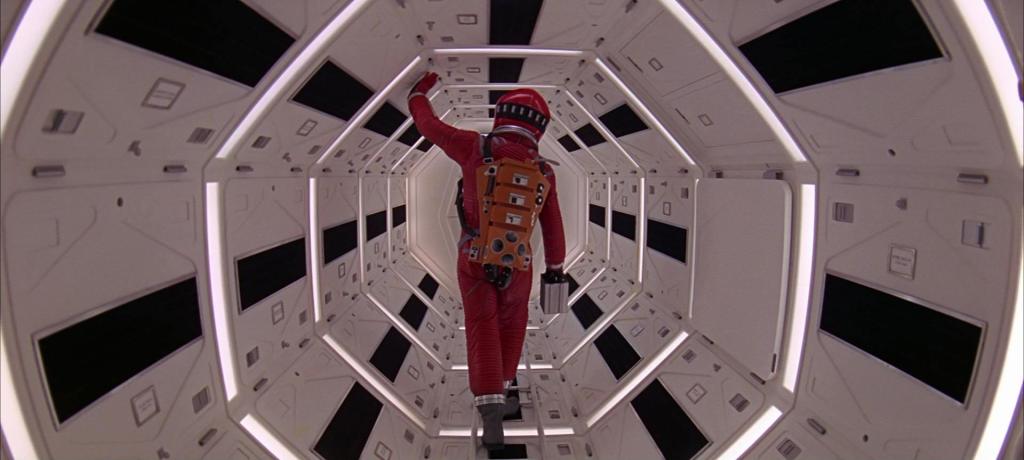
Ground-level shot behind Lex’s feet, and he travels down the access hallway in slow-motion. A technician/scientist walks by as the camera follows Lex into a cloud of smoke. Zack Snyder confirmed this shot is a reference to the 1968 Stanley Kubrick film 2001: A Space Odyssey, where the protagonist similarly walks down a hexagonal sterile hallway very slowly. Both Snyder and this film’s director of photography Larry Fong hold Kubrick’s film among their favourites. The hexagonal shape returns again in the Batman/Superman fight later, and is a possible motif of the Taoist cosmological Bagua symbols that Reel Analysis discusses in this video.
Timpani roll leads into piano, strings, and harpsichord playing the villainous and grandiose Lex Luthor Theme A for the first time, Lex’s feet matching the beat of his theme. This too is a twisted inversion of Superman Theme B.
Medium shot on Lex reaching the end, looking up at his new resource.
Low-angle rear shot of Lex, dwarfed by the monstrous alien vessel before him. The ship is illuminated by spotlights and surrounded by scaffolding in the dim space, creating an eerie atmosphere. This is his now.


Jump back to the past by cutting to Lex’s candy bowl again. We pan up to Lex’s face, but this time he is not even looking at Barrows as he makes his second request: “The complete remains of the dead alien for testing.” He sniffles.
Lex Luthor Theme A subsides. Unhinged low piano and string textures and melodies.
Barrows chuckles, stumped by the tremendous request. “You want Zod’s body?” he asks, incredulously.
Lex feigns thinking for a second before responding with a blunt, “Okay,” as if interpreting Barrows’ question as an offer.
Barrows loses his smile as he realises Lex is serious.


Ground-level shot on a gurney rolling down a hallway, flanked by the boots of two men in military uniforms.
Wide shot of the scene to observe a metal container being rolled down a hallway, led by Mercy. The container is printed with the words “USAMRIID”.
Shoulder shots from the two men pushing the container. At the end of the hallway is Lex, out of focus.
Cowboy shot on him, looking sinister and beckoning the group (and the camera) forward with his hands before halting them (and the camera at a medium close-up). The camera responding to his gestures, obeying his order to stop, establishes him visually as someone with power who enjoys using it. He is flanked by two guards armed with FN SCAR-L assault rifles. As Lex breathes a sigh of satisfaction, the automatic doors behind him slide open.


Rear shot of Lex in a laboratory, wearing sterile gear and standing over the pale body of General Zod. He reaches over to collect a tool.
Cut to Zod’s cold hand, where Lex has the Kryptonite attached to a handle with which he uses as a scalpel to cut the flesh on Zod’s fingertips, using tweezers to pull away the thin slice of his prints — a somewhat unnerving visual.


Just as the peeled skin comes away from Zod’s fingertip, we cut to Lex removing a Jolly Rancher from its plastic wrapper to make the audience subconsciously connect the gruesome imagery of the skin with the wrapper. Lex raises the crimson candy to Barrows’ mouth, and the Senator shakes his head.
Looking smug, Lex says quietly, “It’s cherry.”
Clearly uncomfortable and humiliated, Barrows reluctantly opens his mouth, accepting the indignity if he wants what Lex can give him.
Lex pokes the Jolly Rancher into the Senator’s mouth. “Mmm-mmm,” the villain murmurs. This is one of several violations of personal space that Lex commits throughout the film, with more to come, and is our first look at the real Lex, exerting his power and dominance over others by humiliating them. This is especially cruel considering he intends to have Barrows killed later at the Capitol. Then he licks his fingers. His displays here have been childish, only adding to his creepy attitude.
The scene ends with the words of Kahina Ziri to associate with Lex’s ambitions: “Because the time has come…”
Then the music ends abruptly.


SCENE OVERVIEW
We come to LexCorp, where the last of our introductions is Alexander “Lex” Luthor, portrayed as an exuberant young tech mogul with a knack for references and melodrama, surrounding himself with a façade of magnanimity to obscure his true nature. Accompanied by his aide Mercy Graves, he makes a case to Senators Barrows and June Finch for the importance of Kryptonite as a deterrence to fend off Superman should he turn on humanity, establishing his connection to the mineral uncovered in the Indian Ocean. Leaving Finch to consider his offer, he bribes Barrows in exchange for access to the Kryptonian scout ship and General Zod’s body. Both of these will play major roles in his scheme, primarily as his final trump card. The tone of the tail end of the scene transforms this eccentric and affable young man into a diabolical villain, an excellent scene to introduce the two sides of the character.
SCENE ANALYSIS
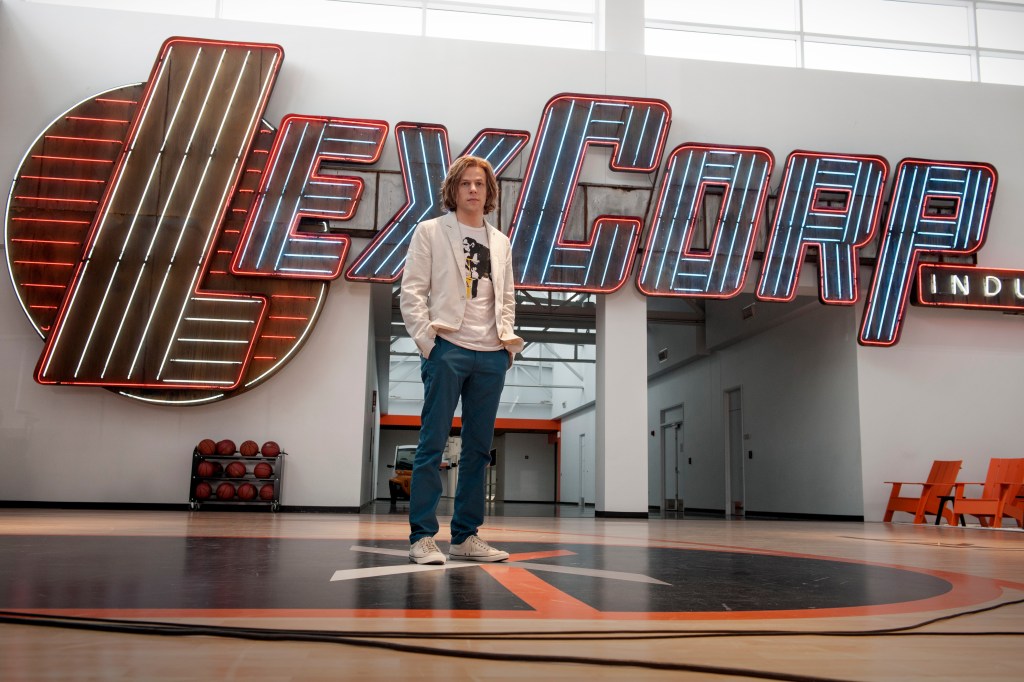
A younger take on the character, Lex’s mannerisms and actions quickly tell us a lot about him, clearly establishing him as a fresh new take on the character. Playing basketball with his employees says a lot about the laidback, sociable atmosphere of LexCorp, comparable a lot to modern tech companies. Of course, this is merely a façade, hiding the kind of person Lex really is by manufacturing an atmosphere of magnanimity. Though this is Lex’s first appearance in the film, his presence and influence on events has existed since the desert scene, or even since the Indian Ocean scene.
“He looks chilled, almost like a surfer or a skateboarder when you look at him. As for his corporation, his building, the whole Google thing came up as a concept… And so his place is super sleek, super beautiful, super fun… at the edge of futuristic, super high-tech…”
Patrick Tatopoulos, Batman v Superman: Dawn of Justice, The Art of the Film, p67, 29 March 2016
“When you walk into Lex’s world, it has ping pong tables, Foosball tables. They got these quirky rock furniture pieces where employees can relax… Patrick’s design ideas were very high end, modern, sleek, so everything is white. The logo has this distinctive orange to it, so we carried that throughout the lobby area.”
Greg Hooper, Batman v Superman: Dawn of Justice, The Art of the Film, p67, 29 March 2016
“That sign was supposed to represent the old LexCorp. You know, when they modernised, they probably knocked everything else down, and [Lex] put it in the lobby as some sort of relic.”
Zack Snyder, Batman v Superman: Dawn of Justice, Watch Party, 29 March 2020
“Lex set up his company with what I would call faux magnanimity, where it seems like the employees are all equal colleagues, that he’s eschewed any kind of status or hierarchy. As you meet him, you start to realise, ‘Oh, it’s a total façade.’ He actually conducts his business from a very isolated and dark place.”
Jesse Eisenberg, Batman v Superman: Dawn of Justice, The Art of the Film, p67, 29 March 2016
“Metropolis had a Federalist Style to its downtown, with light-filled grey and white buildings, modern features and green grass. So, Metropolis could be described as modern, clean, but perhaps a bit soulless. Lex Corp, headquartered there, is white, crisp, contemporary and fun… like a Google think tank… until the sinisterness and calculated evil of its owner is revealed. Orange, black, and white are the dominant colours. The front lobby has green grass carpets and boiled-wool couches that look like rocks, table tennis, a polaroid wall of all the guests and employees. It looked like a great place to work until Batman broke in and discovered Lex’s true intentions.”
Carolyn Loucks, Set Decor, 9 May 2016
This scene is a masterclass in character introduction. As soon as he appears, he’s full of energy and enthusiasm. Rather than, say, standing idly and giving his motivations, Lex’s energy keeps the scene moving. He’s physically expressive, moves from place to place, takes on different poses, and changes his tone to hold the centre of attention. He’s not explaining something to Finch and Barrows, but selling something. He’s in salesman mode, pitching an idea with an emotionally manipulative angle — tying his “deterrence” to his father’s childhood in an oppressive society and associating that with June’s own children: “A silver bullet to keep in reserve to use against the Kryptonians, so the day does not come, madam, when your children are waving daisies at a reviewing stand.” He’s also explaining a small part of his motivation by highlighting how powerful Superman is and what he’s capable of if left unchecked. As opposed to clunky exposition, he does this through his sales pitch for weaponizing Kryptonite. He’s telling the other characters more than he’s telling us, and that makes it organic.
When Barrows first asks for bribes, that is when we get our first glimpse of who Lex Luthor really is. However, though we are given hints as to his goal, he is not fully fleshed-out here. Instead, the film plants the seeds for his character’s continued development, dropping subtle hints here and there as to his total nature. For all we know about Lex’s personality, it is not until the LexCorp Tower confrontation that all these traits are given new context when we learn his motivations. This is how a sense of mystery can be given to the character without having him be an actual secret villain.
Some time after this scene, Finch will show up to Lex’s house to personally inform him that she is blocking the import license for the Kryptonite, having caught on that Lex intends to use it to assassinate Superman. We can examine this scene for the behaviours that tipped Finch off to his true intentions.
- Casually explaining how his father exploited him to sell pitches to investors.
- Subsequently exploiting his father to pitch the weaponization of Kryptonite to the two senators.
- Referring to his blue stress ball as Earth before slamming it down uncaringly onto the Kryptonite container.
- Full-on comparing Superman to a monster.
- Imitating Finch’s accent, trying too hard to pander, or accidentally mocking.
- Finch is assuredly familiar with the long political history of the word “deterrence” to cover for ulterior motives.
Though Lex ultimately does not get the support he wants from Finch to import the Kryptonite, it makes sense to ask, as that would put the government on his side and give him official state support for an anti-Superman plan. Legal alternatives carry less risk than smuggling the Kryptonite into the country.
The music track in this scene is Wishlist (The Red Capes Are Coming in the released score, referencing a later line of dialogue), officially introducing Lex Luthor’s theme song in the motifs Lex Luthor Theme A and B. Being the classic nemesis to Superman, his theme is a twisted inversion of Superman’s themes. This scene juxtaposes Lex’s calculating mind with his eccentricities to establish that however non-threatening, awkward, or twitchy this version of Lex outwardly appears, that is merely one side of a much more dangerous and calculating villain lurking beneath the surface.
In this scene, we finally get Lex’s theme, The Red Capes Are Coming in the released soundtrack, and Wishlist in the actual score. It begins playing when we first fly over the container for the Kryptonian ship, but it reaches its full intensity when Lex begins walking down the hallway towards the crashed alien vessel in slow-motion, and then relaxes for the rest of the scene after cutting back to the conversation between Lex and Barrows. There is even a slight operatic choir accompanying the later notes when Lex is cutting Zod’s fingerprints.
“I also thought it was brilliant that they used a harpsichord, which is like a piano except the strings aren’t struck by a hammer but plucked by a little hook attached to each key. The harpsichord is plucking strings and there is also some use of pizzicato in the string section, which to me aligns with the fact that Lex is always pulling the strings and manipulating those around him.”
Samuel Otten, Comic and Screen, 5 May 2016
BEHIND THE SCENE
“In the script, Lex was introduced much later, but we found that in watching the movie — because he’s such an important player, it was best to set him up sooner. Plus, his presence has so much energy, a twisted comic energy that boosted the film.”
David Brenner, ProVideo Coalition, 10 April 2016

“This is another set that was not seen in its entirety! Interesting that Lex and Bruce and Clark share the shadow of each of their fathers. The LexCorp sign seen in this shot was from the days of Lex’s father’s company. The contrast to the old way of doing business is this fun palace depicted with a basketball court, sharp Brunswick game tables in black: table tennis, air hockey, foosball and shuffleboard… beach chairs and sand, the aforementioned green artificial-grass carpets with ‘rock’ furniture (Livingstones from Smarin), plus a giant polaroid photo wall and a craft coffee shop. Super cool space…”
Carolyn Roucks, Set Decor, 9 May 2016
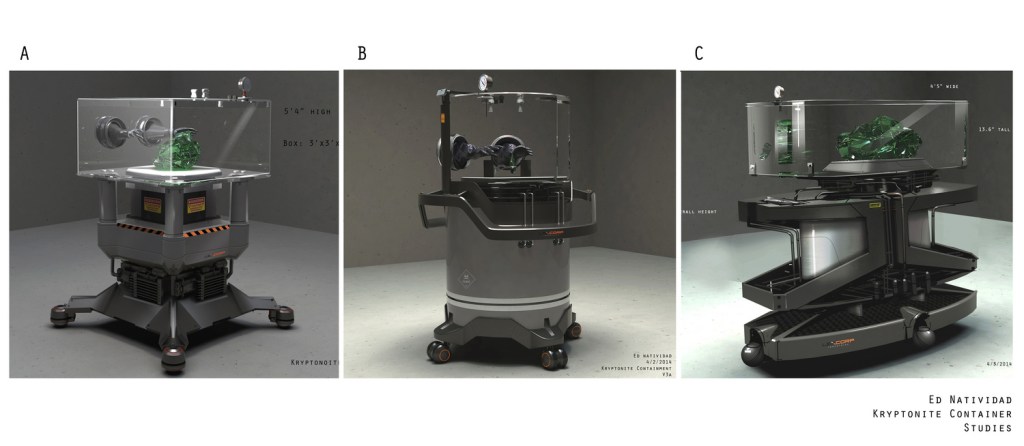
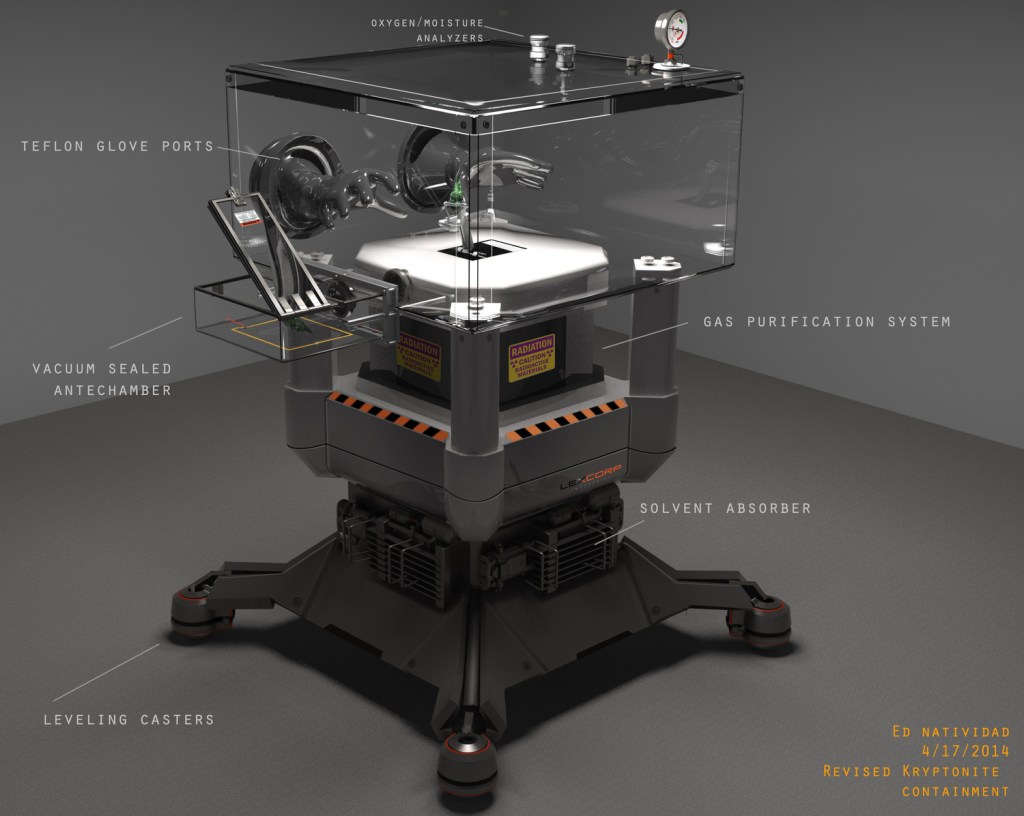
LexCorp Research Park was shot at 2011 Centerpoint Parkway, Pontiac, Michigan, a former General Motors building. During his time there, director of photography Larry Fong posted these photos to Instagram. The lobby was shot inside the building and dressed with a myriad of modern amenities to create a lively, hip tech company. On 12 May 2014, Jesse Eisenberg said he would begin filming in exactly one month, so this was likely one of his first scenes shot for the movie, and interior LexCorp filming was scheduled for around the 12th and 13th of June before rescheduling to the 16th and 17th. Concept artist Ed Natividad has conceptual renders of the Kryptonite container on his website.

Clay Enos, Vero, 7 July 2016
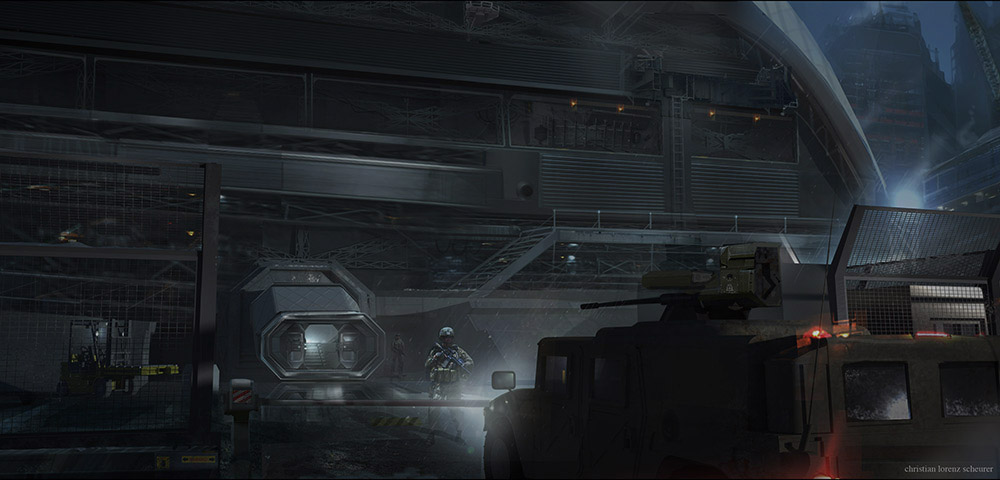
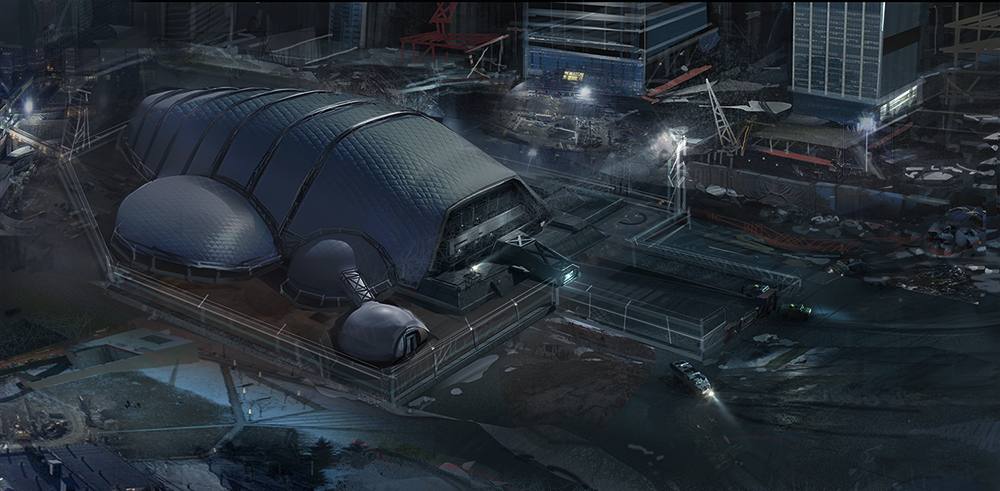
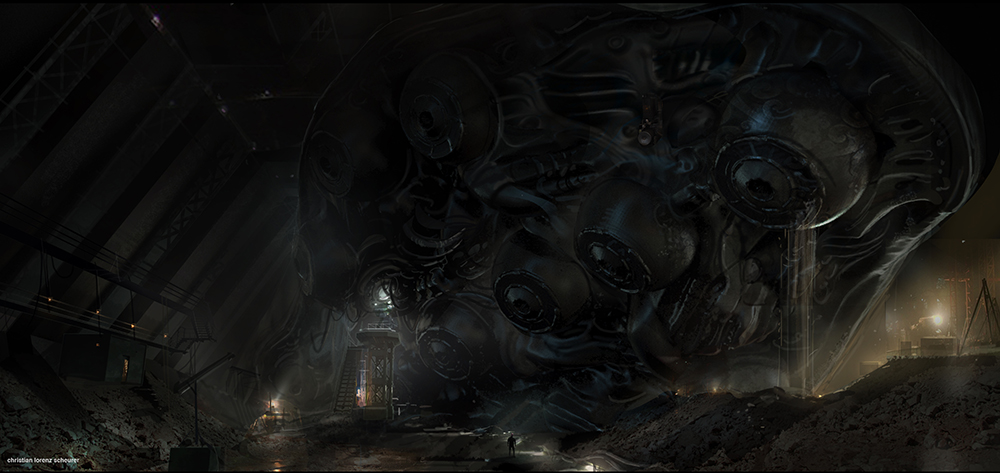
The scout ship entrance checkpoint was constructed as an outdoor green screen at the late Michigan Motion Picture Studios along Centerpoint Parkway, Pontiac, Michigan, directly across the street from the LexCorp location. Military vehicles present were real. On 4 June 2014, with a week’s notice, extras signed up for military roles were called for fittings in preparation for 11th shooting all day into the night for the checkpoint sequences. The shoot was then rescheduled for the 13th due to rain. A month prior on 12 May, Jesse Eisenberg said he would begin filming in exactly one month, so this was likely one of his first scenes shot for the movie. Set photographer Clay Enos and electrician Erica Kim both got photos.
“We had this dummy of Michael Shannon built, a beautiful replica. Calling it a dummy seems rude. It looked exactly like him. It was uncanny. It would be there on a gurney or wherever we had it and it was nerve-wracking. I always thought it would be a cool practical joke if they had flown Shannon in and had him actually lie there and then sit up or do something in the middle of the shot. It would have been awesome, just to freak us out, because it looked so good we never would have noticed in a million years.”
Zack Snyder, Batman v Superman: Dawn of Justice, Director’s Commentary, 2021, 30:13
Zod’s body is a sculpt created by Amalgamated Dynamics, Inc (StudioADI), and you can watch the process of the creation of Zod’s body here on their official YouTube channel. I definitely encourage you to pay them a visit if you are interested in models, puppets, and practical effects in general. Such arts are dying out and they definitely deserve the appreciation.
 Snyderverse Analysis