BATMAN V SUPERMAN: DAWN OF JUSTICE
THE WHITE PORTUGUESE


From the previous scene, pan left to the Bat-Computer. We catch a glimpse of the decryption progress changing from 99% to 100% before the screen indicates that the decryption is complete. This might be symbolic foreshadowing of Bruce’s “1% chance” logic, as what started at 1% has become 100% after Bruce’s terrifying vision of a world where Superman is the villain.
Cut to the screen. The LexCorp logo appears as the drive’s data becomes available to Bruce. This is the LEX/OS, the official LexCorp operating system. It even had its own trailer for viral marketing purposes.
Hollow, metallic ambience fades into a quiet Batman Theme A.


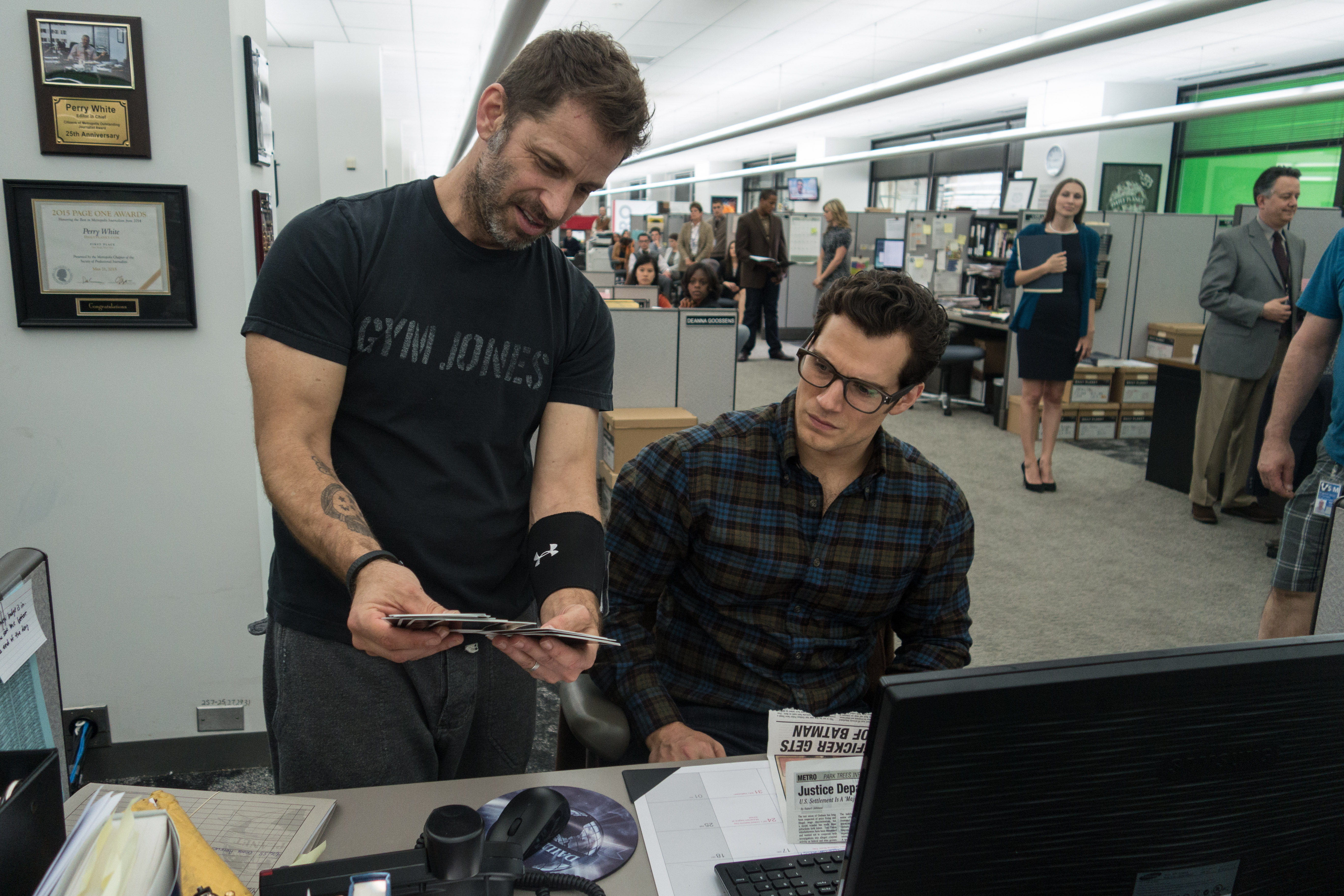
Wide shot of the Daily Planet, Clark at his desk as mail delivery comes by, hanging him an envelope. Low-angle medium shot on Clark. He opens the envelope. High-angle shoulder shot from Clark as he empties its contents onto his desk to reveal a newspaper page and some photographs. The headline of the newspaper reads…
BAT BRAND OF JUSTICE!
HUMAN TRAFFICKER GETS THE MARK OF BATMAN


High-angle medium shot on Bruce, readying the keyboard below frame as he gets to work.
Close-up on the LEX/OS logo. It vanishes, replaced by a search bar. Bruce types in “White Portuguese”.


Low-angle medium close-up on Clark, looking at the newspaper. He looks aside at the photographs.
Close-up on the photos. Clark flips through them, each one showing a dead body from different angles, and each one is marked with a one-word message written in red ink. We see “Judge” and “Jury”.
Batman Theme A replaces Batman Theme B to associate Batman with this brutality, almost immediately joined by a rising, dissonant synthesizer texture.
Return to Clark, looking disturbed by what he is seeing.
Return to the photos. “Executioner”.
Return to Clark, holding on this one photo for a moment.
Return to the photos. Clark pulls aside the photo to reveal one focusing on the Batman brand on the body’s shoulder. “Justice?”
Synthesizer textures reach their speak, resembling the unnerving, agonised scream used earlier in Branding.
For Clark, these messages seem like someone anonymous trying to encourage his fight for justice in Gotham against the Batman. This also sets up Clark’s second visit to Gotham to research the fate of Cesar Santos before meeting his widow.


Low-angle Shoulder shot from Bruce on the Bat-computer, sifting through files of schematics and digitised documents. He opens one of the photos.
Synthesizer textures fade.
Full-screen shot to show the file open to reveal a boat with the name “White Portuguese” across the bow.
With this discovery, Batman Theme A comes in on high piano keys over sustained strings.
Medium close-up on Bruce, leaning forward at the reveal.
Close-up on the photo to emphasise the discovery.
We hear Bruce say, “The ‘White Portuguese’ is not a man. It’s a ship.”
Batman Theme A terminates.


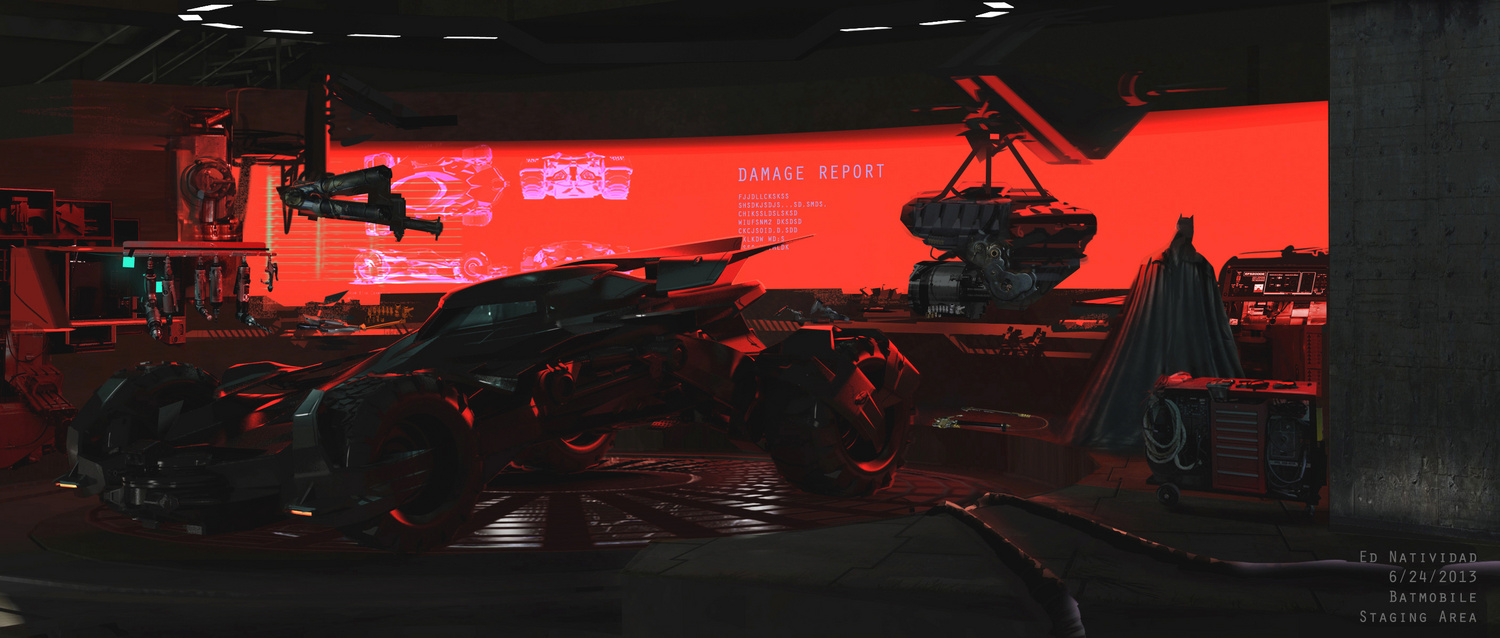
Wide shot of the Batmobile garage, the Batmobile in the foreground lower frame. A semicircle of red screens displaying technical data surrounds the garage. Alfred is wearing a mechanic’s jumpsuit as he places a cable on a work table. Bruce is circling right around the vehicle as Alfred removes more tools.
After a beat, Alfred responds, “Master Wayne, since the age of seven, you have been to the art of deception as Mozart to the harpsichord. But you’ve never been too hot of lying to me.” Alfred stops his work and turns to face Bruce, saying this line firmly and with a hint of anger. The rippling waters below the platform reflect on the dark rock background behind him. “The White Portuguese isn’t carrying a dirty bomb. What is it carrying?” Despite Bruce’s ability to deceive others, Alfred always sees through him, reinforcing how well they know each other.
Bruce is looking down, finally exposed. After a few moments, he decides to come clean. Turning to Alfred as the data readouts on the crimson screen behind him vanish into pure red, he starts to approach Alfred as he explains, “It’s a weapon. It’s a rock. A mineral. Capable of weakening Kryptonian cells. The first sample big enough to mean something turned up in the Indian Ocean three months ago. It is now aboard the White Portuguese being delivered to Lex Luthor… who I am going to steal it from.”
- Behind Bruce, the screens have become a blank red. Recall Alfred’s earlier words, “That’s how it starts, sir. The fever. The rage. The feeling of powerlessness. It turns good men cruel.” Now, behind Bruce, is a field of red to accompany his angry monologue, contrasted against Alfred’s soft black background. Rage has driven him here.
- This puts all his previous actions in a new light and, at last, combines the separate threads of Batman and Superman onto the same path to their clash, making Bruce’s goals fully clear.
- This gives us some context for dates, telling us that the Indian Ocean scene took place three months before now, and since that scene took place eighteen months after Black Zero, that would put it around August 2015, with this scene being set in November.
- This tells us that, after being denied government support for use of the Kryptonite, Lex is having the mineral smuggled into the US.
Music returns with Bruce Wayne Motif on low strings to paint the realisation of Bruce’s true goals with a sinister brush.
Alfred asks, hopefully, “To keep it out of Luthor’s hands? To destroy it?” If that were the case, it would be more in line with the classic, more noble Batman, and Alfred’s words carry a very classically noble superhero tone.
With an unsettling look, Bruce whispers, “No.”
Bruce Wayne Motif transfers from low strings to an eerie lone trumpet. Rage becomes something darker.


Alfred takes a step closer. He cannot believe what he is hearing, and asks incredulously, “You’re going to go to war?”
Bruce angrily whispers, “That son of a bitch brought the war to us two years ago.” His use of “us” draws a contrast between Superman and the human race, making Superman the other. Bruce is also not entirely wrong, as Clark in Man of Steel activated the scout ship and its ancient distress signal that brought Zod to Earth. Bruce gestures aside and continues, “Jesus, Alfred, count the dead. Thousands of people. What’s next? Millions? He has the power to wipe out the entire human race, and if we believe there is even a 1% chance that he is our enemy, we have to take it as an absolute certainty.” He seems to compose himself somewhat before finishing ominously. “And we have to destroy him.” Note his use of the word “destroy” instead of “kill”, further embedding the idea that Bruce does not see Superman as a man to kill.
Bruce Wayne Motif is joined by Batman Theme A and Batman Theme B layered over each other. In a way, the character’s themes come together as his true goals do.
This argument is a political reference. Almost word-for-word, Bruce is quoting Dick Cheney’s rationale for the War on Terror as laid out in journalist Ron Suskind’s non-fiction book The One Percent Doctrine. This rationale was a driving force behind post-9/11 thought, where fear and paranoia reigned supreme. The same is true here. The “brought the war to us” line is also highly evocative of 9/11.
“But, he is not our enemy!” Alfred insists, the voice of reason here, and reminds us that the film is not supporting the logic behind Bruce’s crusade.
Calmer now, Bruce replies, “Not today. Twenty years in Gotham, Alfred. We’ve seen what promises are worth. How many good guys are left? How many stayed that way?”
This alludes to Batman’s history with characters like Harvey Dent (Two-Face), white knights who did not stay on the side of good for long. This closing argument from Bruce also confirms that he sees Superman as another betrayal waiting to happen, having totally lost faith that people can be trusted to be good. After everything he has seen, he simply cannot trust Superman to not abuse his power. His words also apply subtly to himself, a good guy gone bad who has failed to save so many lives.
Bruce steps away, saying, “Fourteen hours.”
Alfred is left standing where he is, looking miserable. He is not happy with where his young master has ended up.
All thematic elements and motifs cease and are replaced with descending low brass chords, fading out as we cross into the next scene.

SCENE OVERVIEW
After his terrifying vision, Bruce finds the decryption complete and learns the “White Portuguese” he seeks is a ship on its way to Metropolis. At the same time, Clark receives some disturbing photos that will prompt him to head back to Gotham to persist in his investigation of Batman’s brutality. Alfred then confronts Bruce, knowing he has been lying to him this whole time, and Bruce reveals his goal all along has been to find the Kryptonite and destroy Superman, finally connecting Bruce and Clark’s respective stories. Explaining his paranoid motivations, we get insight into Bruce’s distrust built up over two decades of crime-fighting.
SCENE ANALYSIS
The first sequence in this scene cuts between the Batcave and Daily Planet, but they are connected with similar elements. Clark and Bruce are both sitting at desks, looking at photographs that, though we may not know it yet, have both been provided to them by Lex. In hindsight, this has the effect of making this scene appear like Lex further enacting his manipulation of the two characters, showing them what he wants them to see. Also, in the previous scene, Bruce built up his motivation to hate and fear Superman, and now we see Clark further developing his own animosity towards Batman.
“In the script there were more story lines than you see in the movie today. That was probably our biggest editorial issue in trying to get the cut down to a reasonable length. For us, the trickiest section was the beginning of the film, until the point where Bruce Wayne tells Alfred the truth about what is on the ‘White Portuguese’ ship… the truth about his plan. This moment set into motion everything until the end of the film really. Until that point the movie was always tracking many solo paths, some intersecting, some not. Finally in this scene, the paths fork into one road.”
David Brenner, ProVideo Coalition, 10 April 2016
The first track in this scene is Quaker Steak And Lube, presumably referencing the restaurant company of the same name. Like certain other tracks, this was probably an in-joke by Hans Zimmer or Tom Holkenborg that we may never get. This track mainly illustrates (when Bruce is on screen) that even without the suit, Bruce is operating as Batman, and highlights (when Clark is on screen) Clark’s growing resentment of Batman. This track is not on any commercially-available version of the score.
The second track in this scene is The White Portuguese. The shift in prominence in the Bruce Wayne Motif when Bruce reveals his intent to weaponize the Kryptonite highlights a bit of a twist in the character of this iteration of Batman, something more sinister — war-weariness eroding Batman’s moral boundaries to the point where he would pre-emptively eliminate Superman to eliminate even the possibility of him wiping out humanity. This track is not in any commercially-available version of the score.
BEHIND THE SCENE
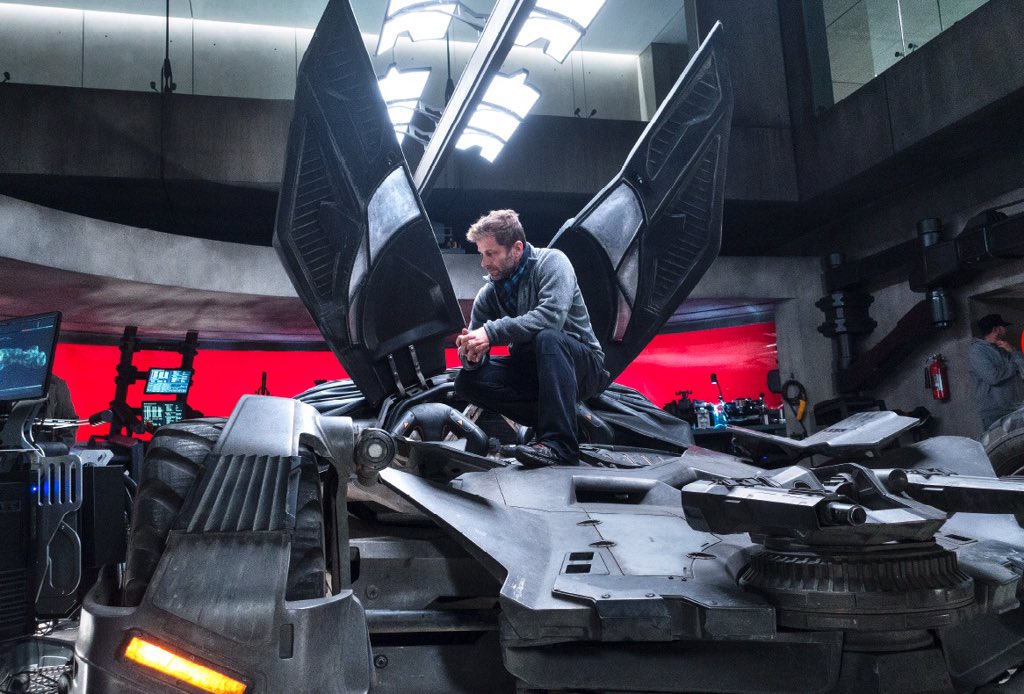
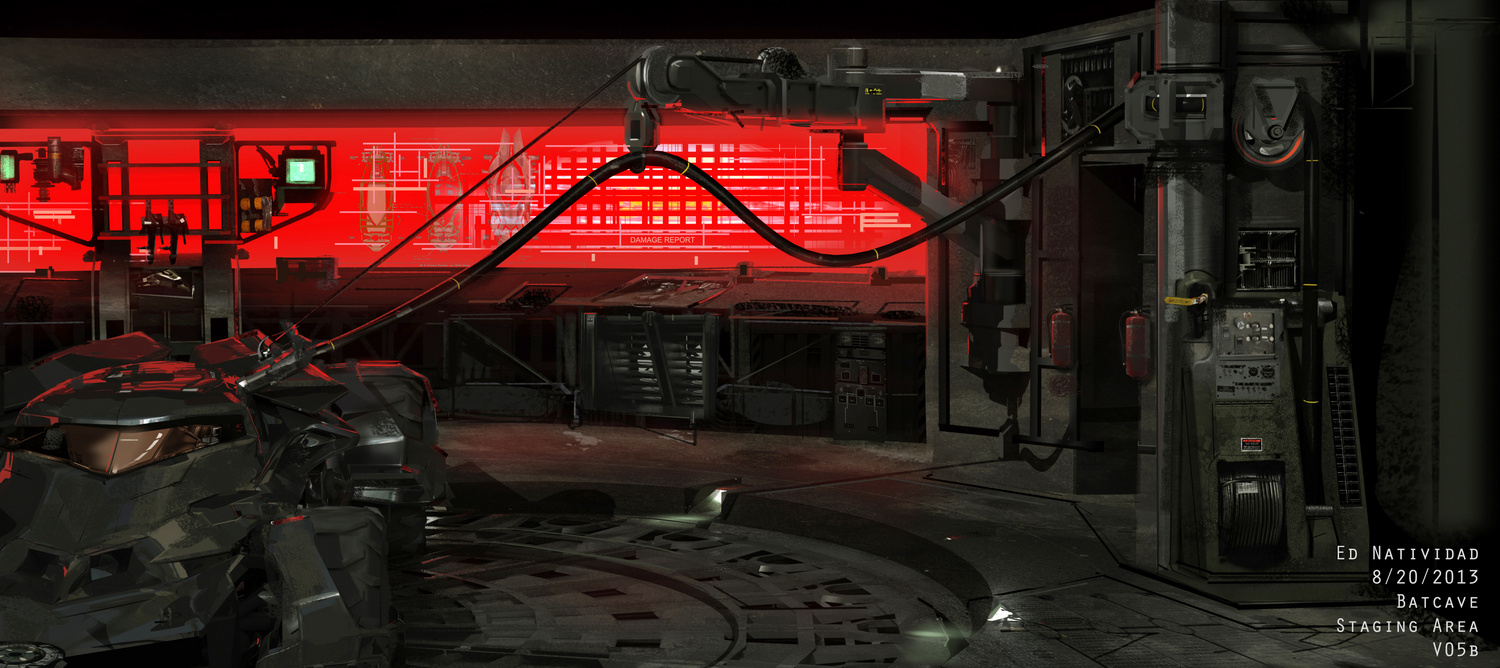
The Batcave was constructed across two soundstages at the late Michigan Motion Picture Studios along Centerpoint Parkway, Pontiac, Michigan. Production designer Patrick Tatopoulos in the Art of the Film and Tech Manual described it as “oppressive” with how the roof of the cave is very low, as though you “barely have the space to live in there.” The blocky, minimalistic, concrete aesthetic of the Glass House above is reflected in the design, which is arguably a reflection of Bruce’s anti-social attitude. The intention with the architecture was to make everything suspended from above to be “reminiscent of the concept of a bat,” and work tables in the lab are attached to a gantry system on the ceiling for moving them around. You can see the official Batcave behind-the-scenes featurette on YouTube. A 360-degree virtual tour was once available before being removed, but you can still see videos of the tour. The sequences here were shot in June or July 2014 when the crew were filming in Pontiac.
“The first time I saw the Batmobile, I was awestruck, and that was on the outside set. But when it was sitting in my workshop in the Batcave, well… that was very cool. I wanted to try a few donuts in the Batmobile and see if I could get the front wheels off the ground, but I was conscious that I should hand it back in reasonable condition. So I restrained myself; but nevertheless I had a blast!”
Jeremy Irons, Press Release, March 2016
“There was a lot of material for that scene, I remember. Ben did it very well from a lot of different angles. But the best delivery of the main final speech (from ‘That son-of-a-bitch brought the war to us…’ until ‘How many good guys are left’) was in a tight medium close-up over Alfred… not the tightest shot on Ben. We had to use that. However, dramatically, and for the best performance we needed to be closer before that, when Ben talks about the real meaning of the rock and why he intends to steal it. So we were ending the scene not as tight as we began. What helped make this size change, without feeling a loss of intensity, was using this dolly move into Alfred, when he steps forward and says ‘You’re gonna go to war?’ This camera shift helped the size change on Bruce’s side, so the change didn’t bump.”
David Brenner, ProVideo Coalition, 10 April 2016
 Snyderverse Analysis