BATMAN V SUPERMAN: DAWN OF JUSTICE
THE RED CAPES ARE COMING

Indirectly answering Perry’s curiosity about who personally invited Clark to the Metropolis Library benefit, we cut to Mercy opening large double doors into an elegant room, permitting June Finch entry. Then Mercy begins pulling the doors closed. Finch stops and turns to watch, as if being imprisoned inside the villain’s lair. Just as the doors click closed, we hear Lex happily say, “Senator!”
Cut to inside the room, tracking Finch as she approaches Lex, who brandishing an expensive bottle of Pappy van Winkle whiskey as he asks, “Little bourbon before lunch?” Also on the table is a small horse statue, missing three legs. This is another instance of the film’s horse motif, and the absent legs would fit the “pale” or “sickly” horse that symbolises Death, one of the four horsemen of the apocalypse. The room also contains some furniture and curiously covered paintings, indicating there are some things that Lex does not want to see but also cannot get rid of.
Still approaching, Finch responds, “My driver’s outside. I can’t stay.” We follow her up to the table beside Lex.
Seemingly surprised, Lex finishes pouring himself a drink and responds, “No bourbon? Kentucky girl like yourself? Hmm,” he hums in a “Whaddya know” kind of way. He sits against the table and explains, “My dad always said that Kentucky mash was the secret to health.” Considering that Lex’s father was abusive, this is certainly a subtle reference to his father’s alcoholism. Once again, Lex is also introducing himself with a reference to his father, and considering how abusive he was, it shows the extent of his trauma. He cannot stop bringing him up.
Finch smiles as he takes a sip.
“Mmm,” he hums with satisfaction. Then he gazes around at their surroundings. “This was his room.” He turns to Finch. “I kept it just the same. Mmm.”


Then he moves away to stand by the fireplace, looking away from Finch with a fist on his hip, taking another sip of the bourbon.
Medium close-up on Lex in the right foreground, the blur of Finch in the left background, as we get this up-close moment with the character. “‘Maybe one day Dad will come back if I just keep everything the same.’” He chuckles. “That is silly.” In stark contrast to his previous mannerisms, his expression on those last words implies something more like disgust, certainly not happy to be repeating wholesome clichés like that regarding his abusive father. Then he turns to Finch, raising his glass. “The magical thinking of orphan boys.”
Lex’s extremely affable attitude here shows he is still putting on his public, friendly façade, but as Samuel Otten points out, it might be that he is also very confident that he is about to get what he wants. The mention of him being an orphan also associates him with Bruce, and is one of several comparisons between the characters.
Finch says flatly, “I’m blocking the import license for your mineral.”
A moment of silence. Lex looks down, tapping his glass. The young man’s demeanour has completely changed. We get an immediate sense of bitter resentment from him, and for the first time, things are not going his way.
Soft, dissonant strings fade in, soon joined by an ominous low piano to instantly change the atmosphere.
“The red capes are coming!” he says, quietly yet dramatically, stepping down from the fireplace towards Finch.“The red capes are coming!” He stands very close to her in his second violation of personal space in the film. He waves his fingers in her face, humming, before tapping the side of the table to mimic the galloping of horses. We cut increasingly rapidly between Finch, Lex, and his tapping fingers as he whispers, “You and your hearings, galloping through the streets to warn us. One, if by land. Two, if by air.”
- “The red capes are coming! The red capes are coming!” references words supposedly uttered by American revolutionary Paul Revere: “The redcoats are coming! The redcoats are coming!” This was Revere warning the American militia of an impending British attack.
- “One, if by land. Two, if by air,” references Paul Revere’s Ride, a poem based on the event: “One, if by land, and two, if by sea; And I on the opposite shore will be.” He further replaces the latter “by sea” with “by air,” certainly referring to Superman.
- Samuel Otten pointed out Lex might also be referencing the many meta-humans with the plural “red capes.” So here, he is mocking Finch for turning a blind eye to the threats that he warned her of while also trying to intimidate and unsettle her.
- Lex’s use of “galloping” again reinforces the horse motif.


Suddenly, Finch places her hand over Lex’s fingers, silencing him with a simple move, and he seems to grimace at this. Finch reads him as a few seconds of ominous silence pass. BvS: By The Minute suggested that, in an interesting inversion of his habit of violating the personal space of others, he does not like other people touching him. This demonstration tells us that Finch refuses to be intimidated. At this point, it is abundantly clear that Finch knows that Lex is corrupt, and all pretence of honest politics are long gone.
Lex, his eyes closed, is just slightly shaking, trying to compose himself. Then he whispers, “Do you know the oldest lie in America, Senator?” Though the first question is ignored here, we do get our answer at the Capitol scene, where the oldest lie in America is, “Power can be innocent.” He then asks, “Can I call you June?” as if trying to keep up some pleasantries even though his façade has been broken.
Over Finch’s shoulder we can see two “faces” watching her, one from a painting and another peeking out from around the bookcase, subliminally indicating the danger she has placed herself in by crossing Lex with the impression of people watching her from behind. Also whispering, she firmly responds, “You can call me whatever you like. Take a bucket of piss and call it Granny’s peach tea.” This kind of language shows that Finch herself has dropped any formal professionalism.
High strings join in on a slow variation of Lex Luthor Theme A.
“Mmm-hmm,” Lex hums with the slightest smile of amusement, acknowledging this comparison for future use when he has her murdered.
Concluding her point, she shakes her head and finishes, “Take a weapon of assassination and call it deterrence. You won’t fool a fly or me. I’m not going to drink it.”
Of course, this analogy is saying she will not fall for an obvious lie, but it comes back around later when Lex uses her words as a final act of mockery before she dies in the Capitol bombing. Also, we can see from this firm response that Finch is highly intelligent in her own right, and has clearly ascertained that Lex does not care about deterrence — he wants to kill Superman. Her observational skills do her credit, having caught on to Lex’s personality ticks and realised his true intentions. Also, considering her condemnation of Superman’s unilateral interference in Nairomi, her words here remind me of condemnation of aggressive United States foreign policy dubbed as “deterrence” as well. This may also reference the Judge Judy Sheindlin book Don’t Pee On My Leg And Tell Me It’s Raining (1996).
Lex smiles at her for a few uncomfortable seconds, having clearly decided her fate. He eventually whispers, “You don’t think Dad would mind, do you? If I changed just… just one thing in this room?” He turns and points above, directing Finch’s attention. “That should be upside down,” he says.
Then the violins of Lex Luthor Theme C suddenly break the softness with a stinging, maniacally jaunty tune. This is juxtaposed against the lines he has here, perhaps his calmest in the whole film, again telling us about a character’s internal feelings via music.


Finch looks up at the large painting on the wall.
Louder now, Lex continues, “We know better now, don’t we? The devils don’t come from Hell beneath us. No. No, they come from the sky.” He raises the glass to his mouth yet again.
Close-up on the lower half of the painting, depicting a hoard of winged demons ascending from hell, and we pan up to see the bright angels descending from heaven. The centre demon bears a spear, likely making Batman out to be the real demon of the film, who later descends upon Superman to murder him with it. Above, the head angel carries a sword. This painting sets up the mentioned inversion at the end of the film to foreshadow the invasion of the forces of Darkseid.
As the violins grow stronger, the first two piano notes of Lex Luthor Theme B come in before the music abruptly ends with the scene.
SCENE OVERVIEW
Having caught onto his true intentions, Senator Finch comes to Lex’s house to personally deny him the import license he needs to bring the Kryptonite to the US. We catch a glimpse of Lex’s true nature as his affable public persona cracks in response, but Finch is undeterred by his mockery, displaying admirable backbone developing her character. Lex concludes with a reference to a painting depicting angels descending to battle demons, saying it should be upside-down to accurately reflect his worldview.
SCENE ANALYSIS
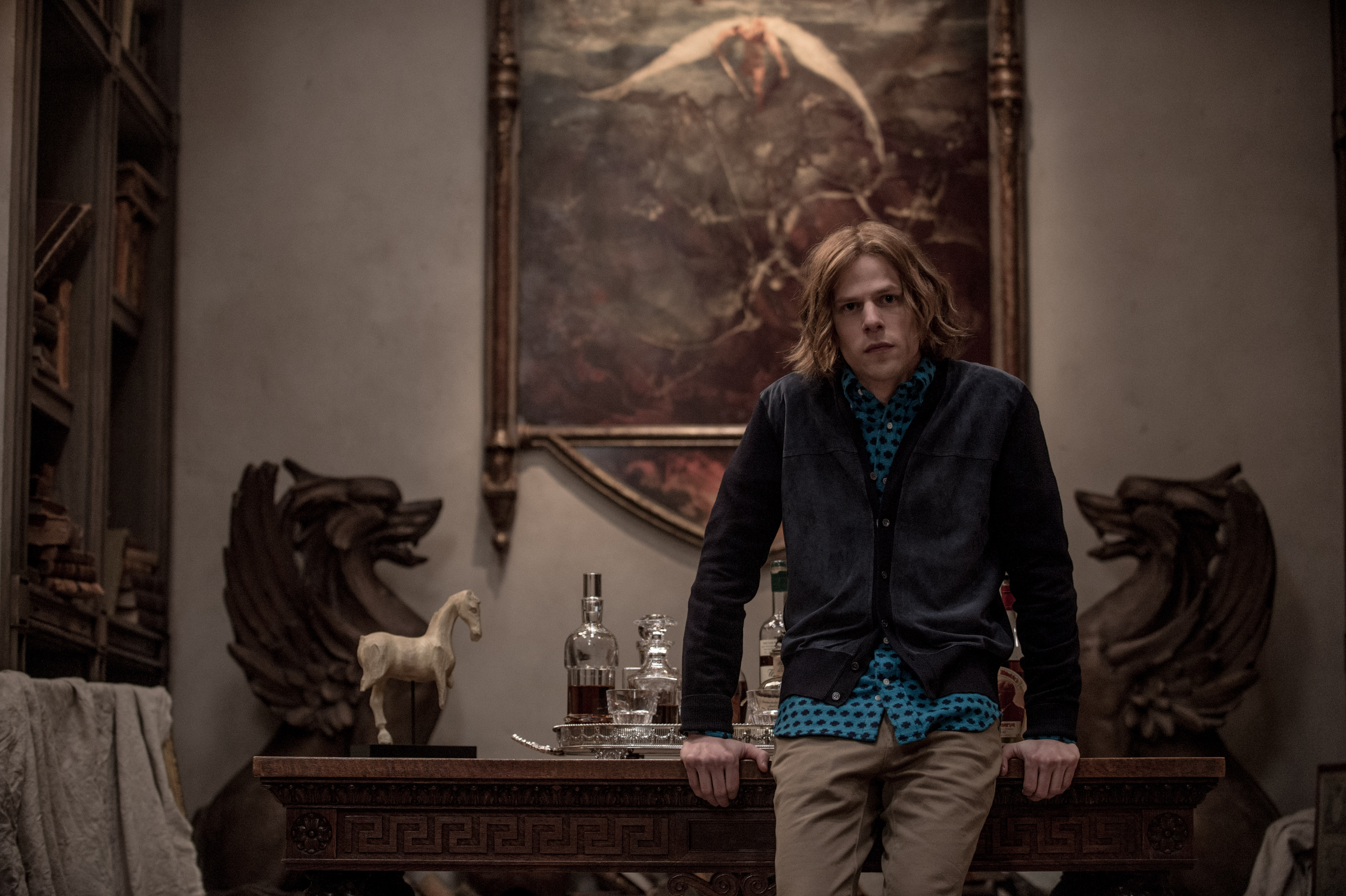
The environment of this scene is a mirror of Bruce’s scene in the ruins of Wayne Manor. Both here and there, these characters discuss their fathers before a fireplace. However, where Lex cannot forget about his abusive father, symbolised by the maintenance of the room, Bruce has allowed himself to forget what his parents really meant to him and how their deaths motivated him, symbolised by allowing Wayne Manor to fall decrepit.
“This little scene inside of Lex’s house, he recreated his father’s study, but he has a super modern house, and he just built this inside of his modern home. … And also that Lex likes to spend time there and meet there. That’s an interesting concept as well. We always imagined that Lex probably killed his father, whether he loosened the breaks on his car or put Drano in his soup, but we do think he was probably the one that got rid of him. It’s interesting though that he also has this desire to emulate him or still seek his approval. It was a clearly abusive relationship.”
Lex Luthor, Batman v Superman Director’s Commentary, 2021, 40:47
“There’s a great parallel weirdly between Bruce and Lex, so I built these two sets to have a similar vibe to what you see in Bruce’s relic. So the two concepts are that this relic of this house, this room, [Lex] has been transported to his super-modern house that he has had built, but he kept this room exactly like a tomb to his father, just like Bruce has kept Wayne Manor, though the two parallels are that Bruce has let his be destroyed while Lex has preserved his. It’s almost like the opposite. Bruce has let his go, but Lex has not.”
Zack Snyder, Batman v Superman Watch Party, 29 March 2021
“In stark contrast to the modern mansion, the Library is filled with historical art collections, antique furnishing, taxidermy, rare finds and treasures… really a complete European mixture of antiquities. Patrick designed the fireplace surround. Zack did not want to use dark woods, so we turned to dry-brushed grey wood. We used Restoration Hardware artefacts combined with pieces from Chicago and Detroit antique dealers. I chose a William Morris-like velvet to recover two English Knole sofas we found through Craigslist to sit in front of the fireplace…perfect sizes, not usually seen in the movies, a sidelight is the play on words — Knole is from Kent, England. … The griffins were purchased at Architectural Artifacts in Chicago. Apparently they came from a movie theatre… the perfect depiction of a monster.”
Carolyn Roucks, Set Decor, 9 May 2016
The music track in this scene is The Red Capes Are Coming, using ominous ambience to radically change the atmosphere when Finch denies Lex’s Kryptonite, then later breaking the near-silence with Lex Luthor Theme C when he comment about the painting. This track combined with Wishlist corresponds to The Red Capes are Coming in the released score.
BEHIND THE SCENE

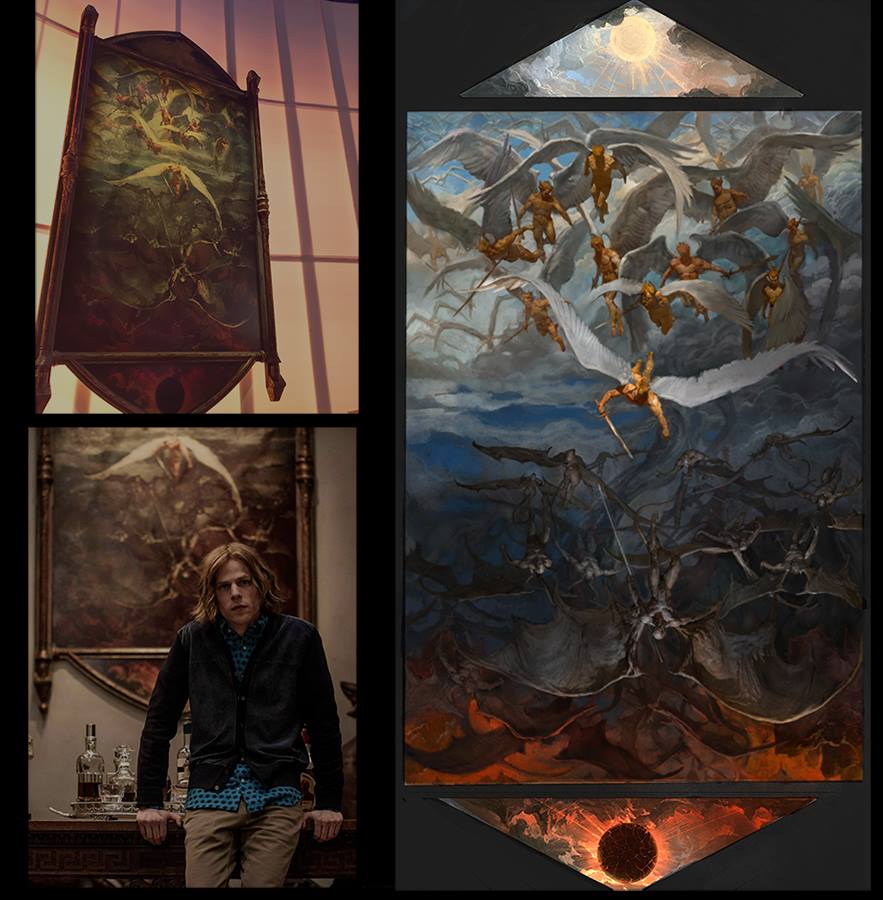
The painting was designed for the film, but was clearly meant to resemble a painting by Gustave Doré for John Milton’s Paradise Lost, which depicts angels banishing rebel angels from Heaven. This painting is similar, but with angels and demons engaging in battle instead. Concept artist Alex Kovacs helped with the painting, or at least a version where the pose of the lead angel is different.
“[Patrick] Tatopoulos painted that painting based on a doodle I had done and then based on some painting reference that I gave him about what I had wanted it to feel like, whether it be an etching… It’s kind of a Gothic 18th or 19th century… like, woodblocks or lithographs.”
Zack Snyder, Batman v Superman: Dawn of Justice Watch Party, 29 March 2020
“For the signature painting, the one that symbolizes evil, darkness, and the opposite forces, I researched several periods of artists: Brugel, the Dutch Masters, the French and Italians of that period… all Creationists! Patrick came up with a beautiful sketch and scale of the painting, and then we commissioned an illustrator who worked along with Patrick over a period of two months.”
Carolyn Roucks, Set Decor, 9 May 2016
The location for the room is unknown, but was presumably shot on a soundstage at the late Michigan Motion Picture Studios along Centerpoint Parkway, Pontiac, Michigan.
 Snyderverse Analysis