BATMAN V SUPERMAN: DAWN OF JUSTICE
THE DEATH OF SUPERMAN
YOU ARE MY WORLD


Superman and Lois, watch the spectacle. Lois has her arms around the man she loves, cradling his face protectively. They both turn to each other.
Softly, Superman says to her, “I love you.”
Rear shot on the two, focus on Doomsday in the distance ahead of them, enveloped in orange lightning as he roars. He stands on a mound of debris, the centrepiece of this climactic resolution. This serves as a reminder that he is about to explode yet again, growing even stronger. Lois turns to watch.
Superman is still looking at her when she turns back to him. Afraid for his life, she pleads, “No. No, Clark, you can’t.”
Then Superman turns to look at Doomsday as Lois tries to turn his face back to her. Looking content, he says calmly, “This is my world.” This is the first time that Clark has referred to Earth as his world, the words “my world” being used only to refer to Krypton before now. As he accepts his humanity, he subverts his previous line, “[This symbol meant something] on my world. My world doesn’t exist anymore,” and his symbol once again represents “a fundamental belief in the potential of every person to be a force for good,” including someone like Batman.
Afraid she will never see him again, Lois shakes her head and begs, “No, Clark, don’t!”
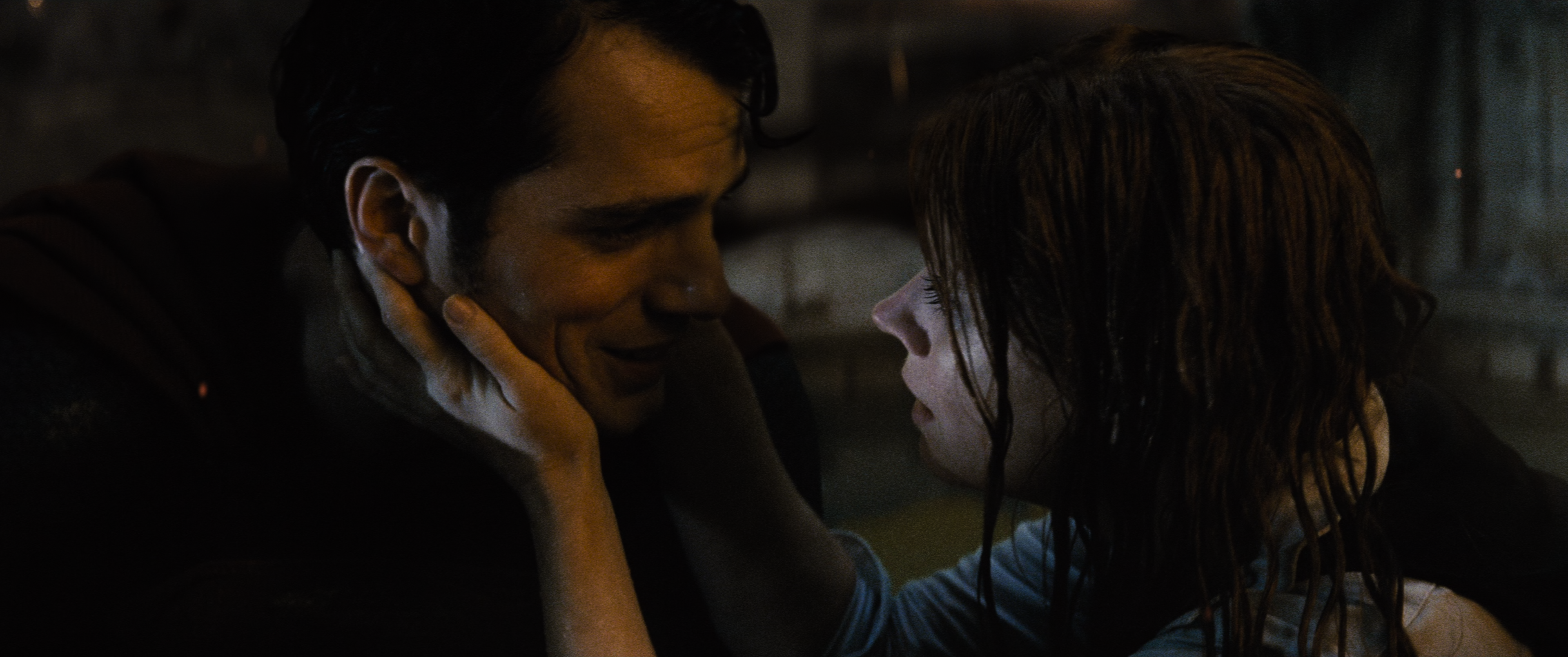
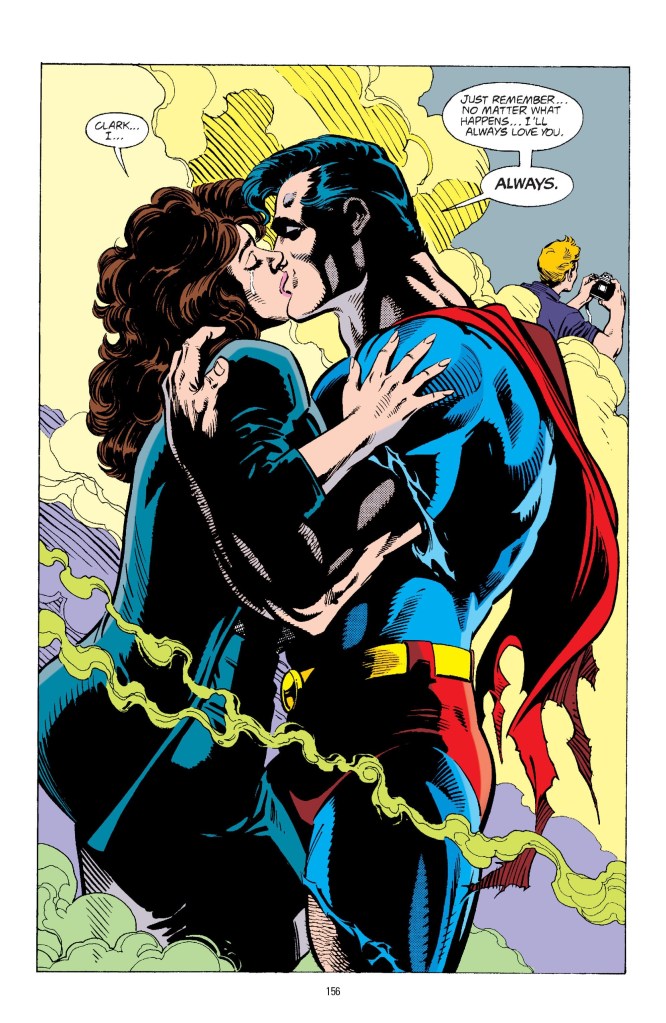
Of his own volition, he finally turns to look Lois in the eyes. Smiling at her, he warmly says, “You are my world.” These minimalist final words maximise the emotional impact with their brevity, embodying Superman’s unwavering love and appreciation for Lois in just one small and thematically poignant goodbye. Several other things are happening…
- He is echoing Jonathan Kent’s words from the mountain. When Clark asked if his nightmares and feelings of guilt ever subsided, the ghost of Jonathan replied, “Yeah, when I met your mother. She gave me faith that there’s good in this world. She was my world.” So too does Lois give such faith to Clark, subverting his earlier words of despair, “No one stays good in this world.”
- This might also be a callback to Man of Steel, where young Clark said, “The world’s too big, Mum!” and Martha responded, “Then make it smaller,” and now his world is embodied in one person.
- This foreshadows the Knightmare, realising the context for Superman proclaiming, “She was my world,” before executing Batman, which reinforces that the vision was real.
“No,” repeats Lois, still holding him tightly.

Then he turns away and his smile disappears. He looks ahead, eyes full of determination. Then he begins to leave her firm grip. Recall the bathroom scene. Both Lois and Clark are soaked in water and occupy the same sides of the screen. Back then, Lois held him possessively. Here, she is still holding him as firmly as possible, figuratively and literally, and now she is about to lose him.
“Please! Clark!” she shouts as Superman escapes her grip and takes flight. From here on, Lois never speaks a single word again for the rest of the film. Everything she does is entirely through Amy Adams’ acting and Lois’ actions, rather than her words. There is nothing more she needs to say — nothing more she can say.
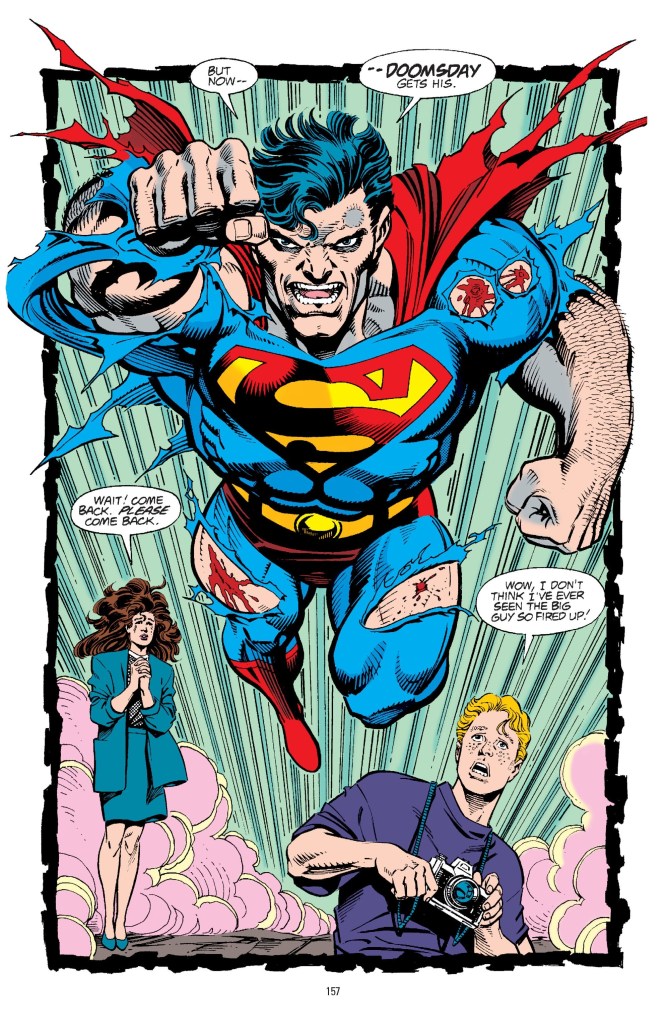
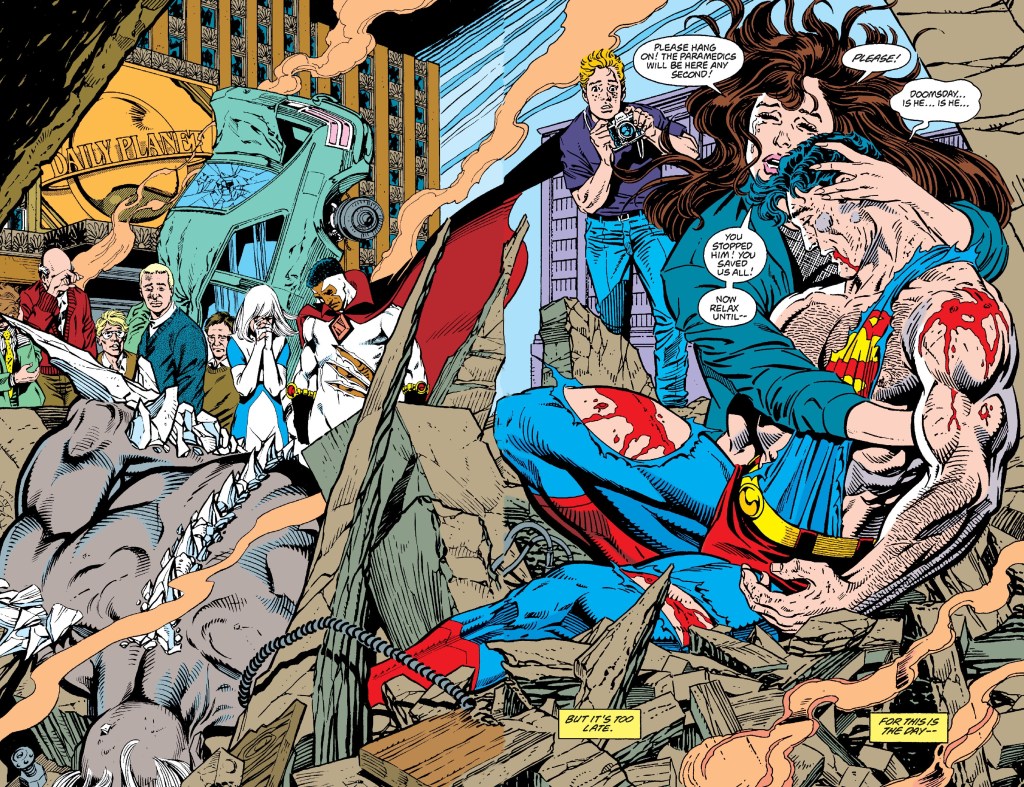
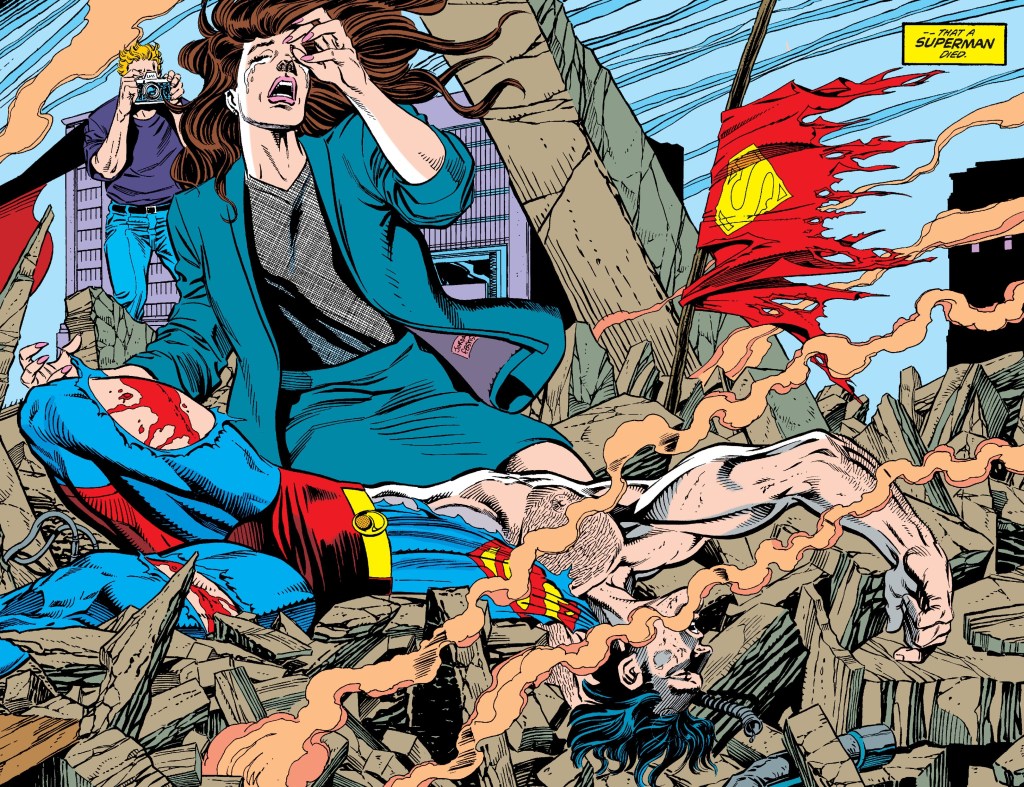
This whole sequence is another reference to The Death of Superman, where he spends a brief heartfelt moment with Lois, saying he loves her while she begs him not to risk his life further before he charges in to finish his fight with Doomsday.
Superman flies low against the ground as we hear Doomsday roar. He seems to be struggling, a foot scraping the rubble briefly as if he is too weak to fly properly. Then he snatches the Kryptonite spear off the ground as he flies over it in the direction of his foe, strain on his face.


Exerting dramatically as his body glows with energy and lightning, Doomsday is suddenly entrapped by Wonder Woman’s glowing golden lasso, pinning his arms to his sides. Diana’s feet are on a slab of debris as she pulls back on the lasso to tighten her grip. A shoulder shot from Wonder Woman shows us the scale of Doomsday to emphasise her feat of strength.
The beast roars down at her savagely before a green gas cloud suddenly explodes in his face, instantly terminating the orange spectacle as the lightning vanishes while Doomsday becomes drowsy and passive. Pan left and zoom rapidly through the charred battlefield to Batman, aiming his grenade launcher from his hiding place place a broken wall. He lowers the weapon, panting.
Superman gains speed, holding the Kryptonite spear tip ahead of him. His expression indicates strain, telling us that proximity to the Kryptonite is either causing him pain, making it difficult to fly, or both. The all-consuming lens flare created by the green spear emphasises this effect. After being soaked in water, a strand of curled hair is visible on his forehead, possibly referencing the character’s classic “S” fringe curl from the Christopher Reeve films and some comics.
Shoulder shot from Doomsday. Superman rockets towards him from across the battlefield.


Shoulder shot from Superman, a dramatic angle with the spear at the ready as he flies at the beast. This shot is often compared to the shoulder shot from Superman flying across the Metropolis skyline to punch General Zod across the city in Man of Steel.
Then Superman plunges the spear into his chest. Immediately, the creature returns to life in a renewed blast of energy, glowing hot and emitting lightning once again, but this time, streams of green energy are interspersed with the streams of orange energy across his body. He roars to the heavens in agony.
Wonder Woman yells in strain as she pulls on the lasso when the slab of concrete collapses beneath her, allowing Doomsday to shake off the lasso and grab Superman in his enormous left hand, yet the hero maintains his grip on the spear lodged in the monster’s chest.


Doomsday raises the spike protruding from the stump on his right arm, bathed in lightning, before plunging it down into the noble symbol on Superman’s chest, through his heart. Recall that, while regenerating in space, the shield was brighter than in any other shot, but here, the destruction of the shield will guarantee Superman’s death, adding visual weight to distinguish this from the fake-out nuking. He throws his arm free arm wide as he shrieks in pain.
Then Superman looks down at the spike in his chest. Utterly dwarfed Superman by the scale of the creature killing him and helpless to escape, he grabs the spike in his heart to try and remove it. His expression shows absolute agony as he groans with effort.
Long shot of the scene, showing the dramatic image of Doomsday looming over the doomed Superman amid the chaotic environment of lightning and rubble levitating around the two foes — an external glimpse of the Biblical spectacle taking place.
Suddenly, despite the fatal blow, Superman’s expression changes from agony to determination, and he grabs another spike on Doomsday’s left arm. Grimacing in pain and grunting with the unparalleled feat of endurance, he uses it for leverage to force the spear deeper into the monster, allowing the spike in his own heart to go deeper. This feat, summoning the strength to slay an undead monster despite the mortal wound in his chest, is a truly inspirational act of willpower that embodies the meaning of the character.
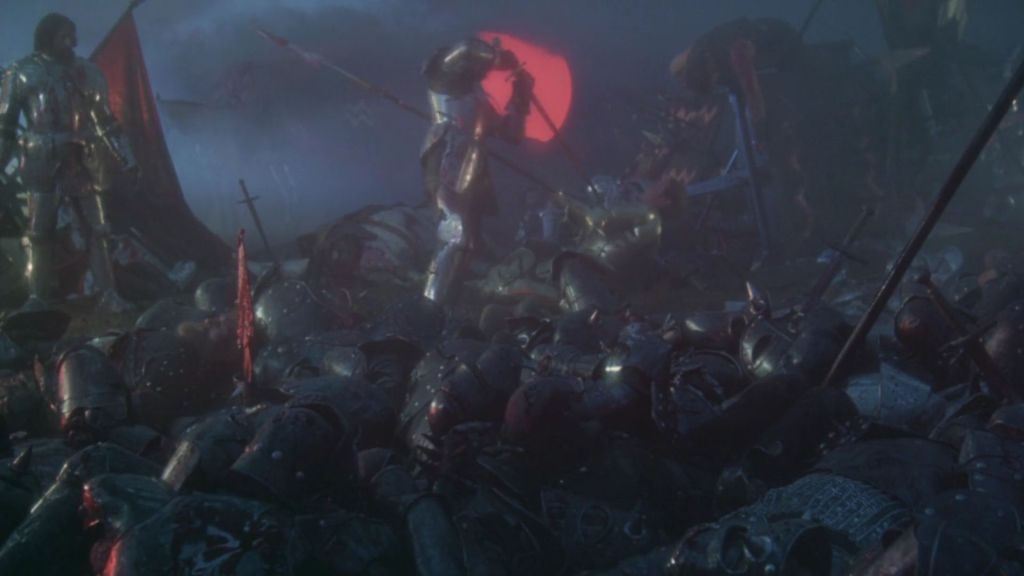
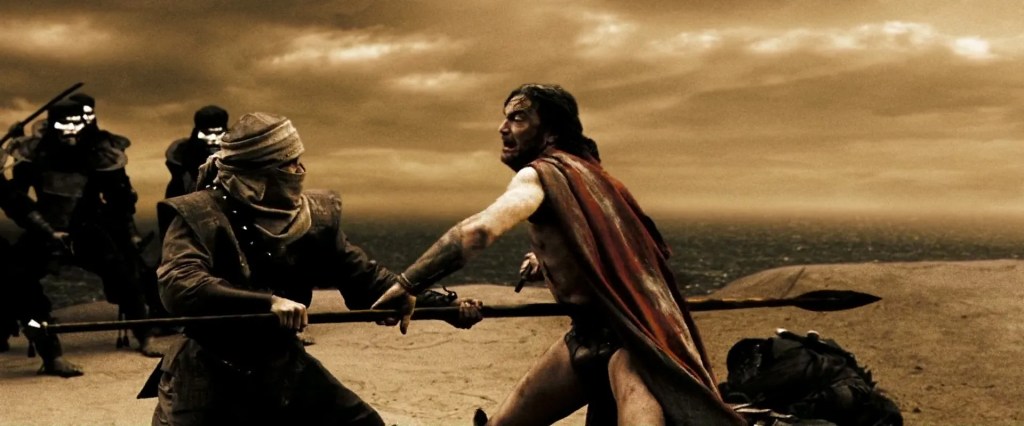

This moment was foreshadowed from the very first scene. This moment is a direct reference to Excalibur (1981), where King Arthur impales himself further on Mordred’s spear to get close enough to impale Mordred on the titular sword. Zack Snyder also added this parallel to his 2007 cinematic adaptation of Frank Miller’s comic 300 (1998), where Captain Artemis impales himself further on the spear of a Persian soldier to get close enough to strike a blow.
The spear goes deeper as Superman unleashing a roar of effort. Then the emerald spear tip breaks out from Doomsday’s back.
Then two massive beams of energy erupt from Doomsday — one beam of heat vision from his face and two green beams firing out his back and front from the spear in his chest, presumably an expulsion of all his energy. This is accompanied by a scream from Superman, the same scream after killing Zod in Man of Steel. This, combined with the remix of the same music from that scene, along with the mirrored stabbing, implies that this is akin to a punishment and redemption for Superman. He took Zod’s life to save humanity, and now he has given his own. It also implies that killing Zod was as painful as dying himself. This is the scream that will awaken the Mother Boxes.
“And then if you really want to wake up a Mother Box, you do it like this. Watch, there’s a wide shot coming up. … You hear [Superman’s] scream echo in that shot right there, and that sound goes out into the world, echoes across the globe, and if there were sleeping Mother Boxes on Earth, that sound would wake them up. No Kryptonians here.”
Zack Snyder, Batman v Superman: Dawn of Justice Watch Party, 29 March 2020


After the beams subside, the monster falls to his knees before collapsing dead on his back, Superman still in his giant hand. The superhero’s arms flop down limply beside him in a cruciform pose. This can be dismissed as Christ imagery pretty typical for this film, but interestingly, the shot positions Superman upside-down. In apocryphal Catholic texts, Saint Peter requested to be crucified upside-down because he didn’t feel worthy of being crucified the same way as Christ, and thus the upside-down cross has became a symbol of humility in martyrdom. In a sense, Superman is Jesus, yet far too humble to think of himself that way.
Ground-level shot pushing on Superman. His eyes are open, but cold and lifeless. There is a very prominent cavity in Superman’s chest. Lex has quite literally made good on his promise to show the world the “holes in the holy.” Superman is dead.
OUR HERO
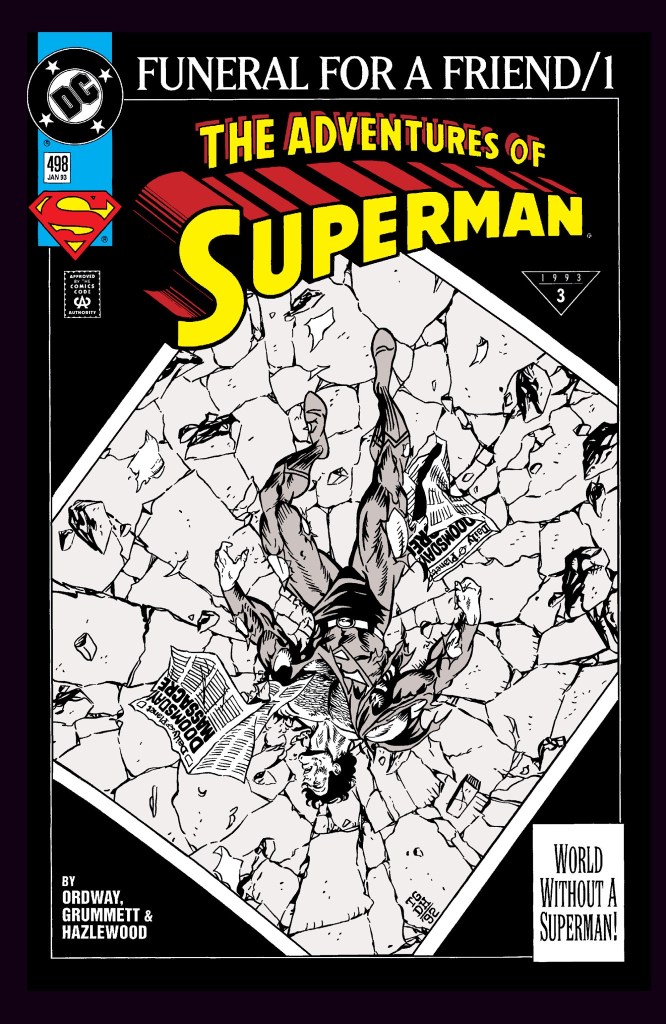

Ascending top-down shot of Batman, stepping around Doomsday to the body of Superman. He looks down at the fallen hero. @boomborks on Twitter pointed out that, from Batman’s perspective, he is looking down at Superman as he would if he had gone through with killing him: Superman on his back, a hole in his chest, and Batman standing over him. Then Batman crouches. Wonder Woman approaches below the elevated slab of debris. The frame is fairly dark, with all the light concentrated exclusively on Superman. This shot almost perfectly resembles the cover for Adventures of Superman #498, following the death of Superman.
Lois rushes through the rubble across the battlefield. She comes to a stop and watches, panting.


Diana turns to look at Lois with a sorrowful expression.
As she realises what has happened, Lois’ face is quickly filled with hopeless grief and tears as her chest heaves with each tearful breath.
Batman folds Superman’s cold hands together over his chest and wraps the slain hero in his red cape.

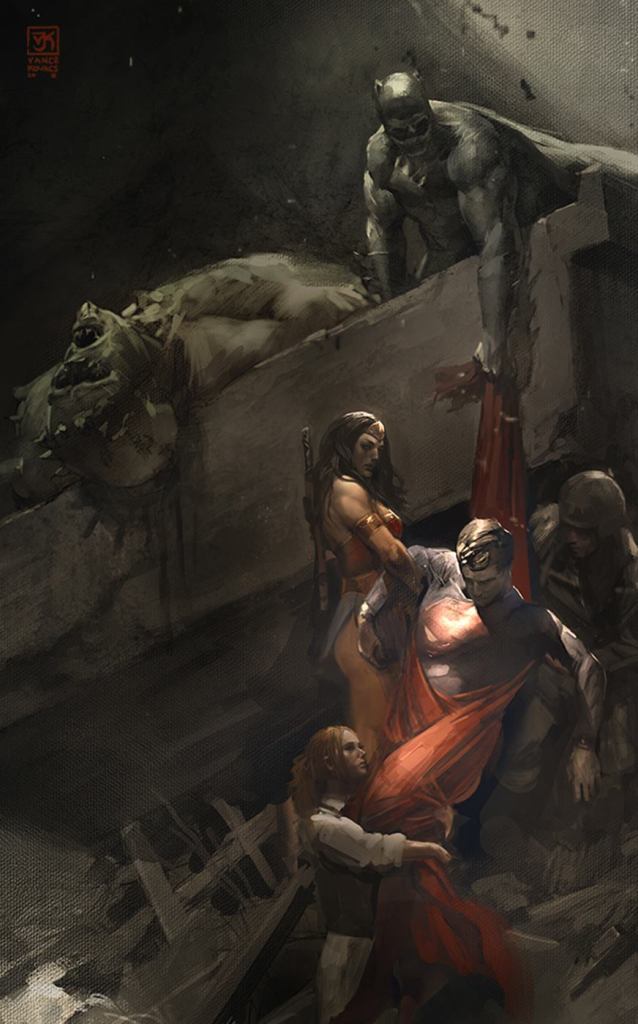
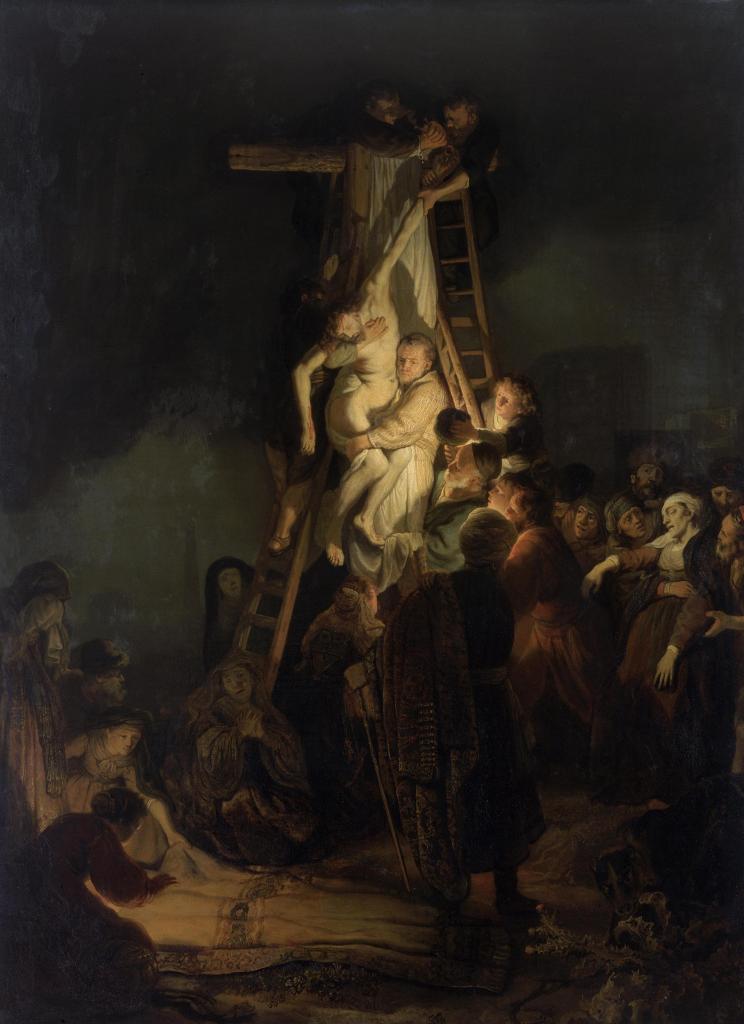
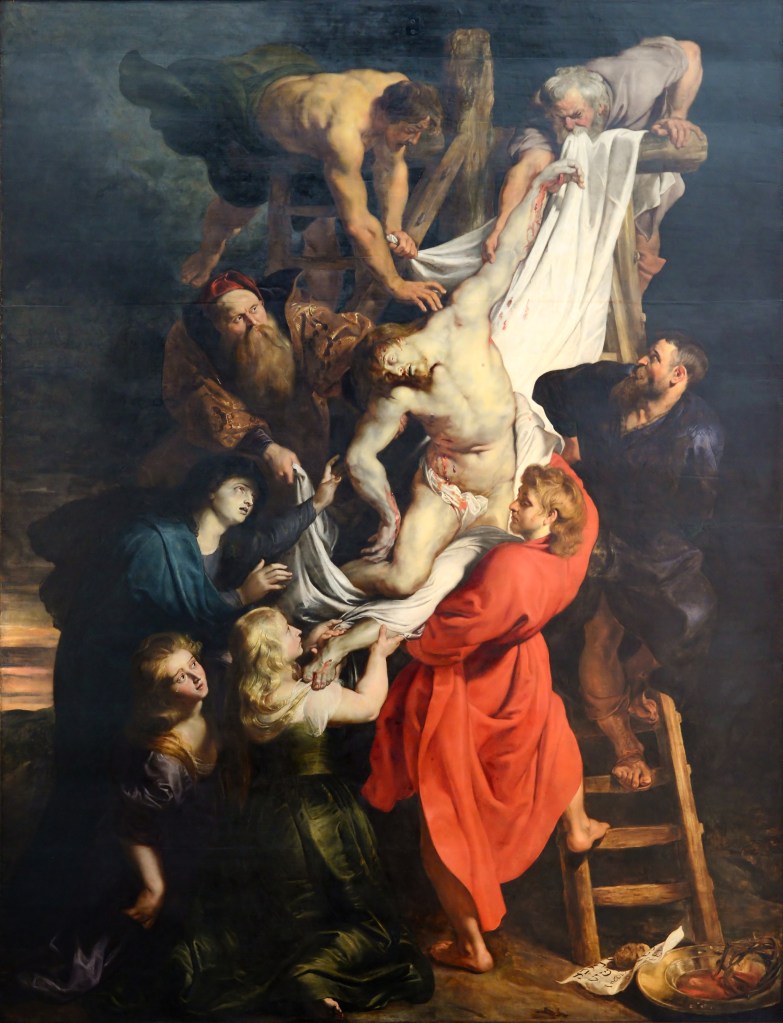
Wide shot from beneath the mound. From above, Batman lowers Superman, wrapped in his cape, to Lois and Diana, who take hold of him. A steel beam resembling a cross can be seen in the left background. According to concept artist Vance Kovacs, this is an homage to the painting The Descent from the Cross (1634) by Rembrandt Harmenszoon van Rijn, where the deceased Christ is lowered from the cross. It may also be a reference to Pietà (1571-1576) by El Greco. In the director’s commentary (2:39:33), Snyder references to The Descent From The Cross by Peter Paul Rubens (1612-1614). Note the three crosses in the left background of the painting. Kovacs’ concept art also suggests a military presence in early drafts.
Batman carefully passes Superman — eyes now closed — down to Wonder Woman and Lois. The grieving journalist tearfully grasps randomly at the body as Diana lowers him to the ground. Lois cushions his head against the concrete below, into her lap.
She looks him over, crying uncontrollably. Superman looks peaceful as she cradles his face, then leans down to kiss his cheek, eyes tightly closed in grief. Then she looks up.
Wonder Woman looks down at the couple remorsefully. She is deeply familiar with loss too, and can no doubt relate to Lois’ feelings.
Lois looks back down at Clark. She puts her face against his and breaks down completely, squeezing her eyes shut.


Cut to Batman stepping out from under some rubble. Behind him is fire, climbing out of the inferno and stepping into the light piercing through the cloud of smoke from above as he arrives in a medium low-angle shot, looking down on the tragedy. This is a symbolic representation that he has completed his arc and escaped from the rage that once consumed him. It was not the Batman persona that saved Bruce from the dark, but Superman that took him to the light. On Vero, Snyder described this as his favourite shot in the film…
“At the end of BvS before the Pietà, Batman comes forward through some rubble and he looks like the weight of the world is on his shoulders, but steady and transformed by sacrifice.”
Zack Snyder, Vero, 31 May 2018
Behind the Scene
“Fun fact: when Zack wanted to grab this close-up, I was preparing to add more fill light but Zack stopped me. As usual, he was right.”
Larry Fong, Twitter, 7 July 2020


Wide shot of the scene. Batman (left) and Wonder Woman (right) stand over Lois cradling the body of Superman (centre), and we pull out to finalise the scene. This shot might also echo the scene from Man of Steel where Kal-El is born. Batman and Wonder Woman stand in place of the robots Kelex and Kelor or Jor-El and Lara, and an almost identical beam of light shines down from the upper left. Kal-El’s birth mirrors his death, just as Superman’s birth is mirrored by his death scream. His death mirrors his father’s death, as Lois cradles Superman’s body much the same way Lara cradled Jor-El’s. Lastly, the frame vaguely mirrors the wide shot following Zod’s death, wherein rays of light shine down from the right. The moment that truly created Superman is reflected in the moment Superman dies.
Three more steel beams in the upper left background resembling crosses are visible, silhouetted by fire, and each with crows sitting upon them — also a symbol of death. All the imagery here is the death motif turned to eleven, accompanying the literal death of Superman. The crosses are subtly foreshadowing the mortality of the three heroes.
“To me, the three crosses represent the Trinity. It was my plan to kill them all, regardless of if they’d stay dead, but that was the idea. The three, Batman, Superman, and Wonder Woman, none of them were safe.”
Zack Snyder, LexCorp, 11 July 2021
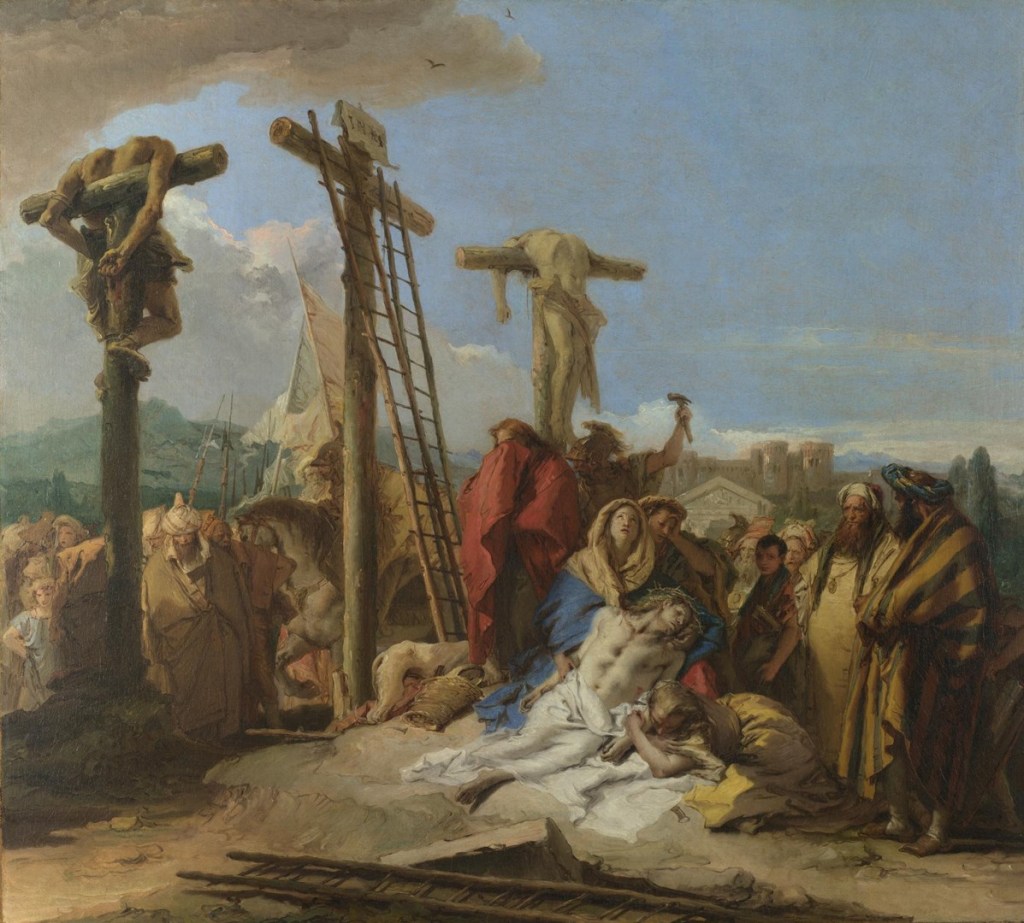
The imagery here resembles a Pietà, artistic renditions of the Virgin Mary cradling the body of Christ after he is removed from the cross. Wikipedia has a gallery of different old paintings and images depicting this. Snyder references The Triumph of Virtue and Nobility Over Ignorance by Giovanni Battista Tiepolo for this scene, a painting currently housed at the Norton Simon Museum in Snyder’s home town of Pasadena, California, Snyder’s hometown. Battista’s son, Giovanni Domenico Tiepolo, painted The Lamentation at the Foot of the Cross (1727–1804), and the similarity, with the three crosses in the left background, is uncanny.
“Giovanni Battista Tiepolo’s painting The Triumph of Virtue and Nobility Over Ignorance. That’s the painting that I use as reference a lot, especially in regard to superheroes, because if you ever see that painting, it’s very much like these figures in the air, and I had always been a fan of the painting and it was funny to be there and say, ‘Oh, there’s the original.’ I always loved that painting, but there’s a lot of Tiepolo reference in this movie, whether it be Superman with the crosses on his shoulders, whether it be Batman in the Knightmare sequence, this sort of representation of the three crosses behind him, or the three of them as the three sacrificial characters, or whether it be even these images at the end of the movie.”
Zack Snyder, Batman v Superman: Dawn of Justice, Director’s Commentary, 2021, 2:40:14
Fade to black.
SCENE OVERVIEW
After saving Lois and retrieving the spear, Superman has a heartfelt final moment with her, wrapping up his arc by embodying in Lois the meaning of the symbol on his chest. Then, with help from Batman and Wonder Woman, he drives the Kryptonite spear into Doomsday at the expense of his own life, saving a world that hates and fears him, setting an example that will motivate Batman from here on. A moment of silence descends on the film.
SCENE ANALYSIS
SUPERMAN’S ARC: REDISCOVERING HIS WORLD
The symbol on Superman’s chest embodies the fundamental belief in the potential of every person to be a force for good. That is what he stands for. After the Capitol bombing, seeing what humanity is capable of, Clark lost faith in that ideal. The world did not corroborate the practical concept of Superman’s values: “[This symbol meant something] on my world. My world doesn’t exist anymore,” meaning the world he thought he knew was a lie, and the sad truth was revealed.
Exiling himself from humanity, Clark turned to nature, where he learned his father’s despair was healed by Martha: “She gave me faith that there’s good in this world. She was my world.” Motivated by the person who gives him faith, Lois Lane, he returns to Metropolis and falls into Lex’s trap. Instructed to kill Batman to save Martha, Jonathan’s message acquires a caveat: “No one stays good in this world.” He needed to see the truth of the lesson.
Believing Batman can only understand force, Superman gave up on reason and resorted to violence — a futile move. Then, at his lowest point, Lois came to his rescue, and the man who sought to kill him was suddenly promising to save his imperilled mother, learning first-hand that everyone truly can be a force for good. Because of this, Lois can once again give him faith that there is good in this world because he has seen it happen.
Now, motivated by hatred and fear, humanity has grown a monster to kill him, but Superman is steady. Empowered by his restored faith, he takes the spear intended for him and saves humanity from itself — a symbolic gesture to reaffirm and honour his belief in the ideal on his chest represented by people like Lois Lane. Rather than risking the life of another, he took it upon himself to kill Doomsday and died to save an ideal, giving his life because he believes there is good in the world.
SUPERMAN’S ARC: HUMANITY
One thing Superman has never truly faced is mortality. Until the age of 33, he had never known what it feels like to fear for his life. Making the ultimate sacrifice is the greatest step he can take to achieve his ideal form. His eventual resurrection will change him, making him a better man than ever before.
“And I thought that, for his evolution as a character, there’s a crucible that he has to go through to really embrace his humanity, or find, like, what is the ultimate thing about being human? Well, the ultimate thing you face is your mortality.”
Zack Snyder, Collider, 27 March 2016
SUPERMAN’S ARC: PAYING FOR COLLATERAL DAMAGE
After all the criticism of collateral damage in Man of Steel, here he gives his own life to save the world instead of taking a man’s. The threat of Doomsday’s next explosion gives urgency to the need to slay him. Superman’s sacrifice is a refusal to allow the monster’s destruction to continue.
“The ending of BvS was designed to show that Superman was willing to make himself collateral damage if it meant saving others. I felt like we had to kill Superman in this movie in order for us to have been serious with the entire premise of the film.”
Zack Snyder, Entertainment Weekly, 26 March 2016
SUPERMAN’S ARC: PAYING FOR KILLING ZOD
“Where we had thought to slay another, we shall slay ourselves.”
Joseph Campbell, The Hero with a Thousand Faces, 1949, p18
Superman can be seen as paying for his sin, which can be seen in parallels to Man of Steel. Superman’s dying scream resembles his agonised shriek after killing Zod, both villains died shooting their heat vision, and the music reprises If You Love These People, tying the two scenes together through the score. Doomsday kills Superman in a manner similar to Zod’s killing of Jor-El, impaling him with his right arm, after which Lois cradling his body resembles Lara cradling Jor-El’s body. Zod killed Jor-El, so Superman killed Zod, so Doomsday (Zod) killed Superman. Just as Bruce said in Russian earlier, “But all accounts are balanced in the end.”
Again, as Jor-El said, “Embodied within that hope is the fundamental belief in the potential of every person to be a force for good.” Superman’s failure was he could not find this faith in Zod. This time, he gave his own life before giving up on that idea again.
BATMAN’S ARC: RENEWED FAITH
Totally devoid of trust in humanity’s potential for good, Batman spent most of the film seeking to kill an alien. After learning Superman’s humanity, Batman witnessed the man he sought to kill taking the spear intended for him and using it to save the world at the cost of his own life. The alien he sought to destroy was a good man, right up until his death at the hands of the real monster. Superman was always the true hero defeating evil, leaving Batman in a position of the utmost guilt and regret. As Batman said, “Men are brave,” and Superman has proven himself brave. His sacrifice becomes the greatest example that good men still exist. Literally and metaphorically, Batman steps out from the fires of his rage, humbled as he enters back into the light.
A typical revenge tragedy sets the vengeful one up to die as penance for their wrath. Instead, Superman has taken Batman’s place, giving his life so no one else has to. Had Batman gone through with his dark intentions, he would not be alive right now. Bruce owes it to him for this opportunity to redeem himself. After this scene, Bruce will affirm this commitment to making amends.
WONDER WOMAN’S RETURN
Drawn into battle by a threat she could not afford to ignore, Wonder Woman has finally returned to the world of men after a hundred years. Having believed before that men created a world where standing together is impossible, she has now fought beside them to slay a monster. The scene concludes with Wonder Woman standing over the body of yet another man who gave his life for humanity. He sees her grief for Steve Trevor in the tears down Lois Lane’s face.
“[In Wonder Woman (2017), Diana finds that] humanity isn’t always the most kind and awesome thing. It has its moments, but it can be brutal, and her coming to terms with that dichotomy is what we come to learn about her. And in Justice League, she’s fully evolved into someone who’s embraced mankind, partly through Superman’s sacrifice. She’s like, ‘All right, I’ve got to pick it up.’”
Zack Snyder, USA Today, 8 January 2017
TRAGEDY
Superman was not someone who held himself above humanity as many assumed. He hitchhiked, rode a bicycle to work, took a ferry across the bay and a bus around Gotham, and hiked. He was humble and showed respect to humanity’s systems, landing beyond the steps of the Capitol and climbing them like any normal man. He bought groceries, liked to surprise his girlfriend, and spoke to his mother when he felt down or needed advice. Without any thought to his own grandiosity, he interacted with the world as Clark Kent to understand and help those who were wronged or afraid. The tragedy of Superman’s death is compounded by these traits that emphasised his innocence and humanity, but perhaps most of all, he is gone too soon. Long before achieving his best self, Superman was murdered by humanity a mere two years into his career as a superhero.
In Man of Steel, Lara feared that humanity would make Kal-El an outcast and kill him. Jor-El was more optimistic, believing, “He’ll be a god to them.” In the end, humanity rejected Superman and a human orchestrated his death, later remarking, “Ding dong, the god is dead.” Lara’s worst fears were realised.
EXECUTION
The unfortunate majority of superhero films have devalued the ultimate sacrifice. It used to mean everything, the peak of what it meant to put others before oneself. Now it is typically included to remind the audience that the protagonist is heroic, to draw a cheap emotional reaction, or to remove certain characters from continuity after the actors’ contracts expire. The heroic sacrifice is tacked-on in the film’s final act more out of some misplaced idea of necessity than anything else, usually as a lazy resolution to a generic character arc conveying that the hero has risen above something. Sometimes these sacrifices get undone literally seconds later, devaluing the act by allowing the hero to have his cake and eat it too, never truly given the weight it deserves.
Zack Snyder has overcome this cynical debasement of selflessness with the definitive act of sacrifice in the superhero genre on the big screen. The death of a major character should serve either the story or the character(s) in some way, but preferably both. The death of Superman in BvS perfectly serves both the plot and the characters, including Superman himself, and has all the ingredients of a good death scene.
- Meaningful Death: Superman did not die randomly or for nothing. He saved the world before, but now he saves it again at the cost of his own life. His last act concludes his story by dying for the belief that every person can be a force for good, affirming his commitment to his values.
- Selflessness: What makes Superman’s death so selfless is he did not necessarily need to sacrifice his life. He could have been a coward and given the spear to Wonder Woman, telling her to risk her life instead. Yet, Clark chose to take responsibility for the monster whose creation can be attributed to the legacy of his home world, and gives his life to save his adoptive world so no one else has to.
- Final Interaction: He had a final moment with Lois to speak words finalising his arc and adding an additional emotional ingredient with an indirect goodbye.
- Reactions: After his death, he is surrounded by those he has impacted: Lois, the woman who loves him; Batman, the humbled man whose soul he saved with his humanity and sacrifice; Wonder Woman, who can understand exactly how Lois feels. After this scene, even the world itself has a profound reaction to Superman’s death as he becomes a martyr in their eyes, and hate becomes mourning.
- Narrative Consequences: With Superman’s death, the ancient Mother Boxes have reawakened, summoning the forces of Darkseid to Earth. Without Superman, the world feels vulnerable, and Batman is burdened with the difficult task of assembling a team of meta-humans who can defend the Earth in his stead.
- Character Consequences: Superman’s sacrifice has inspired Batman to become a better man. As an example of man’s capacity for heroism, Wonder Woman has glimpsed a better world that she can fight for. Interestingly, Superman, Batman, and Wonder Woman share a similar journey of rediscovering their faith in humanity.
CHRISTIAN SYMBOLISM
“And there you can see the crosses. It’s pretty straightforward as far as reference goes. I mean, it’s not really that cryptic. It’s pretty on-the-nose. The fact that this movie came out around Easter is pretty obvious. And, by the way, not to say that it’s all exclusively Christian. I use Christian metaphor because I think it’s universal in its sort of Joseph Campbellian iconographic imagery that we are programmed with in pop culture, beyond religion. Therefore, we all have it in our collective memory banks, these kinds of images.”
Zack Snyder, Batman v Superman: Dawn of Justice Watch Party, 29 March 2020
The spear designed to kill Superman (Christ) was submerged (baptised) in water. After retrieving the spear by diving into the flooded stairwell (his own baptism), Superman then uses it to slay Doomsday (the Devil).
KNIGHTMARE CONNECTION
“The hero of yesterday becomes the tyrant of tomorrow, unless he crucifies himself today.”
Joseph Campbell, The Hero With a Thousand Faces, 1949
This scene might be a parallel to the Knightmare. There, Batman is the messianic figure who dies from impalement through the chest. At the end of this film, it is Superman who sacrifices his life with impalement through the chest, becoming the final messianic figure of the film and seemingly subverting the future dystopia.
SOUNDTRACK
Musical analysis coming soon.
BEHIND THE SCENE
The final battle was shot on a green screen soundstage at the late Michigan Motion Picture Studios along Centerpoint Parkway, Pontiac, Michigan. The scene was shot in June or July 2014 when the crew were filming in Pontiac. In crafting the narrative, Zack Snyder concluded that he needed Superman temporarily absent to make assembling the Justice League a more challenging task for someone like Bruce Wayne. In early concepts, Superman’s absence involved him being thrown into the depths of space, but Snyder decided that the legendary comic book arc The Death of Superman (1992-1993) was the best inspiration. Snyder’s friend Christopher Nolan played devil’s advocate on why the death of Superman was not a good idea for reasons unknown, but Snyder convinced him that it built Superman’s character in a way that made sense for the film.
“I wanted Bruce Wayne to build the Justice League. … I felt like with Superman around, it’s a different conversation when you create the Justice League, right? It’s like, ‘Me and Superman, we want to make a Justice League.’ [Other heroes would be] like, ‘Okay, yeah, I’ll join!’ I just feel like Bruce Wayne having to go out and find these seven samurai by himself, that’s a lot more interesting of a premise. … I also felt like, without Superman, there is definitely a vulnerability to the team that they’re gonna need to figure something out, you know? Superman does represent the powerful. He’s the Michael Jordan of heroes, he’s gonna score.”
Zack Snyder, Entertainment Weekly, 26 March 2016
“The catalyst, the need for the Justice League, has to rise from something.”
Zack Snyder, BuzzFeed, 26 March 2016
“I didn’t just want to put him in a volcano, or [have him] trapped by some, like, Promethean dilemma. I think it had to be Doomsday.”
Zack Snyder, BuzzFeed, 26 March 2016
“It was pretty early, and Nolan and I had a long conversation about it, a really great philosophical conversation about it, and he was really cool because he played an amazing devil’s advocate about why not to do it, and in the end, was like, ‘No, you’re right, it’s better to do it,’ because we had a version we talked about where he got frozen and shot into space or something where he’s gone, because one of the big things I wanted to make sure of, when we went into Justice League, was that Bruce Wayne was the one who was gathering the Justice League. Thought it was really important to have Bruce Wayne be the samurai who goes and finds the other samurai, right? That, to me, was important, and with Superman around, it’s kind of hard for Bruce to like, ‘Yeah, I want to put a Justice League together!’ Okay, but, maybe Superman should be doing that? Because you’re a cool guy, but you’re just a guy.”
Zack Snyder, Collider, 27 March 2016
“It was pretty much right away, and I’ll tell you why. It was when we decided to go toward the Justice League. When we knew we were going to do a Justice League movie at the end of this, which was pretty early on, I said we have to kill Superman because Bruce Wayne has to be the one that puts the Justice League together, and with Superman around it’s going to be difficult, and there’s going to be this urgency to form the Justice League. It’s going to be difficult to muster with Superman around, even if he opposes them, or whatever. I just felt like it would be a cleaner, interesting world to have Bruce, in his panic, have to figure out how to put this team together.”
Zack Snyder, Empire Film Podcast, 30 March 2016, 00:11:46
“It’s birth, death, and resurrection is really what the first three movies are. In the end they’re Superman stories. I think people get sidetracked by Batman a little bit. The idea that we killed Superman was because I needed to resurrect him. I needed him to sacrifice one more thing for humanity, and that was himself. It wasn’t just killing Zod this time. The stakes got higher. I think, in his death and resurrection, he goes almost full circle to being what I would consider as the purest form of Superman.”
Zack Snyder, GQ, 18 April 2024
Despite having claimed that the choice to reveal Doomsday before release in the Official Trailer 2 was consensual on his part, Zack Snyder was surprised that audiences did not expect Superman to die by the end of the film after the villain was revealed in promotion. This is also especially understandable considering the leaked crowd of mourners over the floral tributes at the destroyed Superman statue, or reports of Ben Affleck filming a scene at the Smallville cemetery set.
“I was shocked that people did not immediately jump to the conclusion. I think they just felt like, ‘That’s impossible. They’re not going to kill Superman.’ I mean, a couple people did [figure it out], but then they were all yelled at. It was funny.”
Zack Snyder, BuzzFeed, 26 March 2016
Dan Jurgens — the author of the original The Death of Superman (1992-1993) comic book story arc — had good things to say about Zack Snyder’s retelling of the iconic event, appreciating how Snyder captured the core and aesthetic of the epic battle. Not only did he approve of Doomsday’s design, but he had high praise for how the inspiration was smoothly intertwined with the narrative, from Doomsday’s creation via Zod’s corpse to the method by which the monster and Superman are slain. Most of all, he praised Snyder for preserving the core of his story. He was not so positive towards Tim Burton’s planned Superman film, which he criticised openly for its spider-like depiction of Doomsday.
“Well, to start with that one, no, [I was not consulted], other than them using some of the source material. And then obviously what they had to do was get away from the origin that we had come up with for Doomsday and then repurpose it to kind of fit the idea of the film with Luthor and everything else, which I totally understood. That made sense. I think that, in terms of the overall film itself, and seeing it for the first time — you know, we saw it at the premiere of the Radio City Music Hall, which was a lot of fun, and it was very special — and this gets back to a little bit of what I talked about before, which is this idea of, as comic creators, we see ideas that we have replicated on screen somehow. It might be live-action TV, it might be animation, it might be a movie, and we’re sort of used to that.
What I found so interesting with BvS was this idea that Zack Snyder was so literally trying to recapture some of the scenes that we had drawn and come up with in the book itself. So I’m sitting there, on the one hand, just watching it in terms of the overall idea and the story structure, right? Just trying to experience it as a viewer, watching the whole thing unfold, and then the other part of it was very much this idea of, it is the physical manipulation of actors and imagery to finally capture what we had on paper, which was also so tremendously fulfilling, and it was fun to see that as well. So, overall, it was great to see. I found it interesting that they took Doomsday and made him so big, and so much bigger than Superman, so I got a kick out of that. Obviously they increased his powers a little bit, and they changed the mechanism of his death. Whereas we just had Superman and Doomsday sort of slugging it out and falling in front of the Daily Planet building, they came up with something a little more intricate than all of that, which I appreciated, but it was still the core of the story, and it was a lot of fun. It was very special to see.”
Dan Jurgens, Man of Metropolis, 25 March 2021
“Oh, that was great. Because that’s what we wanted to see, and part of it is that, you know, if you go back to a movie that was never made, which was Tim Burton had looked at doing a Death of Superman movie for a bit where they came up with a version of Doomsday that was more like a giant spider or something like that. Nope, that’s not how he is. Please don’t do that. So, to get to the point where we start to see some of that exoskeleton manifest itself in Doomsday, I mean, that was awesome, and because that was so much of that character, which is even the bony ridges across the eyes that were protective in nature. That’s what all those exoskeleton features were is they were protective of Doomsday, which is why there was this great — well, I think it’s great — but sequence in Superman #75 where Doomsday has one of these big knee bone protrusions that comes out, where Superman just kind of kicks it off and breaks the bone, which I thought, ‘That was fun.’ So yeah, to see that manifest itself in the film was great.”
Dan Jurgens, Man of Metropolis, 25 March 2021
 Snyderverse Analysis