BATMAN V SUPERMAN: DAWN OF JUSTICE
THE BATMAN


We cut to a small screen showing a football match between the Gotham City Rogues and Metropolis State University. “Fifty-eight to nothing,” says the first announcer, Dave Pasch. “Metropolis, again, blowing out Gotham City.”
We pull out to two police officers in a car together, one taking a sip from a coffee cup. They are named Rucka (Mason Heidger) and Mazzuccheli (Kiff VandenHeuvel) in reference to Greg Rucka (an accomplished Batman comic book writer) and David Mazzucchelli (who pencilled Batman: Year One). They are watching the match on their vehicle’s small television.
“Really, only the die-hards are left in the stands,” says the second announcer, Tom Luginbill. He and Pasch are making cameos here on the real ESPN College Football.
The two men look disappointed in the performance of their city’s team. Then the police scanner says, “Delta Charlie 27. Reports of screams coming from vacant home at 1939 Harborway.” 1939 references the year the first ever Batman comic was published, and the police ID (Delta Charlie 27) references the comic’s title: Detective Comics #27.
The two cops, however, ignore the order. Their attention is focused on the screen, where Pasch says, “Tom, it’s been great working with you.” On the screen, one Metropolis fan can briefly be seen holding up a photo of Richard Nixon in his signature raised arms with V-shaped hand gestures, a signal of victory — a possible reference to Watchmen (1986/2009) or subtle foreshadowing of short-lived victories. “I want to thank our producer and director. Now, wait a second…”
“I don’t even want to suggest…” says Luginbill.
The dispatcher pesters, “Delta Charlie 27, respond.”
“Just take a knee,” says officer Mazzucchelli, ignoring the radio.
Pasch explains, “They’re lining up as if Clarkson is gonna throw it deep here.”
Mazzucchelli looks hopeful as Luginbill says, “Don’t tell me, Dave.”
“Going to the end zone!” cheers Pasch.
“This is unnecessary,” says Luginbill.
Dispatch continues, “Delta Charlie 27.”
Pasch exclaims, “Zeke Baker is open. Baker with a touchdown catch!”
Luginbill remarks, “I can’t believe I just watched that.”
Mazzucchelli sighs with disappointment as the scanner demands, “Delta Charlie 27, do you copy?”
Looking at Rucka, Mazzucchelli answers the dispatcher, “10-4. We’re on it.”
Pasch relates, “And now a fight breaks out. Gotham City, you know how they are about their football team.”
Goof
If you look carefully in the final shot from the football game, you can see that most of the stands are empty. This is because the sequence was shot with a much smaller audience displayed throughout the footage to create the illusion of a larger crowd, so the final shot was likely a last-minute unexpected addition.
The screen shows the two announcers behind their desk now. Pasch finishes, “Things could get ugly in the city tonight.” Things very much will…

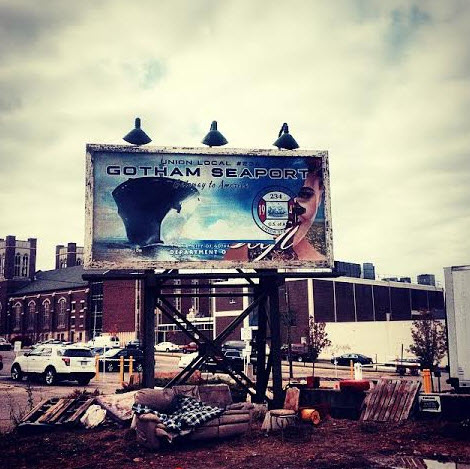
Top-down shot of the police cruiser leaving, a 2011 Dodge Charger Pursuit for Gotham City Police Department. We pan to follow its exit from the scene, and an aged and vandalised billboard comes into view establishing “Gotham Seaport”. Most events in Gotham City in this film will take place at this general location.
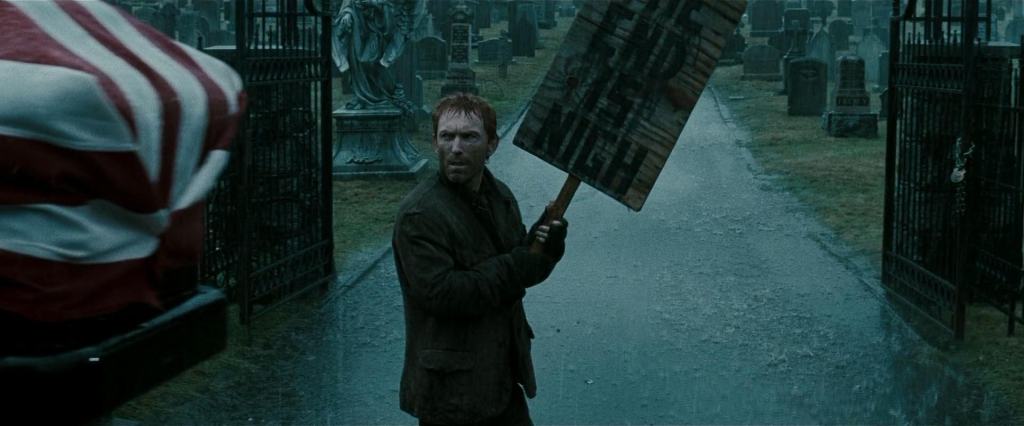
Below are spray-painted the words “THE END IS NIGH”, meaning doomsday, and is thus likely a reference to the monster of the same name, who rampages through this area at the climax of the film. It is also a possible foreshadowing of Superman’s demise. Of course, the football match is all clear foreshadowing of the coming conflict between Batman and Superman that concludes in Gotham right here at the port. Lastly, and most importantly, “The end is nigh,” is also written on a sign that Rorschach carries in Watchmen (1986), same font and verticality.
On the right of the frame is an Ace Chemicals sign on one building, the company of whose vats of chemicals created the Joker.


Top-down shot out from a chimney, a plume of bats flying up at us — a clear foreshadowing of Batman’s presence. We pull back to see the cruiser, sirens blaring, come to a stop outside the dilapidated building. Knee-level shot on the vehicle’s left headlight.
Rucka pushes the front door open, armed with a Remington Model 870 shotgun at the ready. He is flanked by Mazzuccheli with a SIG-Sauer P226R pistol. They storm through the doorway into the dark building.
One high-pitched, eerie, sustained note is played.
Cut to beside the stairs, where a Batarang silhouetted by the flashlights beaming from down the hall is stuck in the wood. This is our first introduction to the new Batarangs in this universe, and the first instance of them being used as a “Batman was here” signature and message in this film.
A jolt of low strings to highlight the message.
Observing the object briefly, Mazzuccheli signals Rucka to take the basement staircase through a busted padlock door, Mazzuccheli close behind. As they descend, we hear women chattering indistinctly.

The officers emerge into a cellar where several foreign women (Ahney Her, Jean Ho, and jewellery designer Kristine Cabanban, wife of set photographer Clay Enos) are imprisoned behind bars, looking terrified. “It saved us,” says one of the women in her native tongue, captions translating for us. “A devil.”
“It’s okay,” reassures officer Rucka, the youngest of the two. “It’s okay. We’re gonna help. We’re here to help.”
“It saved us,” the woman repeats. We can assume the officers have no idea what she is saying.
Rucka continues, “We’re gonna get you out of there. Okay?”
He reaches to open the bars, but the women pull it closed again, whimpering fearfully while shaking their heads.
One woman points up at the ceiling. Shaking, she mutters, “It’s still here.”
“We know better now, don’t we? The devils don’t come from Hell beneath us. No. No, they come from the sky.”
Lex Luthor, The Red Capes Are Coming
“I don’t understand,” responds officer Rucka, confused.
As if on cue, we then hear a loud crash upstairs, followed by a man screaming, and the women gasp.
“Please, don’t. Please, don’t,” repeats a shrill male voice from upstairs.
Whether due to eargerness to see Batman or a desire to prove himself, Rucka slowly heads back up the stairs by himself. Mazzuccheli stays in the cellar and seems to smile, suggesting he knows what to expect, and watches his partner ascend the steps.
Eerie and suspenseful textures continue.
We cut between high-angle and low-angle shots from above and below the second floor stairs to watch Rucka climb. As he nears the top, we move aside on the landing to watch him arrive through the banister.
Nearby, we hear frantic pleading: “Please. I don’t know who he is. I don’t know who he is!”
After yet another loud bang, Rucka stops in his tracks with his weapon primed, nervous.
We hear a prolonged and agonised, “No!”
After a moment, Rucka continues. The fear on his face is unmistakable.
Now on the landing, we cut to a shoulder shot from Rucka as he advances, hearing the unnamed male groaning in pain. Turning a corner, he enters a new room, and the camera focuses heavily on Rucka with shoulder shots and medium close-ups, blurring the image before him.
As Rucka closes in, we see for ourselves a shirtless man (Cesar Santos, portrayed by Sebastian Sozzi) chained by both wrists to a radiator, sweating and swearing in agony.
Eerie textures almost scream now.
The suspense continues to grow. Since Rucka had seen the room’s entrance as he ascended the stairs, he knows that Santos’ assailant must still be here. He peers around to his right, slowly and nervously. Over his left shoulder, we see a dark silhouette balanced in the upper corner of the room, out of focus.
Bass hit to highlight the sighting.

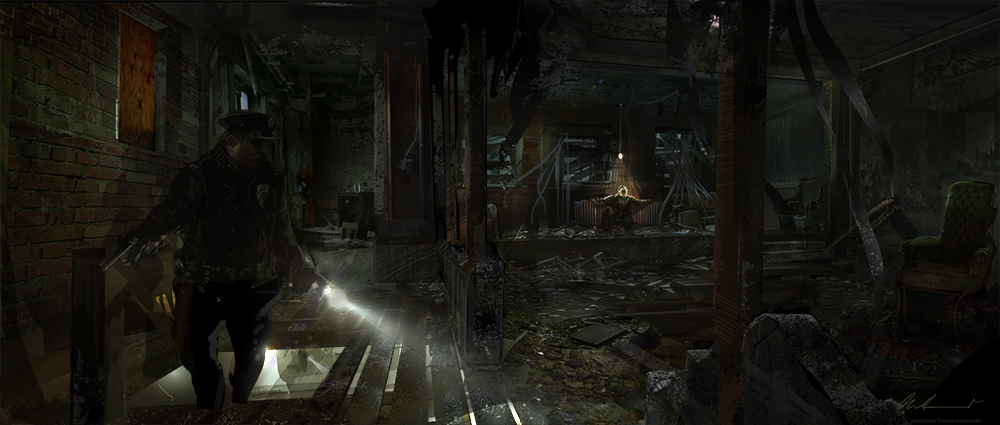
With one half of the room scouted, Rucka knows the culprit must be right behind him. Timidly, he slowly turns to look over his left shoulder, and we get our first look at the Batman in the flesh, spread out in the upper corner of the room.
Behind the Scene
Concept artist Jerad S Marantz drew an idea for this shot.
Panicked, Rucka immediately aims his shotgun and fires, but Batman dashes aside and the shot misses, scattering stone and plaster. He fires again, totalling four missed shots as Batman scurries along the ceiling like some kind of demonic creature. Frame-by-frame, we can see Batman is fully against the ceiling, indicating he is likely sliding on a cable. Finally, the Dark Knight ascends through a hole in the ceiling, possibly again symbolic of demons from above.
A faster, repeating rhythm is introduced as Rucka fires away.
Just then, Mazzuccheli emerges from the doorway, shielding his face from the blast. “Christ!” he yells, showered in chips of debris. This has relaxed the severe tension of the scene.
Music returns to subdued, eerie textures, but with less suspense.
“I saw him,” Rucka says, shaking. Mazzuccheli approaches as he stammers on, “I never saw him before. I… I didn’t know.”
“You almost took my face off,” says Mazzuccheli, disappointed. He steps around Rucka. “How about you don’t shoot the good guys, huh?” he finishes, his voice trailing off. This may be foreshadowing Batman’s quest to kill the good guy in this film, or perhaps even the military launching a nuke at Superman. The line also implies that Batman is one of the good guys.
Then Mazzuccheli bathes Cesar Santos in his flashlight, and we see him layered in sweat while panting rapidly.
Rucka looks horrified as Mazzuccheli murmurs, “Oh. Oh. Jesus Christ.” Cut to a close look at the bat-shaped brand seared into Santos’ flesh, inching closer on the gruesome sight as the officer finishes with the statement, “He branded him.” The music especially ramps up here, making it very clear that what we are seeing is not a good thing, but a cruel act of brutality for its own sake. These notes are also the core melody of Batman’s theme song, once again.
Batman Theme A highlights this act of brutality, last heard in the ruins of the Wayne Financial Building to subtly connect Bruce’s rage there with here, and this is the first time it has actually coincided with Batman’s presence. A rhythm on low synthesizer closes out the track into the next scene.

SCENE OVERVIEW
With Bruce, Lois, and Superman introductions done, we come to our first proper introduction to the Batman in a dilapidated Gotham house, portrayed as a monster of the night who stalks the shadows and moves like a wraith. Now, everyone is afraid of Batman, including cops and innocent people, instead of just the bad guys, making him appear as a villain himself, which is essentially the point of his character in this film. We have our first look at his brutality in the form of his branding human trafficker Cesar Santos — who will play a role later in the true villain’s scheme — and the film contrasts his prior heroism with his new indifference to the terrified trafficking victims down in the basement.
SCENE ANALYSIS
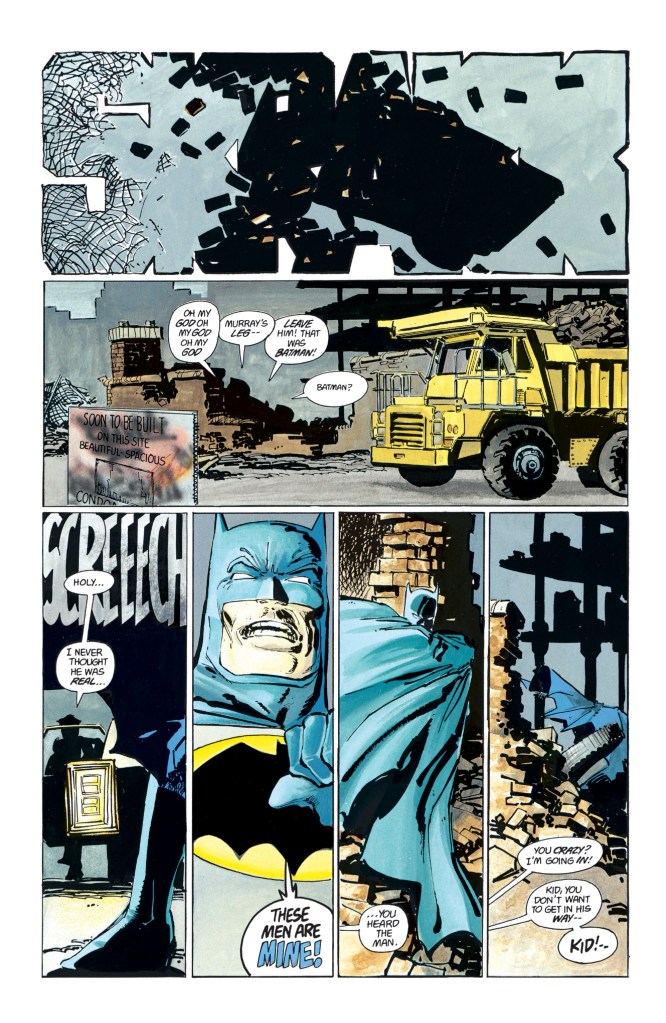
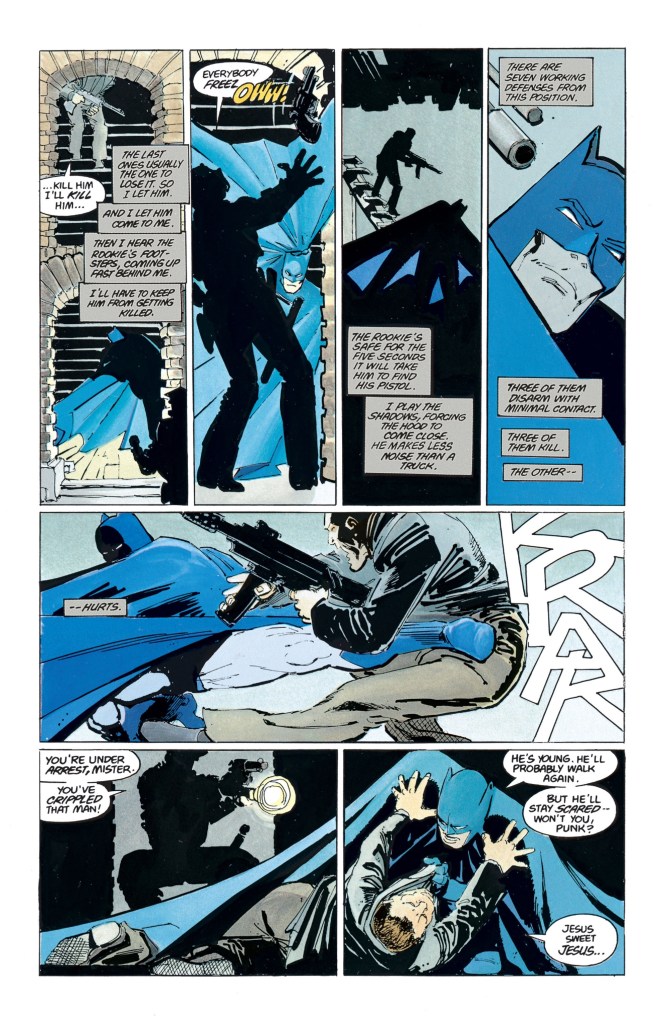
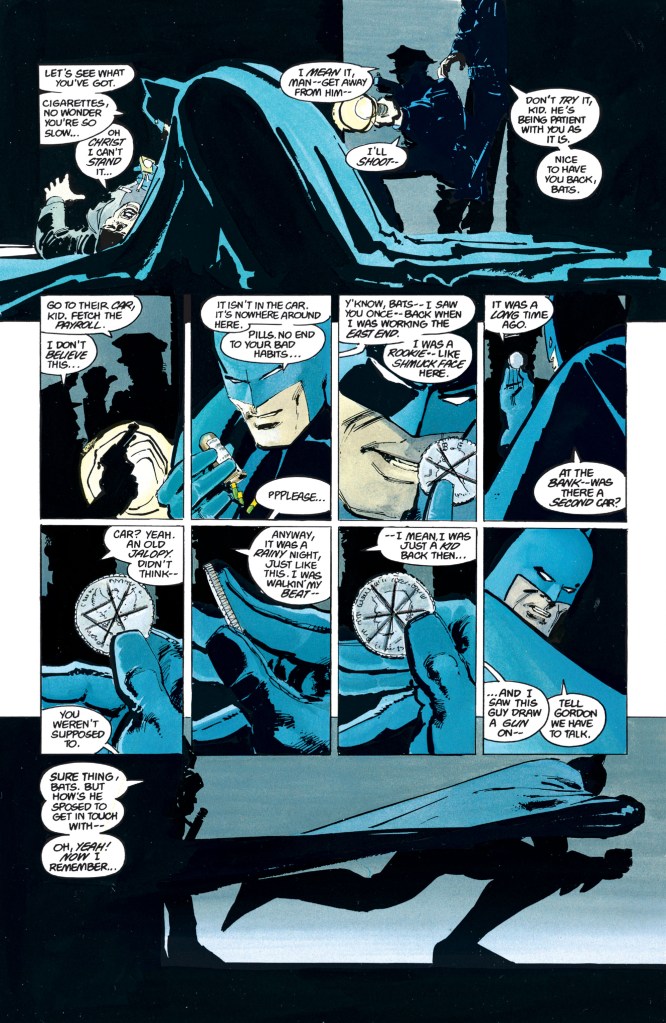
This scene is a reference to The Dark Knight Returns, where two police officers encounter Batman on the first night of his return to crime-fighting. One officer was a young rookie who tried to apprehend the Batman against the wishes of his older veteran partner who was personally experienced with Batman, which is also implied in this scene.
“I really wanted the first time we saw Batman to be scary. The idea was for us to see him the way society saw him and the way law-enforcement in general saw him, and it was only after we had to get back to the Batcave and talk to Alfred that we understand his tenuous relationship with what he was doing as a vigilante.”
Zack Snyder, Film Junkee Vodka Stream, 14 November 2020
The scene is executed brilliantly. As we know when the police first arrive, Batman is involved, which creates suspense as we lead up to his inevitable appearance. However, we do not know how he is going to appear or what is going on upstairs, which also creates mystery. Both of these things combined add to the thrill of Batman’s first appearance in the movie. Half of what we see of him is just his black cape. He is truly an ominous force, exactly as many have attempted to portray him as. This effective tone is often compared to a horror film. The music augments the scene even more…
“I think we compared [the music in this scene] to Zimmer’s Joker score from The Dark Knight. You almost don’t even notice it. It’s so subtle. It’s not really music. It’s very atmospheric, and it’s just this slowly screeching, droning, whine noise.”
Stephen Colbert, Batman v Superman: By The Minute, 17 June 2019
Of course, Batman saved these women from their captors, but the fact they are still so terrified that they refuse to leave their cell is very telling about how threatening Batman is, despite them acknowledging that he saved them. Rather than trying to comfort the victims, Batman is upstairs torturing a criminal, which factors into his character for this film. He is not here to save innocent people necessarily, but to acquire information, as we later learn.
Note the contrast between this scene and Their War Here. In that scene, Bruce Wayne’s first and only priority is saving people. It is day, he wears a blue suit, and his humanity is plain to see. In this scene, Batman’s purpose was not to save people, but to punish a criminal and acquire information, later describing it as an unproductive night. His humanity is obscured in the shadows, clad in the dark colourless suit he wears to strike fear into the hearts of not just criminals, but in all who witness him. There is a clear contrast not only in the humanity of Bruce Wayne and inhumanity of the Batman, but in how Bruce has clearly changed in the years since mankind was introduced to the Superman.
Snyder confirmed in the Remastered director’s commentary (00:56) that the brand is inspired by the 1920 and 1940 films both titled The Mark of Zorro, where the titular vigilante would cut a “Z” logo into the flesh of his defeated enemies with his sword. The 1940 film was referenced on a movie poster in the opening scene of this film outside the theatre. It is also worth noting the upside-down triangle within the symbol, where Superman’s shield placement on the movie’s logo is situated.
Here we see Batman’s new outfit for the first time, and it is especially accurate to the comics in a way that no other Batman costume has been on the big screen since Adam West, with the grey tights beneath the black cowl, cape, gauntlets, boots, and a large bat logo on the chest.
“I thought this football metaphor, how you would show the way these two cities interact, using their two football teams… as a metaphor I think it’s kind of fun. Of course, we get to see later that’s Cyborg’s alma mater, if you will, or the team he played for before his injury.”
Zack Snyder, Batman v Superman: Dawn of Justice Watch Party, 29 March 2020
The reason Gotham is suffering in the football match is because their star quarterback, Victor Stone (Cyborg), has suffered his serious disfigurement by this time, and thus is not there to play for his team. Ray Fisher, Cyborg’s actor, confirmed this, which is a nice bit of connected continuity.
The music track in this scene is Branding. It serves solely as an ambient accompaniment to the scene’s suspenseful nature, as it is almost entirely suspenseful textures without any melody until Batman Theme A makes its return.
BEHIND THE SCENE
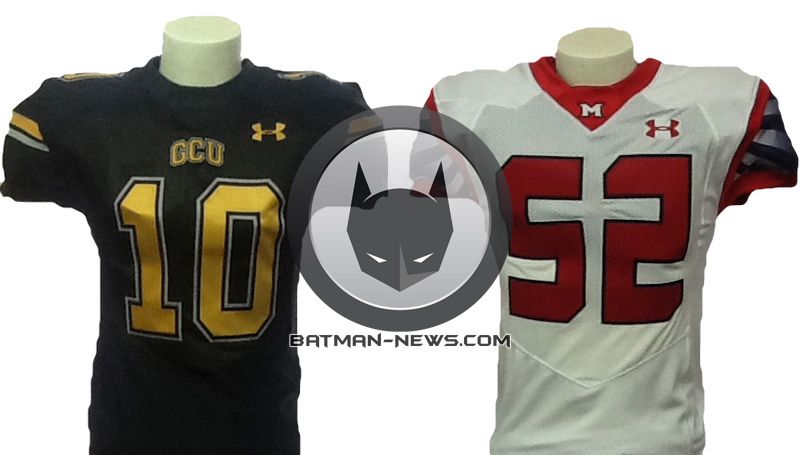
The football match was shot at the Weingart Stadium in East Los Angeles College, 1301 Avenida Cesar Chavez, Monterey Park, California. The Gotham Rogues (also seen in The Dark Knight Rises) were played by the East Los Angeles College football team, and Metropolis State University were played by the Victor Valley College team. The Gotham Rogues are clad in black and yellow, likely referencing the classic colours used to represent Batman. The MSU uniforms were donated to Maranatha High School, a private preparatory Christian school in Pasadena, California. At the time, Zack Snyder’s son Eli attended the school, and became one of their top quarterbacks in the oddly-named team the Minutemen. Zack Snyder himself also attended the school in his youth, presumably after leaving the Daycroft School of Christian Science. Snyder confirmed that Eli’s coach, Anton Clarkson, is in the game.
This was the first thing shot for the movie on 19 October 2013 and the shoot lasted a mere 20 minutes. The location and details of the scene were first reported by East Los Angeles College Campus News, who revealed that the first 2,000 extras (primarily ELAC students) would receive exclusive T-shirts and prizes for their contribution as Gotham fans in the stands. Behind-the-scenes footage of the match can be found here and here, plus multiple videos on the YouTube channel of Vahn Gharakhan, who played an extra in the stands. Many additional photos of the shoot can be found at Batman News, Superman Homepage, and Henry Cavill News, including footage of Zack Snyder waving at the audience.
“The Pasadena prep outfits actually got retrofitted. The Maranatha school logo became the Metropolis school logo because I knew I was going to give all those uniforms to my son’s high school — which is called Maranatha — and they share a letter with Metropolis, so it worked out pretty great for everyone involved. These high school kids got these super awesome chrome helmets and look f–kin rad, so I was like, this is cool. I just said to Under Armour, ‘You know what would be cool? If you guys donated these uniforms to Maranatha.’ And the cool thing was, they had, like, receiver gloves… And that’s where I went to school too, so it all worked out great. The kids were so… And, by the way, they won their league that year.”
Zack Snyder, Zack Snyder: The Director’s Cuts, 24 March 2019
The police cruiser at the start of the scene was situated in the small parking lot at 10 Warren Avenue, Pontiac, Michigan. We see the vehicle leave West on Warren Avenue, along where the Gotham Seaport sign was constructed. The city environment beyond the immediate surrounding buildings is completely CGI. Pontiac residents @Weemz on Reddit and @samxperez on Twitter got photos of the sign, indicating the sequence was shot in late October, possibly the 24th.
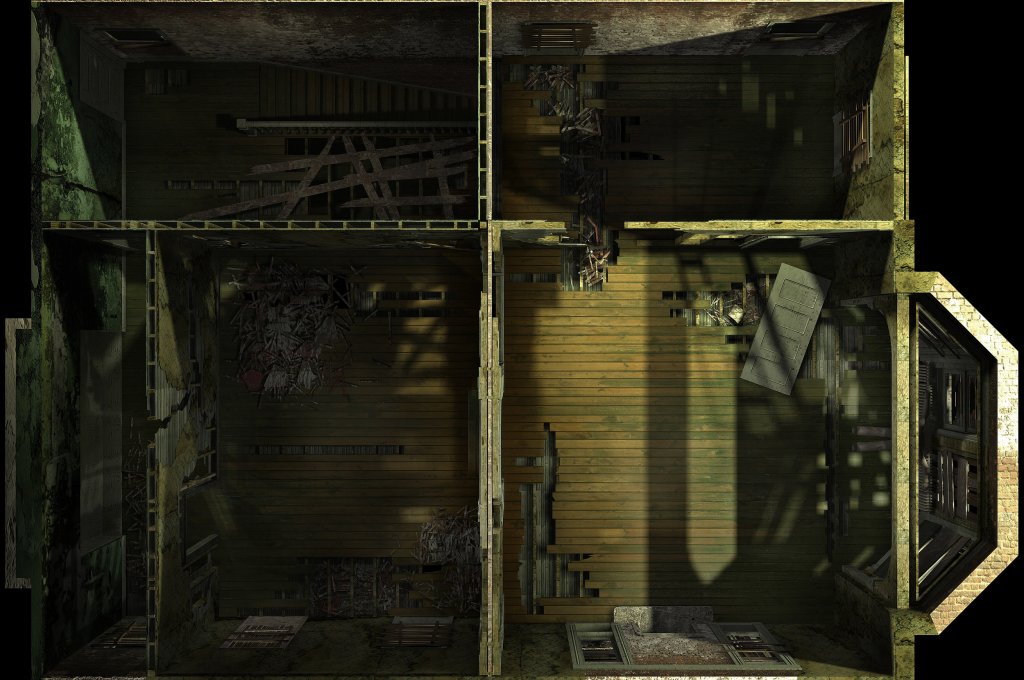
The dilapidated building was shot at the Ransom Gillis House, 205 Alfred Street in the Brush Park district of Midtown Detroit, Michigan. It was built all the way back in 1876. (Source) The chimney was fake, a large scaffolding was constructed for the crane camera used to film the top-down shot of the chimney, and boats were placed around the vicinity to establish the port setting. Bananadoc got several photos of the construction. In 2015, the house was refurbished on the TV series Rehab Addict, hosted by Nicole Curtis.
The police arriving outside the building was evidently shot the night of 26 September 2014. Bananadoc snapped a multitude of set photos as they filmed the sequence, and mc176911 and itcamefromdetroit both recorded video showing the filming of the police cruiser skidding to a stop outside the old building. Base Camp was set up on the empty plots along Watson Street a few blocks away, which are now home to The Scott at Brush Park apartment complex. During their time shooting, they were fed by FoodLab Detroit, who thanked the crew for supporting the “Detroit Grown and Made” campaign. Set designer Anshuman Prasad has a 3D render of the “Dilapidated Crack House” on his website.
 Snyderverse Analysis