BATMAN V SUPERMAN: DAWN OF JUSTICE
PAST MEMORIES
THE MOUNTAIN


Cut to an establishing shot of the slope to a mountain peak, introduced by a lingering treacherous blizzard, wind and snow flowing across every rock to create a surreal, dream-like, moving environment. Clark’s silhouette slowly emerges from the haze.
Clark hikes to the peak, looking burdened, as if this journey takes effort, reinforcing his state of mind. Up ahead, the torrent begins to dissipate, and a figure appears ahead throwing rocks onto what appears to be a cairn, a structure commonly used as a primitive trail marker — Jonathan is showing Clark the way, guiding him back. Frame-by-frame, you can see the moment Jonathan flickers into existence, a subtle indicator of a manifesting apparition or figment of Clark’s imagination.
“Cairns, traditionally, in the mountains, you would build a pile of rocks as a trail marker, and the idea for me is he’s trying to show his son the way, and by piling these rocks, you give a goal, you give a way forward. It’s a waypoint on the journey. … That’s what brings him back.”
Zack Snyder, Full Circle, Batman v Superman: Dawn of Justice commentary, 29 April 2023
Clark stops in his tracks, looking in uncertainty. Then he continues to approach. The blizzard is all but gone now, transforming Clark’s environment from a chaotic storm into a quiet, serene limbo.


We get a close look at the cairn as a gloved hand adds another stone. We turn up to the left, getting a good look at Clark’s Earth father, Jonathan Kent. We track him as he picks up more rocks before smiling at his adoptive son. Even in death, it seems this grizzled man of the land is always working.
Clark stops his approach, mouth opening in incredulity at seeing his father. As we hear Jonathan toss the rocks onto the structure, we push into a closeup to dramatically emphasise Clark’s reaction without the need for music.
We get our first full shot of the ghost of Jonathan Kent as he tosses another rock. Then he steps away from his project and looks out at the view. Just as Clark treads in further from the right of the frame, Jonathan says, “Something, isn’t it?” The grizzled farmer puts his hands on his hips. He then continues speaking as he gestures to the lands below, “We men of Kansas live on a pancake, so we come to the mountains. All downhill from here, down to the floodplain. The farm at the bottom of the world.” Jonathan is explaining why Clark came here: a man from Kansas at the bottom of the world, living on a pancake, has come to the mountains where downhill is the only place to go. Clark has come seeking peace, away from controversy, media, and Superman — an internalised Fortress of Solitude.
Clark looks at his late father in confused awe. He turns away for a moment, trying to process what he is seeing. He was definitely not expecting this encounter.
Pa Kent goes on, “I remember one season the water came bad. I couldn’t have been twelve.” He reaches down for another rock.
Clark looks down, avoiding eye contact.
Jonathan continues speaking as he reaches down to collect and deposit another rock. “Dad had out the shovels and we went at it all night.” He chuckles as he explains, “We worked till I think I fainted, but we managed to stop the water.” Then he turns sombre. “We saved the farm. Your grandma baked me a cake, said I was a hero.” The use of “your grandma” as opposed to “my mother” is a nice reminder of how Jonathan truly thinks of Clark as his son, despite being an alien. He collects and deposits another rock on the pile. Ever more sombre now, he says, “Later that day we found out… we blocked the water, alright. We sent it upstream. The whole Lang farm washed away.”
Clark turns to look away right, now placing father and son on the left of the screen, facing the right. This is called a match cut, in which a shot cuts to a different shot it strongly resembles in subject and composition. This technique connects Clark and Jonathan via cinematography, in turn associating Jonathan’s story with his son. They’re the same.
Jonathan goes on, “While I ate my hero cake their horses were drowning,” again iterating the horse motif throughout the film. He pauses before saying, “I used to hear them wailing in my sleep.”


Clark looks down and swallows as he recalls his own similar experiences. He closes his eyes for a moment, certainly remembering the faces of the dead, and asks, “Did the nightmares ever stop?” before opening his eyes again. This all shows that he too has been haunted by the unintended consequences of his actions and the dead that have surrounded him.
The old man deposits a final stone before nodding. “Yeah. When I met your mother. She gave me faith that there’s good in this world. She was my world.”
Music returns with the Earth Motif, complementing the positive emotional turn with its warmth.
Clark, hearing these words, tilts his head up slightly, eyes straight ahead, finally comprehending the lesson. These words, with Clark visually the focus, are the last of the visual connections the scene generates. What Clark realises is that the hope Jonathan discovered in Martha Kent can also be found in his own beloved: Lois Lane. She is his world.


Jonathan’s voice breaking a little, he finishes, “I miss you, son.” By now, Jonathan has stopped building his cairn, and this line further suggests this is no memory. Maybe it was, but now Jonathan is in the present and interacting more directly.
Clark Kent Theme comes in on piano to add the finishing emotional touch to the soundtrack, but it is fragmented, each segment terminating before the final note. This might be subtle foreshadowing that this moment will not conclude Clark’s arc as the film leads us to suspect.
Clark takes a breath, shoulders relaxing as he looks up at the sky. “I miss you too, Dad.”
Wide shot of Clark with the cairn behind him. He is alone now. Or he always was. Or maybe less now? His father is always with him, in one form or another, ending this sequence on a faint hopeful note. There is no need for a goodbye, and yet they miss each other.

THE MANOR

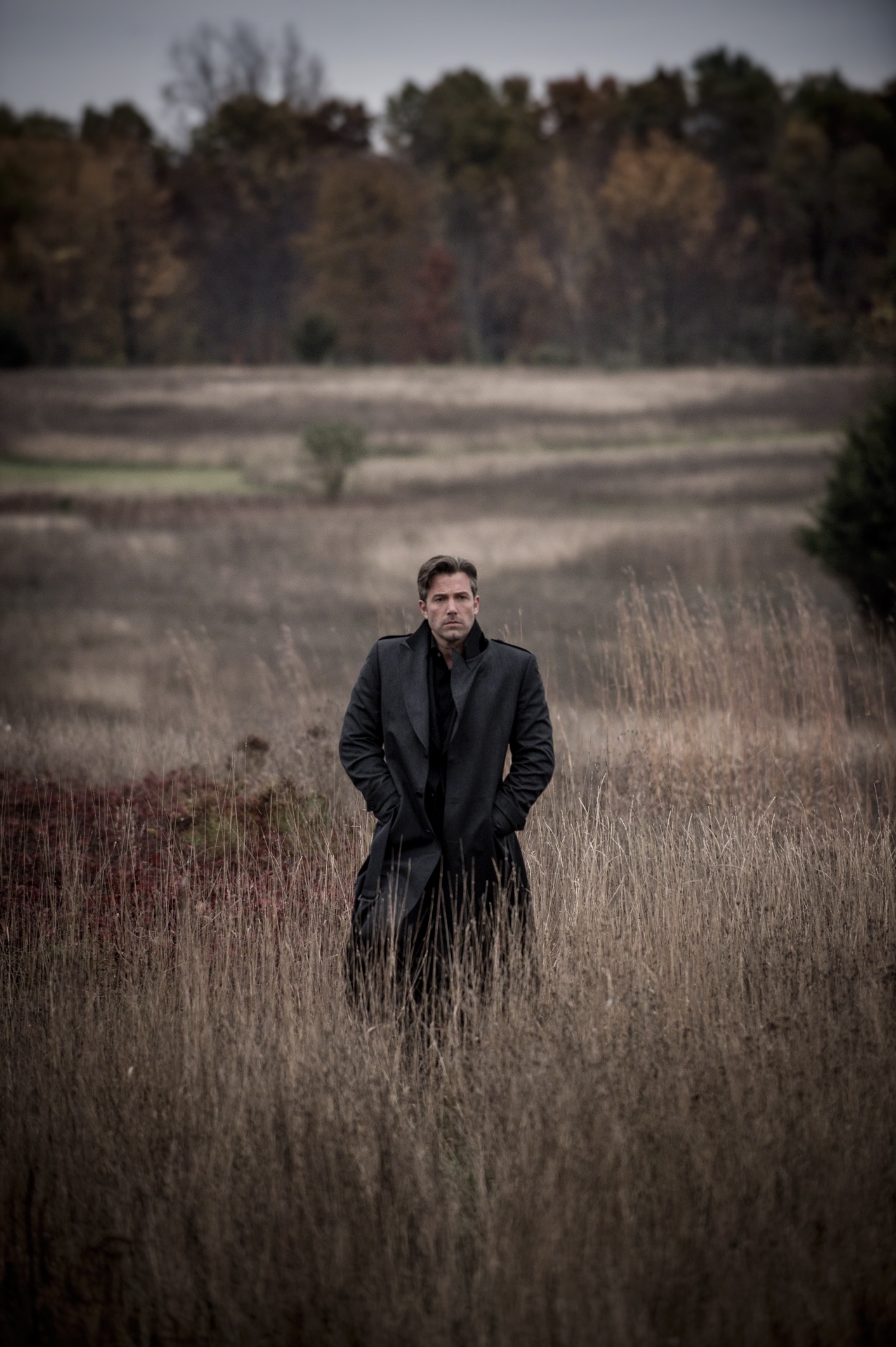
Wide hip-level shot of Bruce, back turned to us. He approaches the husk of Wayne Manor in slow-motion, through the tall grass to again repeat the motif of Bruce off the path. His position in the frame coincides with Clark’s in the previous shot. His right hand skims across the blades, reminiscent of imagery from Gladiator (2000) that implies long-time familiarity with the environment. The camera follows him, slowly and steadily keeping up through the foliage.
Hum of the Earth Motif continues on from the previous sequence.


Cut to a medium close-up of Bruce on the left frame, now inside the cold, dark, black living room. Though it still looks chilly, the visuals are completely different from the mountaintop. Clark was in the light, whereas Bruce seethes in the dark.
Transition to slow Bruce Wayne Motif, changing the warm tones of the mountaintop scene to the dark, sinister sounds of Bruce’s soundtrack.
Over his shoulder, Alfred steps into view and stops to look at Bruce. Alfred steps toward him, and says, “You know you can’t win this.” He steps into the man’s field of view, his face illuminated by the light from outdoors. “It’s suicide,” he finishes. Even if Batman slays his whale, to murder Superman would be the death of Batman as a hero. There is no winning in this pursuit.


Bruce has his back turned to the hollowed-out entrance, almost silhouetting him against the overcast daylight outside, drawing an especially villainous look complemented by the black coat and high collar, contrasting the light on Alfred — Bruce has turned his back on the light, while Alfred remains noble. Bruce doesn’t look at his faithful friend, his gaze unchanging. In response to Alfred’s words, he shifts uneasily somewhat before responding, “I’m older now than my father ever was. This may be the only thing I do that matters.”
“Twenty years of fighting criminals amounts to nothing?” Alfred asks, looking disappointed.
Bruce is looking at Alfred now. “Criminals are like weeds, Alfred.” He turns back away and says, apathetically, “Pull one up, another grows in its place. This is about the future of the world. It’s my legacy.” The vast majority of people will never be in a position where the fate of the world rests in their hands, but we can understand wanting to leave a meaningful mark on the world, so the film connects these two things to make us connect with Bruce.
Defeating Superman, to him, feels like the only thing he can do that might actually leave an impact. Recall his earlier line, “We’re criminals, Alfred. We’ve always been criminals.” Bruce thinks of himself every bit as irrelevant as the criminals he takes down, which in turn ties into his sense of powerlessness that he seeks to overcome. Note that he also never defines his legacy thus far in the people he has saved, but in the people he cannot destroy. There is likely a message in the fact that Batman’s violence has not had the affect he wanted.

Then he looks down at the Wayne coat of arms embedded in the stone floor beneath the fireplace. “You know, my father sat me down right here, told me what Wayne manor was built on.”
Piano notes come in here, dignifying the old family crest with a very slight positive tone.
Alfred is also looking down at the relief in the floor. He slowly looks back up at Bruce as he explains, “Railroads, real estates, and oil.”
Bruce says, “The first generation made their fortune trading with the French. Pelts and skins.” He looks at Alfred for a moment as he says this, but pauses for a few seconds before finishing, “They were hunters.” He gives Alfred one final look before turning to leave. Like the Waynes that came before, Bruce’s legacy will be that of a hunter, and Superman will be the monster he slays. He is declaring this his destiny. His words also draw another comparison to Moby Dick, where Ahab sets out on a vengeful quest to hunt down the whale that crippled him, potentially one of many references to that story in the film.
Batman Theme A marches in here, foreboding to highlight the downright villainy of Bruce’s mindset and sealing his intent.
Bruce steps away from Alfred by the fireplace to head for the exit, hands in his pockets.
Each step he takes is accompanied by the thudding notes of Batman Theme A.
Alfred looks concerned as he tracks Bruce’s departure from the scene.
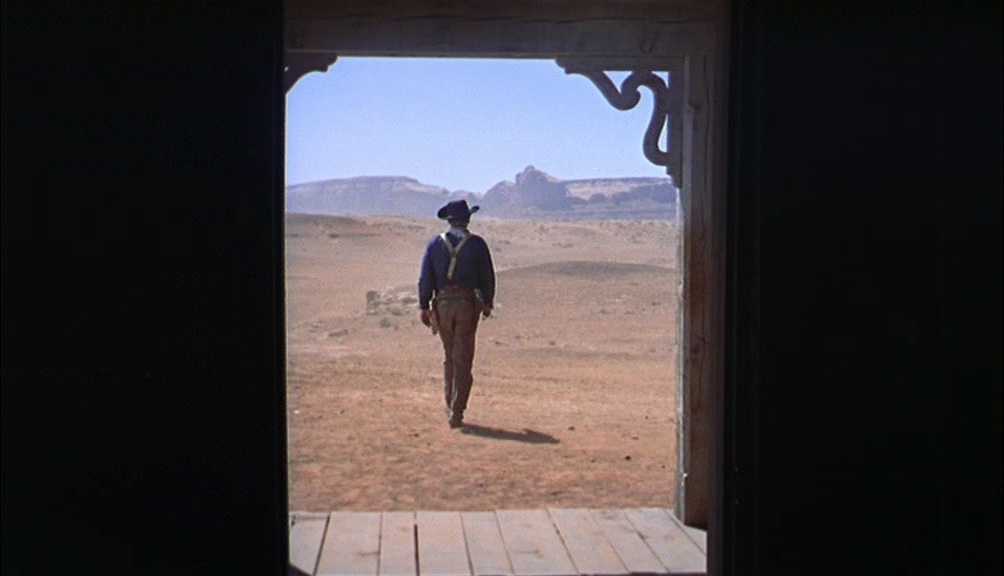

Connecting the end of the scene with the beginning, Bruce descends the steps from the decrepit front doorway, once again in silhouette walking away from the camera through tall grass, once again off the path. This shot resembles the earlier shot of Clark’s silhouette climbing the mountain, but where Clark ascended to find hope, Bruce only descends deeper down the wrong path. It may also be a reference to The Searchers (1956), one of Zack Snyder’s favourite films.
Alfred watches Bruce leave. The troubled old man remarks poetically, “So falls the house of Wayne.” Fittingly, the literal ancestral home of the Wayne family has become a withered husk. This line also repeats that the quest to kill Superman, one way or another, will be the end of Bruce Wayne. Ironically, by the end of the film, it is the House of El that falls with its last descendant (its crest is pierced) while the House of Wayne lives on.
“We gotta wait for more evidence,” we hear Nancy Grace say, as if criticising Bruce’s actions, or a note to Alfred that things will not end like he thinks they will. Cut to the next scene.

SCENE OVERVIEW
Seeking solitude on a mountaintop, Clark has an ambiguous encounter with his father, Jonathan Kent, who explains his own struggles with feelings of guilt, mirroring Clark’s traumas. Jonathan found his faith in Martha, setting up Clark to find his faith in Lois, giving him new hope in humanity. Meanwhile, Bruce visits the ruined Wayne Manor to dwell on what he feels is a wasted legacy, and will kill Superman to give his life meaning. To the despair of Alfred, Bruce sets out to finish his dark crusade. Superman is prepared to return, but Batman will be waiting.
SCENE ANALYSIS
“Sitting still is precisely the sin against the holy ghost. Only thoughts which come from walking have any value.”
Friedrich Nietzshe, Twilight of the Idols, 1889, p9
Jonathan’s story is a parable resembling Clark’s own experiences. Like Clark, he did his best to do the right thing, but while he relished in the joy of his victory, the fruits of his efforts to save the farm had disastrous consequences for another, and the wails of his unintended victims haunted his dreams since. Every word implies Clark feels the exact same way, holding immense relevance after what he has witnessed, and his father knows what that weight feels like. The kicker comes when Jonathan mentions Martha, which reminds Clark of how much Lois means to him as a symbol of the good in the world.
It is ironic how Clark lost faith in the ideals of his biological father, who spoke the most highly of Superman’s purpose, but now Clark is given renewed faith in his ideals by his Earth father, who regularly stressed the importance of keeping Clark’s secret from the world. At his lowest point, Clark returned not to the memory of the father whose ideals he chose to live by, but to the father who told him to choose his own path. Jonathan does not give his son advice or tell him what to do, but rather just relates an event from his own childhood, in effect restating the important lesson from Clark’s upbringing: there are consequences. In the end, only Clark can find the answer. All Jonathan can give him is the motivation to keep looking for it.
It is incredibly important to understand Jonathan’s approach to helping Clark here. He does not give a big speech on how Clark should just stop being sad, or give him a pep talk the way Martha and Lois both did, but instead shows Clark that he can relate. He does little more than explain his own story, saying what he experienced and — when Clark presses — how he overcame his trauma. Jonathan understands his son’s pain. This is vital in approaching depression, connecting with the person suffering, showing they are not alone. Clark has inherited his father’s problem, but has also inherited his solution.
Note the cinematography here. Jonathan is regularly on the left of the screen, looking right. When we cut to Clark, he is also on the left and looking right, reflecting Jonathan’s position in the frame. Clark is following his father’s footsteps in a sense, focusing all the hope in the world in the ones they love most to overcome their feelings of guilt. The cinematography visually frames them as the same.
Unlike his comic book counterpart, when Zack Snyder’s Superman needs to be alone, he doesn’t retreat to a crystal palace in the Arctic to be pampered by robot servants who treat him like a king. Instead, he retreats to nature. He’s just hiking like a normal person, wearing warm clothing for the environment like humans would. He doesn’t leave the world, only civilisation. As Snyder says, he has an “internalised” Fortress of Solitude. The character’s strong connection to nature is perhaps shown strongest here.
I personally doubt Jonathan’s appearance is just a memory of something he once said, since Clark earlier asked Martha why he never left Kansas, yet his words here would indicate he was actually on a mountain at some point.
“Chris and I talked a lot about this sequence of Clark seeing… Is it a memory? Is it a ghost? Is it a conversation with yourself? I think those are all viable versions of this sequence because, in the end, the Fortress of Solitude has become internalised by Superman into a conceptual, self-imposed solitude. So, what would be normally this insane ice structure has become this simple, incredibly organic place. It’s more the idea of self-reflection where he is experiencing — in a very Joseph Campbellian kind of way — this re-connection with… Instead of going to talk to this space dad, if you will, he goes to talk to his human father who he’s internalised to teach him about the thing that he already knows, in this simple story about how trying to do the right thing can often have tragic results, but in this case, you have to try. I think the lesson is you do the best you can.”
Zack Snyder, Batman v Superman: Dawn of Justice Watch Party, 29 March 2020
“In my mind, he’s a conversation that Clark is having with… Is Jonathan Kent actually there? I don’t know. That’s a fun thing to play within your mind. And then it’s awesome that this scene is happening at the same time as that scene. This is a conversation about, ‘I’m older now than my father ever was,’ you know? It’s like them both realising who they are, except that Ben’s character, where I feel like Superman has found a little bit more clarity, he’s gone deeper into his anxiety about what he is, and really kind of single-minded. There’s only one thing to do.”
Zack Snyder, Full Circle, Batman v Superman: Dawn of Justice commentary, 29 April 2023
This scene represents a three-way parallel between Clark, Bruce, and Lex. Each sequence is about the impact of deceased fathers on their sons. The mountain and manor contrast each other. The mountain sequence is, by the resolution, wholesome and carries hope for the future. Surrounded by nature and white snow, Clark has received the wisdom he sorely needs if he is to break through the darkness in the world. He is alone here, yet he carries his father with him wherever he goes. At Wayne Manor, there is only foreboding, surrounded by decrepit architecture and blackened concrete, Bruce refuses to listen to Alfred, learning nothing as he remembers his father only for the reassurance his family history gives him to persevere down his dark path.
Bruce’s scene in the manor parallels the earlier scene with Lex in his father’s room. These locations are the “relics” of Lex Luthor and Bruce Wayne. Both here and there, these characters discuss their fathers before a fireplace. Bruce has allowed the memory of his parents to whither away, forgetting what they really meant to him and twisting his family’s legacy to motivate himself further, symbolised by allowing Wayne Manor to fall into disrepair. Lex is unable to escape the traumatic memory of his abusive, hated father imprinted on his psyche, symbolised by the maintenance of the room.
“This is where Bruce goes to lament a life not lived. He’s kept this monument to his broken life to remind him constantly of what he has to live up to I think, in a lot of ways.”
Zack Snyder, Batman v Superman: Dawn of Justice Director’s Commentary, 2021, 1:47:49
“There’s a great parallel weirdly between Bruce and Lex, so I built these two sets to have a similar vibe to what you see in Bruce’s relic. So the two concepts are that this relic of this house, this room, [Lex] has been transported to his super-modern house that he has had built, but he kept this room exactly like a tomb to his father, just like Bruce has kept Wayne Manor, though the two parallels are that Bruce has let his be destroyed while Lex has preserved his. It’s almost like the opposite. Bruce has let his go, but Lex has not.”
Zack Snyder, Batman v Superman: Dawn of Justice Watch Party, 29 March 2020
“And then you have this sequence here where Bruce goes to his version of seeking the father. We have this whole thing about the father and redemption in the eyes of the father, and I think that this is Bruce’s version. It also parallels the earlier Lex scene that we talked about where Lex was at the mantelpiece of his father and Bruce goes to the mantelpiece of his father just as Clark goes to the mantelpiece of his father, which is a simple relationship to the land, he’s a farmer. He has this relationship to the Earth. The Waynes have this relationship to commerce and industry. I think that’s how each character reflects their internal struggles through these three different environments, and they’ll all come to a head here.”
Zack Snyder, Batman v Superman: Dawn of Justice Watch Party, 29 March 2020
The music track in this scene is Past Memories. It connects the two sequences to draw a comparison, mirroring each other tonally. Clark is alone, but there is hope and love in the score, albeit with a subliminal hint of uncertainty. Bruce is confronted by his friend, yet his score reinforces his descent into darkness.
BEHIND THE SCENE
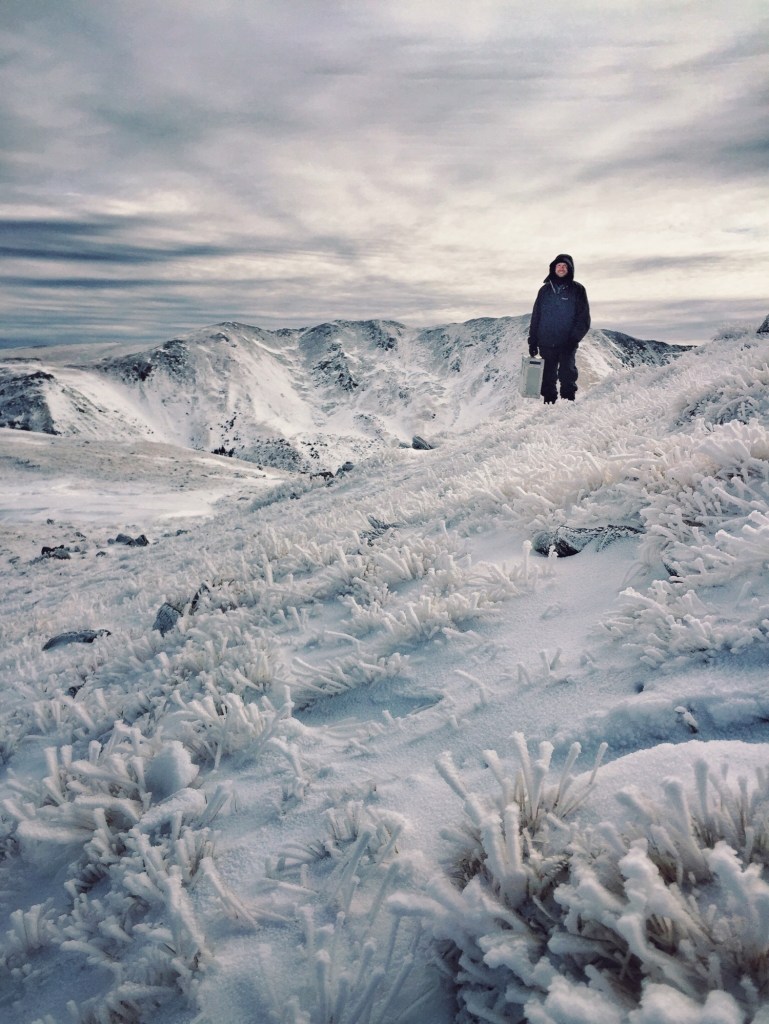

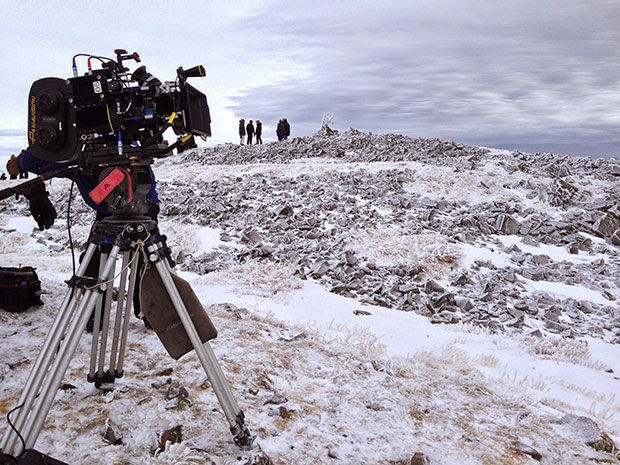


The mountaintop scene was shot in Taos Ski Valley in Taos County, New Mexico, atop Kachina Peak. Snyder has a penchant for skiing, so he likely chose this location after having come here before to pursue his hobby. The scene also demonstrates Snyder’s commitment to location shooting whenever possible.
“This was in New Mexico. We shot that sequence at the beginning of the movie, and then we went just up to the North and shot this at that ski resort.
[It was] fun. You know, in the cold and whatever and putting the camera in the snow and having to get it up on the top of the mountain. I like shooting on location.”
Zack Snyder, Full Circle, Batman v Superman: Dawn of Justice commentary, 29 April 2023
“It was, and this was really high, and everyone was getting altitude sickness. These two guys were fine, but I think we lost our makeup artist. She went down and a couple other people went down due to altitude sickness. There was like a handful of us still like standing there at the top of the hill when we shot this, but it was cool. And Kevin, of course, and Henry were fine. They were like, ‘Oh, no, this is great.’”
Zack Snyder, Full Circle, Batman v Superman: Dawn of Justice commentary, 29 April 2023
On 3 December, director of photography Larry Fong posted a photo of snow on his Instagram (earning a comment from Christina Wren). On the 5th, Fong posted a cryptic Instagram to wrap the shoot and another to bid New Mexico farewell. On the 10th, Zack Snyder tweeted his goodbyes to New Mexico, and was thanked for his visit by the official New Mexico Twitter account. Clay Enos tweeted his goodbyes with this photo on the 5th, this photo that day getting on his plane to leave, and later reminisced with this photo on the 11th. He also posted photos of the set on Vero [1/2]. Second assistant camera operator Trevor Carroll-Coe posed for a photo. Camera loader Jule Fontana got this photo with his crew. Electrician Erica Kim photographed the horses. Set costumer Kate Abraham celebrated wrapping with this photo with some of the crew. Taos News reported that the production had spent $13 million in the New Mexico economy and hired 200 New Mexico crew members during that time. Principal photography had officially concluded.
“On behalf of the cast and crew of ‘Sage and Milo,’ thanks to everyone at Taos Ski Valley for making our recent film shoot such a success. Gordon Briner and the staff at Taos Ski Valley staff are truly exceptional. It’s not easy bringing a major Hollywood film to the top of Kachina Peak, but with the assistance and support of the TSV staff, we successfully completed our work without incident or injury. Special thanks to Michael Mitchell — we couldn’t have pulled off our ambitious plan without his tireless efforts. Thanks also to Eric Garner and Kevin Lehto at the Carson National Forest for their help in permitting our film project. With first-rate support like this, New Mexico is sure to continue to attract major film productions, along with the positive economic impact they bring, to the Land of Enchantment.”
Production Message, Taos News, 10 December 2014
“We are thrilled that the towns of Playas and Taos, New Mexico could play host to such a large-scale production. In fact, they built one of the largest set pieces in New Mexico film history. We are pleased with the number of New Mexican residents and suppliers that the show was able to utilize during their stay.”
New Mexico Film Office Director Nick Maniatis, Taos News, 10 December 2014
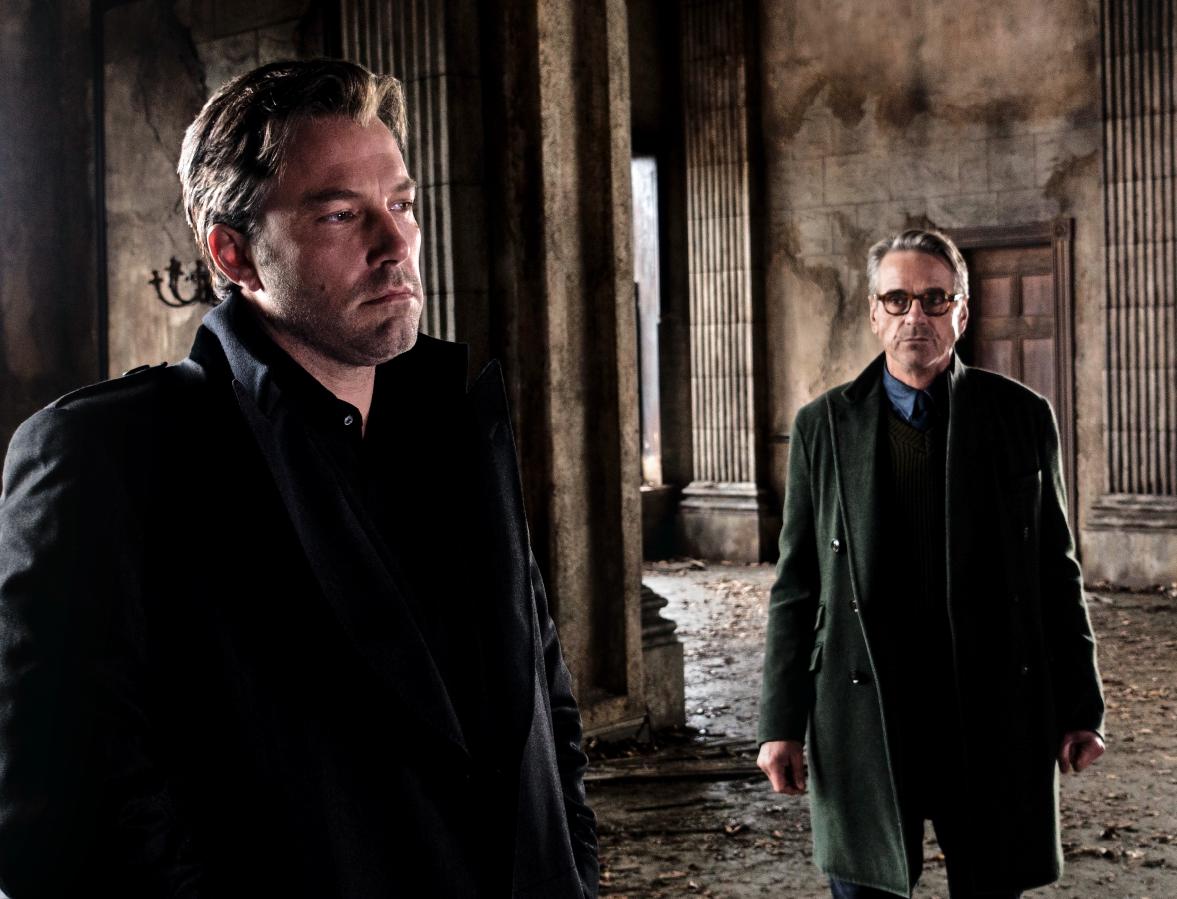
Zack Snyder, Vero, 19 September 2020
The Wayne Manor interior was a small set constructed and filmed in Orion Oaks County Park, 2301 Clarkston Road, Lake Orion, Michigan. Batman News and OLV provided several detailed photos of the set. Larry Fong took this photo from inside the fake entrance. Michigan film production stalker Bananadoc snapped photos of the set here and here. The exterior is fully CGI. The design was based on Sutton Scarsdale Hall, a ruined stately home in Chesterfield, England. The interior set was incorporated into the VFX model. Filming evidently occurred in October 2014 around the 25th and 26th.
“We kept the dressing to a minimum, destructed wall sconces, a damaged piano in the corner, and a once magnificent dining room table… but you don’t see any of it really, you just feel the lost beauty.”
Carolyn Loucks, Set Decorators Society of America, 9 May 2016
 Snyderverse Analysis