BATMAN V SUPERMAN: DAWN OF JUSTICE
MUST THERE BE A SUPERMAN?


Full shot of Superman, flying down with a child (Jade Chynoweth, credited as Carmen) in his arms. He is silhouetted by the burning building collapsing behind him. We descend to follow his touchdown, the crowd of onlookers emerging in the foreground. Fire-fighters close in, some removing their masks to witness the event more personally, while others respectfully remove their hats and hold them to their chests.
Sustained Krypton Motif to represent Superman’s otherworldly qualities before Superman Theme A comes in to accompany, repeating its distinctive chords on a deep guitar glissando, adding a majestic element to the supernatural heroics.
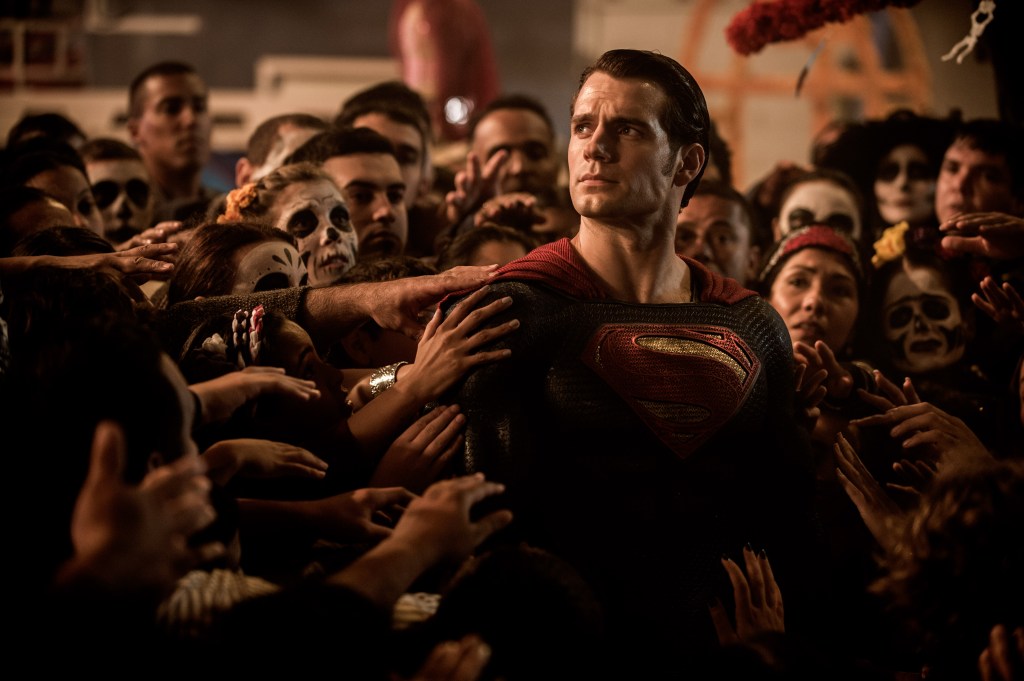
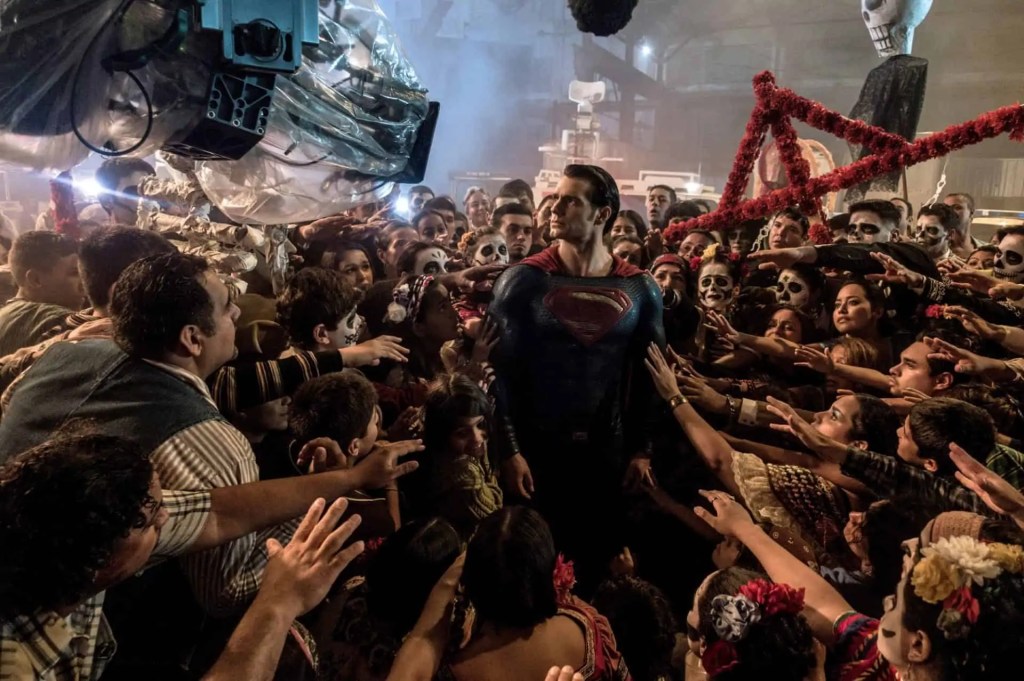
The crowd makes way for the Man of Steel, allowing him to pass through with his grateful cargo. The camera tracks him, moving back as he walks before turning right to follow his path, smiling warmly when he spots Carmen’s mother (Aida Munoz). She falls to her knees in tears, arms outstretched to the angelic deliverance while the camera ascends above the scene. Superman kneels too, disappearing into the mess of people to deliver the girl into the arms of her mother. The crowd, faces painted like skulls in accordance with the celebration, closes in. They reach for Superman, just to touch him.
When he rises again, Superman turns to digest the surrounding veneration. Now we move in on a medium high-angle shot, focusing on his face to see he is not entirely comfortable with this as he looks over his shoulder. Buried in skulls, this is a likely thematic callback to the Man of Steel dream sequence in which Superman sinks into an ocean of skulls. Here, the comparison likely represents death following Superman, haunted by the consequences of that fateful day that changed the world.
Superman Theme B overtakes Theme A with a more uplifting and heroic tone, rising triumphantly as Superman ascends into the embrace of the crowd.
When they had crossed over, they landed at Gennesaret. And when the men of that place recognized Jesus, they sent word to all the surrounding country. People brought all their sick to him and begged him to let the sick just touch the edge of his cloak, and all who touched it were healed.
Matthew 14:34-36

“We, as a population on this planet, have been looking for a saviour. Ninety percent of people believe in a higher power and every religion believes in some sort of messianic figure,” says Vikram Gandhi, as Superman looks up. A real documentary filmmaker, Gandhi is making a cameo here as himself. His words fit with the religious imagery of people reaching out to touch Superman like a religious figure akin to Christ.
Indeed, all he wants to do is help people, as expected of Superman. Beyond the Superman statue, this is also our first look at just how much he is revered and even downright worshipped, rather than simply hated and feared, and he certainly does not want this either. This sequence (all one big shot) does not occur during the Mexican Day of the Dead celebration for no reason. It is also a reference to the dream sequence from Man of Steel where he sinks into an ocean of skulls, with Clark dragged down by the victims of the day of Black Zero, which Snyder confirmed on Vero. Now, however, he is rising from the skulls. Also, it could very well symbolise death reaching for him, foreshadowing his imminent demise.
We cut to a medium shot of Gandhi now, being interviewed on the fictional “In the Moment”. He continues, “And when this saviour character actually comes to Earth–“ His credentials on screen read…
VIKRAM GANDHI
Documentary Filmmaker
THE SUPERMAN QUESTION
#AlienAmongUs/www.inthemoment.net


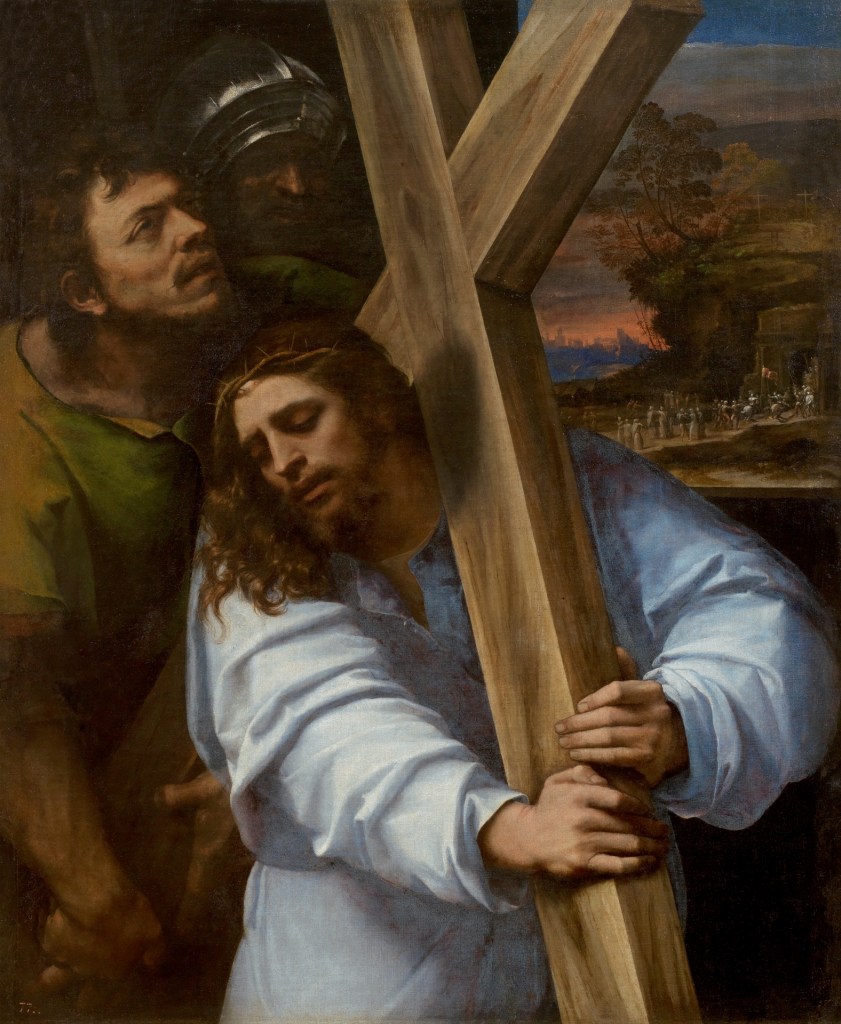
High-angle shot on Superman’s boots trudging through snow. As the camera aims upward, pulling back to a full shot, we see he is dragging a huge capsized ship across the Arctic, pulling it over his shoulder by the huge anchor chain. The crew are gathered on the side of the capsized vessel. Exactly as Snyder intended, it looks like something out of ancient mythology, grand and biblical in scale. The sun is on the horizon and the Northern Lights dance in the sky. This might be a reference to Christ carrying the Cross considering his pose and gait.
Superman Theme B shifts into a more solemn variation of Superman Theme C now on low strings.
Ghandi says, “–we want to make him abide by our rules? We have to understand that this is a paradigm shift. We have to start thinking beyond politics.”

“Are there any moral constraints on this person? We have international law,” says Andrew Sullivan, a conservative political commentator making a cameo as himself. Then we cut to a medium shot of him, where he is being interviewed on GBS. Firmly, Sullivan says, “On this Earth, every act is a political act.” Indeed, with someone like Superman, unconstrained by any human authority, his every action can be considered political in the sense that he casually performs actions of immense political significance. His very existence is a political question.
Stock market statistics are on the right, including a 0.61% increase dubbed, “New 52 week highs,” a reference to the 52 new titles rebooted in the post-Flashpoint DC comics continuity in 2011. Below that is company stock, and where LexCorp’s stock is going up, Wayne Enterprises stock is going down, very obviously symbolic of Lex’s growing power and Batman’s moral fall, further adding to the “fall” theme of the movie.


Back to the Arctic shot, Superman still dragging the vessel. Next we hear, “Is it really surprising that the most powerful man in the world should be a figure of controversy?” asks Charlie Rose on PBS as we cut to a of him over Senator June Finch’s shoulder. Rose is a real journalist who plays himself in this movie. His mentioning of Superman’s power is especially fitting with the imagery of him dragging a ship across the Arctic.
Medium shot on Finch, who responds, “To have an individual engaging in these state-level interventions should give us all pause.” This follows perfectly from Sullivan’s words, further carrying the theme of Superman’s political power to perform actions with tremendous ramifications.


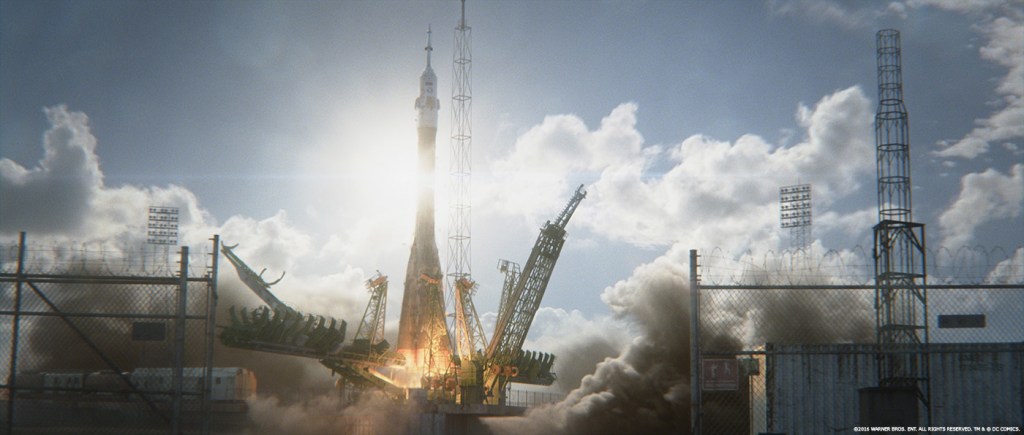
As she says this, we cut to a wide shot of a Russian Soyuz space rocket, silhouetted by the sun as it launches. Then it suddenly explodes in a huge fireball, the debris raining down around the launchpad.
“Human beings have a horrible track record of following people with great power down paths that led to huge human atrocities,” says Glen Woodburn (Chad Krowchuk), reprising his small role from Man of Steel. Starting from a mere conspiracy blogger, it is clear that Woodburn has moved up a great deal since publishing Lois’ article about pre-public Kal-El. Cut to him as he says this, interviewed on the fictional news channel Metropolis News 8, which was also previously seen in Man of Steel. Woodburn is titled an “International Blogger”.
Back at the launchpad, Superman emerges from the inferno, carrying the crew module held above his head. He gently descends to the ground into a kneeling position to account for inertia, still holding the damaged vehicle up with his arms like a figure of ancient mythology. This might also be a reference to the graphic novel Superman: The Coming of Atlas with the symbolism of the world on his shoulders. Not to mention, the logo on the hull of the capsule resembles a globe.
The camera moves in on Superman as he stands and steps forward, entering a low-angle shot. He extends his arms above him fully and grimaces with effort. Now Gandhi continues, “We have always created icons in our own image. What we’ve done is we project ourselves onto him. The fact is, maybe he’s not some sort of Devil or Jesus character. Maybe he’s just a guy trying to do the right thing.”
“Well, now, hang on a second. Isn’t it possible, just a little, that he’s not doing this for fame, he’s not doing it to be a celebrity, he’s just doing it because he thinks it’s the right thing to do?”
A talking head, Superman: Earth One #2, 2012
His words are absolutely accurate, as Superman is motivated by a simplistic desire to do good, and his heart is that of a mere man. This is the essential ingredient that defines the character both in the comics and especially in this film, that Superman can be any one of us. This also works as a counter to Andrew Sullivan’s words, where Sullivan tries to politicise Superman’s actions, whereas Gandhi recognises that politics is a non-factor to Superman over morality. Of course, this simple possibility is quickly put to the wayside as the scale of Superman’s existence takes centre stage. However, this line also tends to be oversimplified as the movie telling us what to think of the character, but the truth is more than that. One of the most important themes of this story is that people are complex, and Superman is no exception. Indeed, Superman is a guy trying to do the right thing, but he’s also a fundamentally Christ-like being, having been sent to Earth from his heavenly father to show humanity a better path. Despite this, he’s also imperfect and fully capable of making mistakes, as we’ll soon see.

“We’re talking about a being whose very existence challenges our own sense of priority in the universe,” says Neil deGrasse Tyson. Cut to a medium shot of him as he says this, sitting beside Vikram Gandhi on the same show. A well-known scientist and science communicator, Tyson is making a cameo here as himself.


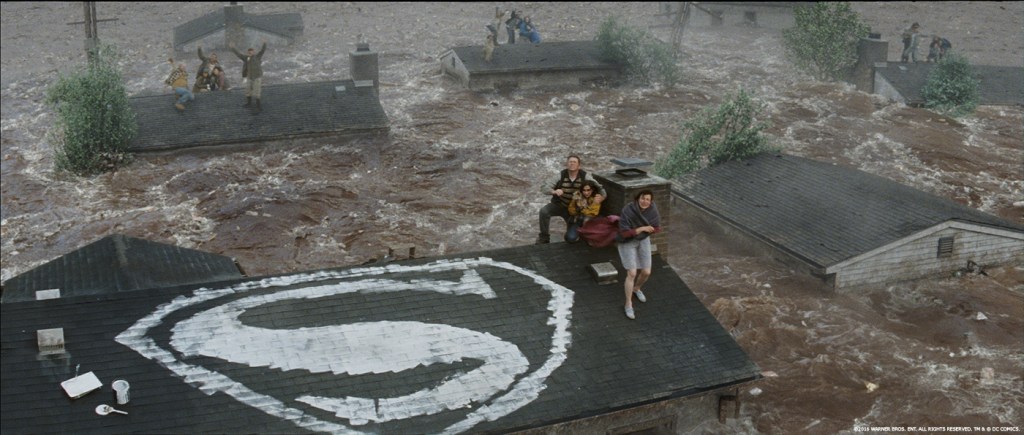
Cut to a high-angle shot on the victims of a serious Colorado flood. Muddy waters rush between the submerged neighbourhood, and the survivors on their roofs begin waving to the sky, trying to flag down help. One family of three has drawn Superman’s shield on their roof. The father (David Dailey Green), clinging to their daughter (Madison Autumn Mies) and dog, raises his hand to the sky as we approach them.
Tyson continues, “When you go back to Copernicus where he restored the Sun in the centre of the known universe, displacing Earth, and you get to Darwinian evolution and you find out we’re not special on this Earth; we’re just one among other lifeforms.” Medium shot of Tyson on In The Moment. “And now we learn that we’re not even special in the entire universe because there is Superman.” Back to the flood as Tyson finishes, “There he is. An alien among us. We’re not alone.”
Crying, the mother (Milica Govich) raises her hand. As we circle around her into a low-angle shot, the woman in the right foreground, we look up at the sight that has taken the attention of the survivors: Superman hovers above the destruction, silhouetted by the sun to create an especially heavenly and angelic effect. He looks out upon the needy people, here to answer their prayers. In that sense, the symbol drawn on the house was that family’s prayer. Note that we cannot see his face. This imagery is showing us how people see Superman, not as a person, but as a supernatural deity. It also makes him more mysterious in the eyes of the world, adding to the uncertainty they experience around his motives and trustworthiness.
Samuel Otten pointed out that floods are mentioned three times: the bathroom scene (“You’re going to flood the apartment!”), here, and when Jonathan relates the story of the horses he unintentionally drowned. If intentional, I am uncertain what the significance is, but considering the Biblical themes, it may be a reference to the flood that God set upon the world to wipe out most of humanity to let them start anew. The imagery in this scene is especially reminiscent of that. Considering that the future story involved Darkseid destroying the Earth before the dystopia is undone, this may be relevant to the overarching themes.


Charlie Rose goes on, “Are you, as a United States Senator, personally comfortable saying to a grieving parent, ‘Superman could have saved your child, but on principle, we did not want him to act’?” Superman’s arrival at the flood implies action, but juxtaposing this dialogue over that image subliminally suggests inaction, inviting the viewer to consider the notion of him withholding aid at the behest of laws or national boundaries.
Finch responds, “I’m not saying he shouldn’t act. I’m saying he shouldn’t act unilaterally.”
Low-angle shot of the television in the apartment Clark and Lois share, where we can see the interview being broadcast. Rose looks frustrated with Finch’s response and asks, “What are we talking about here, then? Must there be a Superman?” This is likely a reference to Superman #247 titled Must There Be A Superman? by Elliot S Maggin. In that story, Superman is faced with the question of whether or not his help might be doing some harm to the world. This question also ties into the climax of the film, as Superman defeats the monster that humanity’s most powerful weapon cannot. Therefore, yes, we will see that the world needs Superman, a sentiment repeated in Zack Snyder’s Justice League verbally.
Finch pauses before responding with only two simple but powerful words: “There is.”
Indeed, regardless of the way things should be, Superman exists, and that is the reality they must deal with. It is also the reality that we deal with on a regular basis, where things tend to be a certain way and we cannot change that. All we can do is deal with the consequences. However, recall Kahina’s earlier words: “To look him in his eye and ask him how he decides which lives count… and which ones do not.” Now, recall Clark’s echoing of these words: “Perry, when you assign a story, you’re making a choice about who matters and who’s worth it.” The thing about Superman is that he has to make these kinds of choices. At least, as long as he is Superman. The very idea of him demands that he make these kinds of hard choices in order to help people. Later, that weight becomes too much to bear and he relinquishes the cape under the assumption that the idea of Superman is not practical.
Medium shot on Clark watching the interview from the apartment couch. He shakes his head, looking troubled and frustrated. The music comes to an end. The editing here implies that these televised debates were all being watched by him all along, and now he is totally unable to ignore the controversy any longer. He has become fixated on how the world is responding to him. Also, very symbolically, we transition from images of this god-like and dehumanised being to a guy watching television in his apartment. The world only sees the otherworldly figure, but he really is just a good-natured guy at heart.
The music drops off and the soundtrack goes silent.

Wide shot of the Kent farm house at night. A single light comes on upstairs, and we hear Martha say, “Hello?”
Cut to the master bedroom where she is lying with the phone to her ear, the bedside lamp on as we very slowly move in on the scene. We hear Clark on the other end say, “Mum?” like a child looking for comfort, and also reminding the audience who he is talking to.
Sitting up in the bed, Martha asks, concerned, “Clark! What is it? What’s wrong?”


Clark stammers, “No, nothing. I just, uh…” Medium shot of Clark in the apartment, sitting by a window. He breathes. “Hi.” He simply wanted to hear her voice, a true mother’s boy.
Back to Martha. Realising her son needs her, she smiles with a soft laugh and responds, “Hi.”
Back to the apartment, slowly moving in on Clark now. After a few seconds, he asks, “How come Dad never left Kansas?” This is also setting up the mountain scene, where Jonathan’s words tell us that he is not just a memory, but a real apparition of some kind, since he never left the flat plain of Kansas yet speaks with the recognition of his mountain surroundings.
Back to Martha. “Well, he just… You know how he was. ‘What do I need to travel for?’” she says with a happy chuckle. “‘I’m already there!’”
Medium close-up on Clark now. He looks up. “I just wish it was more simple.”
Back to Martha. She cradles the phone, as if Clark were just an infant again. With a sigh, she says, “My baby boy. Nothing was ever simple.” Therein lies a major point of this film and of Clark’s struggle as Superman.


SCENE OVERVIEW
Next we see a montage of Superman’s immense and monumental feats to help and save others. At the same time, the talking heads in the media discuss Superman’s impact on society, his inherent political implications, what he means for the status of human civilisation, and what he should be expected to do, but one suggests the simple truth: “Superman is just a guy trying to do the right thing,” but this is lost in the sea of controversy and negativity. Now, the unwanted politicisation of his very existence is beginning to affect Clark, so he calls his mother for emotional support, humanising him in juxtaposition against his grandiose depiction seconds prior.
SCENE ANALYSIS
This entire sequence is littered with visual references to the graphic novel Superman: Peace on Earth (1998), illustrated by Alex Ross, who took note of the similarities. In the comic, we see Superman saving innocents from a burning building, helping flood victims on house roofs with a large chain over his shoulder, a female politician (presumably) being interviewed, and Clark sulking in his apartment. The woman bears a striking resemblance to June Finch, so the actress was likely chosen for that reason included. Jay Oliva said he wanted to mimic the feeling of an Alex Ross image, but there were no direct references intended, though it is clear that much of Peace on Earth leaked through. The idea for the Superman shield on the rooftop may be derived from The Death of Superman (1993), where a boy draws an “S” on the ground to get Superman’s attention.
“They clearly want us to be having these sorts of conversations, which of course are not merely fantasy but are a means for examining our own values. And by presenting it through a media montage, they are also inviting us to think about the role of news coverage in shaping our perceptions of powerful figures, and how the news is often not really news or analysis that brings clarity but is often a narrative that breeds controversy or fear.”
Samuel Otten, Comic and Screen, 7 June 2016
“This sequence here, I really wanted to use this imagery to tell the story that, the more Superman saves people — the more miraculous things he does — he doesn’t see himself as anything other than just trying to do the right thing… I did a lot of drawings of this stuff and those things are always all about Jesus with the cross, religious imagery we’re all familiar with. It’s in all our collective psyches, things we’ve seen throughout our lives. Even this Atlas, with this, ‘World on his shoulders,’ kind of imagery, combined with these Christ-like images, even in the context of, ‘I’m rescuing someone,’ you understand how the lines could get blurred. This guy floating up in the sky, how do you not rely on him to solve all our problems? And that’s not what he wants. That’s not his thing. He’s a kid from Kansas just trying to do the right thing and we look at him like this. We ask a lot of him.”
Zack Snyder, Batman v Superman: Dawn of Justice Watch Party, 29 March 2020
The sequence perfectly encapsulates Superman’s struggle throughout his arc. He’s not faced merely with a new supervillain, but the struggle to find peace in a world torn between worship and hate of him. He wishes things were simpler, but the very nature of Superman sparks controversy, and at this next stage in his long journey, he’s reached a point where he cannot continue to ignore the growing issue.
This is Superman’s second appearance in costume in the film, excluding the Black Zero scene, where we barely see him. In both these scenes, Superman is saving people. This scene establishes a sense that he is part of the world now, as mentioned by Finch at the end. He has become as much a part of life as politics itself, and here we see him helping people around the world as a matter of course, but a matter that incites argument nonetheless. Harkening back to Watchmen, like Doctor Manhattan and his allegory for nuclear power, Superman impacts the world just by being there. In accordance with Superman tradition, we see how the character has developed into a symbol of hope for people. They paint his mark on their rooftops to signal for his help like a prayer, or they reach out to touch him like a Biblical figure in the flesh, but these things are presented differently than usual.
Normally, a montage like this in a Superman film would be used to celebrate and glorify the character through his fun and enjoyable acts of effortless altruism. In Batman v Superman, such a scene instead subverts the traditional formula as part of the deconstruction. There is no joyous fanfare, but rather a melancholy score as Snyder explores the realistic consequences of Superman’s existence in our worlds. People worship this seemingly divine being like deity, while others fear him, or at least feel uneasy at having lost our anthropocentrism, essentially replacing humanity at the top of the food chain. Superman’s other-worldly feats are framed as almost terrifying, more like Biblical prophecy manifest than a brush with a magic celebrity flashing his pearly whites. Superman is a divine figure, whether he likes it or not. This is what would happen if Superman were real, a theme that Man of Steel didn’t have much time to explore outside of its effect on the character himself. As such, this excellent scene concisely articulates the deconstruction of Superman taking place in this film.
It’s also especially interesting how the pro and anti-Superman camps have become so political by this point. Similarly to real life, politics and controversy surround the very question of how to do good. In that sense, the film is also discussing us, and how we make such an issue around questions of morality. Clark cannot simply be Superman. He means different things to different people, projecting their personal views onto him, as especially evident from criticism of the movie. The controversy in this scene that accompanies Superman’s mammoth acts also distinguishes him from a guy who wants to do the right thing, and makes him out to be more of a faceless force of nature who lacks agency and emotions of his own. As Andrew Sullivan says, “On this Earth, every act is a political act,” which contrasts Vikram Gandhi’s take that we “project ourselves onto him” and is simply “just a guy trying to do the right thing,” which the movies frames as closer to the truth of who Superman is. Unfortunately for Gandhi — and Clark — who Superman is cannot be removed from what he is.
Superman himself phoning his mother when he feels down sends a powerful message: It’s okay to talk to your parents. You don’t need to convey strength in perpetuity. One’s parents are there to support their child, and reaching out for help is no shame. Without question, Martha knows exactly what Clark needs, and is happy to lend him her time, even during the middle of the night. This shows not only the unwavering goodness of Martha and her ideal parental spirit, but also Clark’s own childlike innocence in calling her. This profound humanity is juxtaposed against the previous montage to contrast Superman as humanity sees him against the kind of person he really is.
The scene denotes a time jump. These various events are clearly taking place over at least several days. The last time we saw Bruce Wayne was during the previous scene, Metropolis Library Fundraiser, where Diana steals his drive of stolen data, and the next time we see him is during Museum Gala, where he has tracked her down. This scene conveys a sense of time having passed before Bruce finally catches up to her.
This final sequence where Clark speaks to his mother over the phone might be inspired by a scene from Superman: Earth One (2010), where Clark also calls Martha for a heartfelt discussion.
The music track in this scene is “Day of the Dead” (“Must There Be A Superman” in the released score).
BEHIND THE SCENE
“Yeah, we did a little bit of a search. Neil deGrasse was, I think, on the top of my list as like a voice of reason, and then the rest of them we just kind of played with who… It was more of a process. It was fun to do. We kind of had that laid out and they just riffed, played a lot. Those lines were in there, but they worked around it. It was cool to see because those guys are super smart and, given the intellectual exercise of riffing on the theme, like that, you can imagine they could do it. It wasn’t hard, especially knowing that it’s all about this debate, whether it’s okay, whether the existence of Superman is a good thing. Must there be a Superman? There is.”
Zack Snyder, Full Circle, Batman v Superman: Dawn of Justice commentary, 29 April 2023
“Zack had a very specific idea for these four long and distinct shots of Superman saving people on a global scale to be woven into a montage of broadcasters debating what it means for the world to have someone like this a part of it. The genesis of each of the vignettes started (as it does with all shots on his films) with a series of storyboards drawn by Zack himself. To refine the ideas art director Jelmer Boskma created a series of illustrations to help define mood, lighting and some of the more specific details of the individual scenes. Being able to go back and forth with Zack in this manner allowed us to narrow our focus as we moved into actual shot production.”
Bryan Hirota, Art of VFX, 11 April 2016
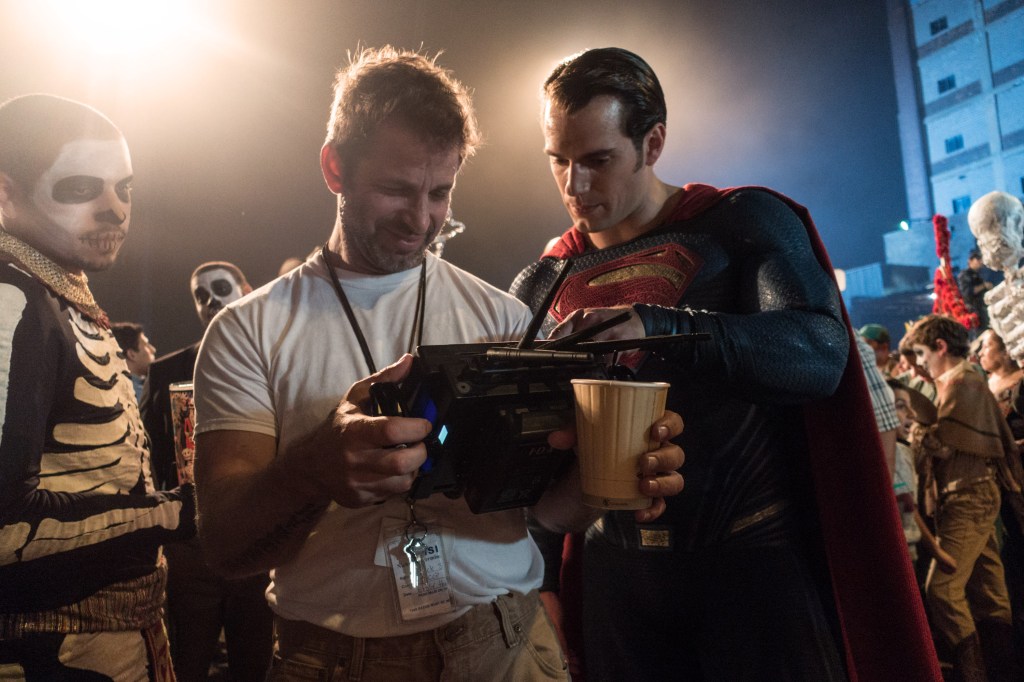
Based on set photos, the Day of the Dead sequence was shot at the Russell Industrial Centre, 1600 Clay Street, Detroit, the same place where Superman’s first confrontation with Batman was filmed after the Batmobile chase. The location was likely scouted on 19 July 2014 based on this photo by key second assistant director Misha Bukowski. The location was closed from the 2nd to the 18th of September for the duration of filming. On the 7th, a notice was posted warning locals that shooting for Sage & Milo would occur on the 9th to the 12th. Base camp was nearby at 2611 Chrysler Drive. According to podcast host Jeff Dwoskin, his daughter is among the extras in this sequence.
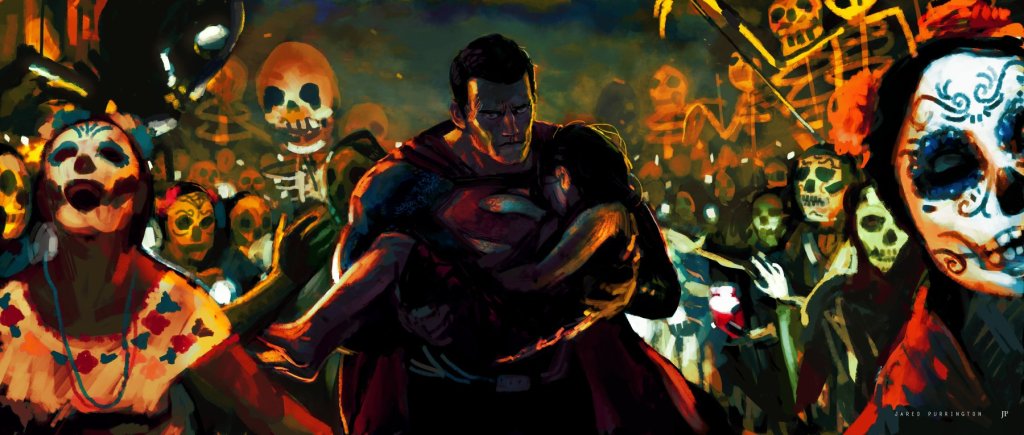

“The Mexican factory was improvised a bit from our original intention. The night we were going to shoot it the weather was not cooperating and we were unable to raise the planned green screen and lift Henry and the girl on the wire rig. Ultimately we needed to rely upon digital versions of both of them and similar to the Soyuz vignette do a handover upon landing. Our FX team collapsed the building and provided us with fire, embers, and pyroclastic smoke elements that we combined with some live action elements.”
Bryan Hirota, Art of VFX, 11 April 2016
Deleted Footage
Zack Snyder discussed deleted footage wherein Superman’s intervention in the fire motivated the factory owners to relax their safety precautions…
“There’s a fun conversation — we filmed it, it’s not in the cut — but there’s a conversation when [Superman] saves the girl from the garment factory, we had a line where a guy goes, but now all the garment factory owners, they’re not concerned with safety because they just figure Superman will show up to save them if the building catches on fire. It’s sort of a catch-22 to being the Ex Machina, being the hand of God: the hand of God can’t be everywhere the same time. You’re headed for a fall.”
Zack Snyder, Wall Street Journal, 21 March 2016
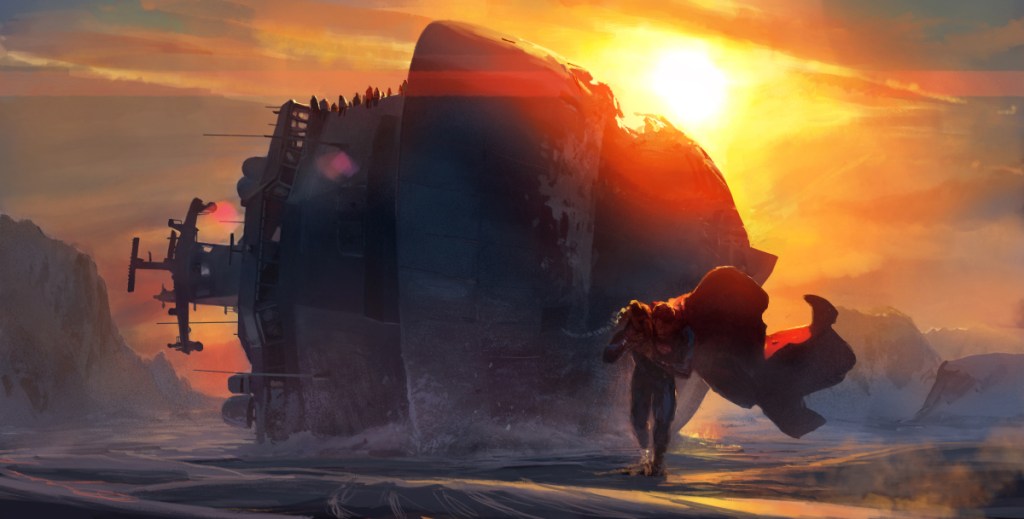
Superman pulling the ship across the Arctic was shot on a green screen soundstage at the late Michigan Motion Picture Studios along Centerpoint Parkway, Pontiac, Michigan. Everything, except for Henry Cavill (minus the cape) is CGI.
“For the arctic vignette Henry was photographed holding a proxy chain and pulling against resistance on a green screen stage. We replaced the chain in his hands with a digital one that led back to a damaged Ice Breaker being pulled on it’s side. We created a large ice field that would break and accumulate chunks on the leading edge of the ship as it was pulled forward. Additional simulations were run for the blowing snow and compressed snow under his feet.”
Bryan Hirota, Art of VFX, 11 April 2016
Art of VFX, 11 April 2016
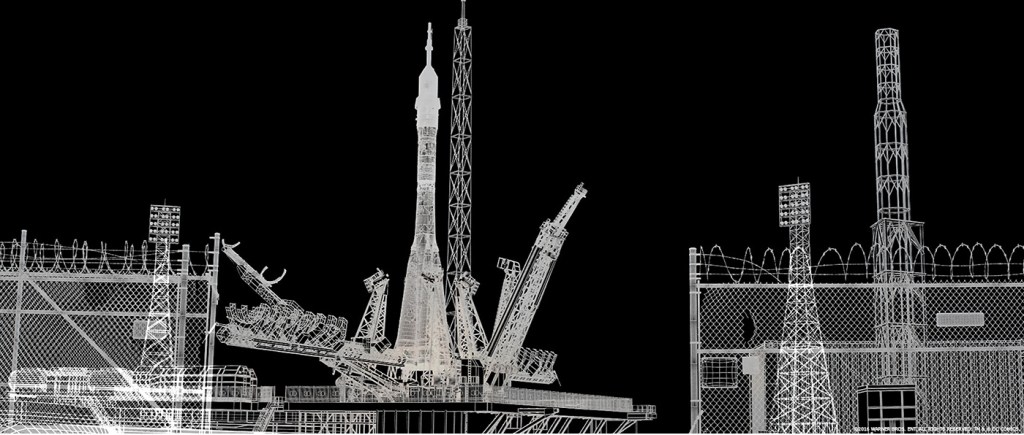
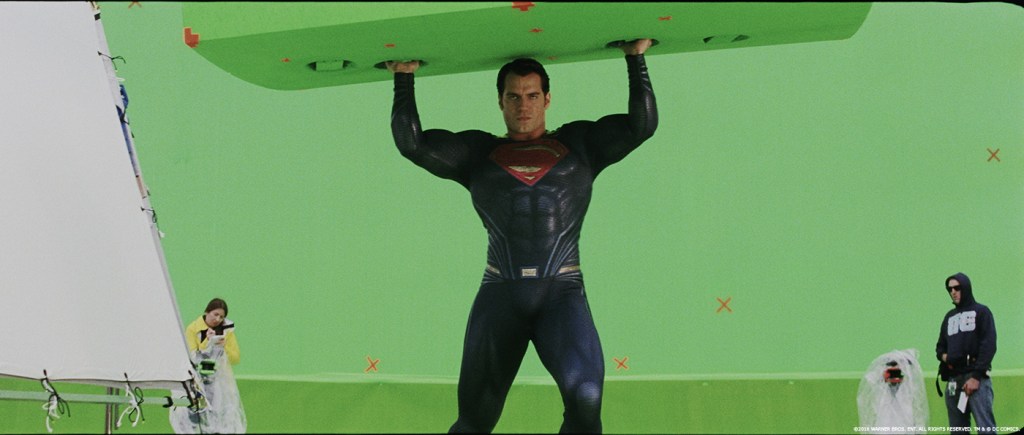
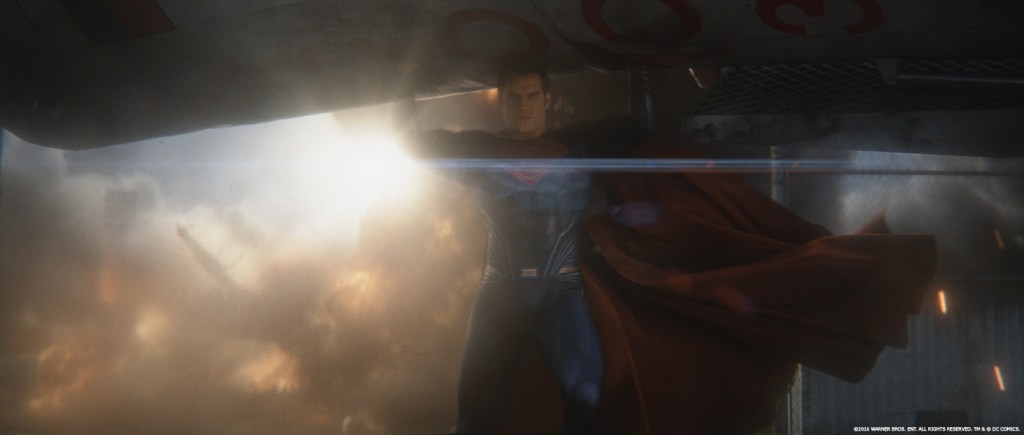
Superman saving the rocket module was shot on a green screen soundstage at the late Michigan Motion Picture Studios along Centerpoint Parkway, Pontiac, Michigan. Once again, everything except for Henry Cavill (minus the cape) is CGI. Cavill held a large green object above his head to struggle against.
“For the failed Soyuz launch, Henry was photographed holding up a weighted buck up over his head and completed the action of landing and hoisting it. We built a digital Balkinour Cosmodrome and combined both simulations for the launch and ultimate failure with a mix of photographic pyro elements. As Superman flies forwards and lands we switch over from our digital character to the plate of Henry.”
Bryan Hirota, Art of VFX, 11 April 2016
Art of VFX, 11 April 2016
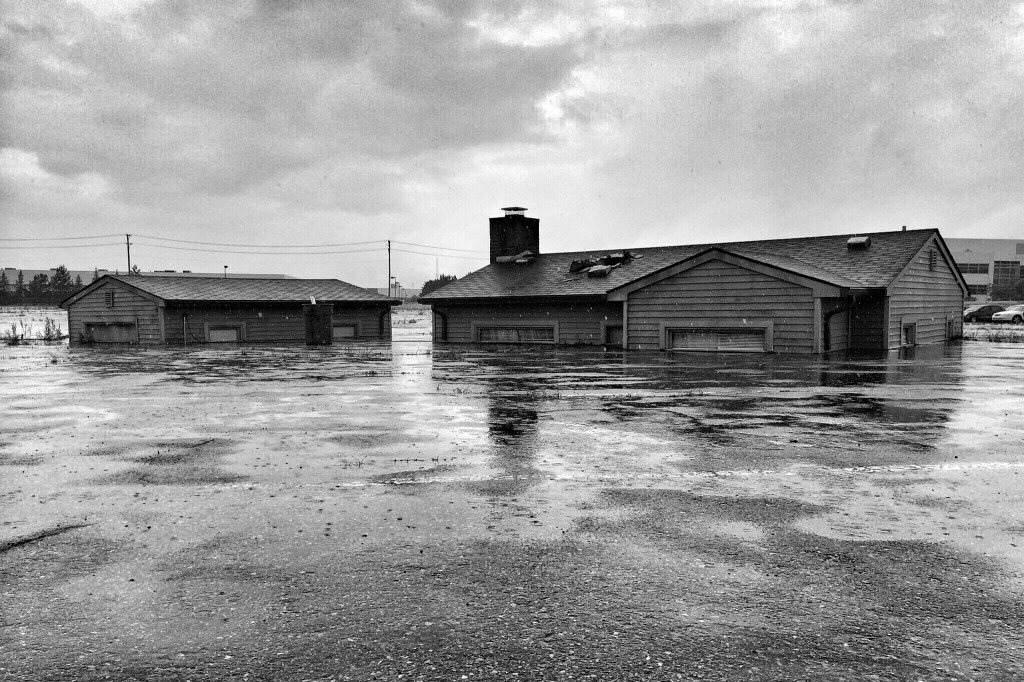
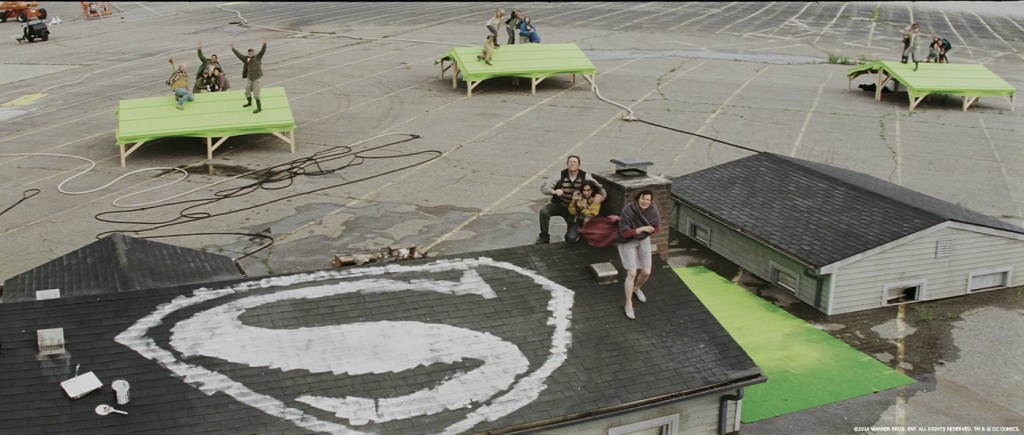
The flood sequence was shot at the late Michigan Motion Picture Studios along Centerpoint Parkway, Pontiac, Michigan, where half-sunk houses were constructed on the lot. The ground beneath was digitally transformed into rushing flood water. Bananadoc got a photo of the sunken houses, and Dan Newman explored the site to get footage. The sequence was presumably shot in late June 2014.
“The Colorado vignette that was photographed in the backlot of the studio in Michigan with rooftop sets on asphalt. In post we used our flowline software to simulate the river and debris going around the houses. We extended the environment with added extra houses, trees and distant mountain ranges. We ended up replacing the sky to give it a bit more visual interest and as we turn around we added in Superman.”
Bryan Hirota, Art of VFX, 11 April 2016
“Fun fact: it was a very cloudy day so we put a huge light up on a crane. It not only gave us a ’sun‘, but something to look at so all the actors would have the same eyeline.”
Larry Fong, Twitter, 13 July 2020
“Fun fact: it was an overcast day, but we got the tallest crane possible and put the brightest light available on it. That way we got the flare, the backlight, and an eyeline for the actor!”
Larry Fong, Twitter, 12 December 2025
Lois and Clark’s loft was a set likely constructed at the late Michigan Motion Picture Studios along Centerpoint Parkway, Pontiac, Michigan. The sequences here were shot in June or July 2014 when the crew were filming in Pontiac. Art director Lorin Flemming designed the apartment, and you can find detailed photos of the set and conceptualisation at her website.
The Kent Farm was shot at 5498 Schoolhouse Road, Yorkville, Illinois. The house was constructed for Man of Steel and then demolished after principal photography. In late October 2013, lights were spotted at the location, and on 26 November, the Yorkville Patch confirmed the farm was being reconstructed for the film’s sequel. There are progress photos for November and December 2013, and Heather Westmoreland photographed the finished house. Chicago Tribune reported that filming in Illinois would begin in fall, and Reel Chicago confirmed “winter scenes” would be shot in November for “one to two weeks.” Base camp was set up at the Whitetail Ridge Golf Club during filming. At the time, one resident claimed she was unable to reach her local polling place to cast her vote on election day due to road closures for filming. While there, set photographer Clay Enos photographed this atmospheric tree, set costumer Kate Abraham photographed the farm, and Larry Fong recorded Snyder throwing corn at his camera. By 4 October 2016, the house was sadly demolished yet again, presumably after filming at the site for Justice League.
Snyder confirmed in the director’s commentary (55:54) that the interior in Martha’s bedroom was actually shot on a soundstage at the late Michigan Motion Picture Studios along Centerpoint Parkway, Pontiac, Michigan, very early in production. Diane Lane really called Henry Cavill to do the scene.
Deleted Dialogue: As heard in the teaser trailer and the Comic-Con trailer, June Finch has the lines, “Power corrupts, and absolute power corrupts absolutely,” and, “That kind of power is very dangerous.” Presumably, they were somewhere around here or in Finch’s speech announcing the Capitol hearing.
 Snyderverse Analysis
