BATMAN V SUPERMAN: DAWN OF JUSTICE
FALSE GOD


Cut to some eggs frying in a saucepan. Clark, shirtless, is keeping them from sticking to the pan. His hair is an unkempt mess, having just got out of bed. Despite his incredible god-like powers, Clark cooks his breakfast like anyone else.
Carried on from the previous scene, we hear Kahina Ziri saying, “Because the time has come for the world to hear the other side of the story.”
Clark looks away from the eggs and does a double take at the television up on the wall.
Kahina is being interviewed outside her apartment, which we will see again soon. She continues, “They say that Superman is a hero. Okay, but whose hero?” This line of thought was first established by General Amajagh earlier when he called himself as a man loved by his people while others called him a terrorist.
The television is attached to the brick wall above a workshop of tools and Clark’s bike, indicating Clark still cycles to his workplace. Clark turns from his humble breakfast and gives her his full attention.
The interviewer asks, “If Superman were here right now, what would you want to say to him?”


Clark watches, listening intently for Kahina’s answer.
Tearing up, she responds, “That my family, too, had dreams. To look him in his eyes and ask him how he decides… which lives count… and which ones do not.” This question carries for Clark throughout the film. The very nature of Superman forces him to confront questions about the moral responsibility on his shoulders, which motivates the core of his arc.
Krypton Motif, steadily growing.
As evident from his reaction, Kahina’s words have had an effect on Clark, and he looks down in thought, finally recognising the consequences of his actions. When last we saw him, he was ignoring these issues, but now the subject is following him, and is finally beginning to claim his attention. This also reinforces that, although he does not want to believe his actions have negative consequences, he does care.
But most important about this sequence is what it means for Superman throughout his entire fictional history. Every second that he isn’t spending saving lives is a second he’s choosing to let people die. If he were a god internally as much as he is one externally, he would spend every waking moment of his life saving people. But because he’s ultimately just a man who happens to have god-like abilities, he can’t do everything. If he tried, he’d simply break down. In this scene, he’s confronted with the sad truth that he’s constantly choosing who lives and who dies. From this moment on, he endeavours to change that, and never experiences a moment’s peace for the rest of the movie because of it. He gets no moments of true joy like he does in Bathtub Love because he’s devoted himself completely to taking his mission dead seriously.


Following from Kahina’s words, we make a thematically relevant cut. We slowly slide right to get a good look across a wall of newspaper clippings, primarily regarding Superman’s accomplishments and feats. Cinematographer Larry Fong (who is also a magician) hides his favourite card, a three of spades, in at least one shot of his films, which can be seen here partially obscured behind a clipping. Here are some of the headlines…
SUPERMAN PREVENTS MISSILE STRIKE!
HEROIC SUPERMAN RESCUE
BRUCE WAYNE RESCUES EMPLOYEES – MAN PULLED FROM RUBBLE BY CEO: Bruce’s heroic acts during Black Zero did not go unnoticed.
LOCAL TRAGEDY NARROWLY ESCAPED – SUPERMAN SAVES ALL THE CHILDREN ON BUS IN RAPIDS
SUPERMAN SAVES STARVING HOMELESS MAN CAMPING IN FOREST: Nothing is beneath Superman.
SUPERMAN FOILS CRIME – CRIMINALS FLEE THE SCENE
SUPERMAN RESCUES VICTIMS AT BUILDING EXPLOSION
SUPERMAN SHIFTS TECTONIC PLATES – PREVENTS DEVASTATING EARTHQUAKE: A reference to Superman saving California in Superman (1978).
A MANUFACTURED SUPERGERM THAT COULD END HUMANITY WAS HALTED FROM RELEASE BY THE MAN THEY CALL SUPERMAN
An uneasy rendition of Superman Theme A plays, once again twisting the character negatively.
Cut to a man’s hands, using a knife to cut a cable. Then he stretches out some duct tape.
We see his form silhouetted in front of the wall of clippings as he stretches the tape further, visually establishing this wall as his creation.
He cuts the tape free with his teeth and assembles something with it. Snyder confirmed in the director’s commentary (34:19) that the goal was a subtle misdirect that Wallace was building a bomb, but despite his rage, he is not that radical. Ironically, he will eventually be set up as a suicide bomber regardless.
He removes the photo of his family from the clippings. In its place on the wall, we see some artwork resembling the classic comic book cover of Action Comics #1 (1938), depicting Superman holding a car above his head and smashing it against a cliff.
Cut straight to the photo depicting Wallace Keefe, happy, with his wife and daughter. But when Wallace lays the photo down, we see the flowers laid below. The location has changed with the seamless cut to the photograph. Wallace, looking sad, turn to look up with pure scorn on his face.
An ominous variation of Superman Theme B plays on low brass and strings, gradually becoming louder and more dramatic.
Cut back to see the circle of black marble surrounding the area, strewn with flowers and photos to those who died during Black Zero. Placing the photo of Wallace’s family here implies they were killed on that day, yet we learn the truth later. We also see now that he is wheelchair-bound, both his legs having been amputated since his injury. He rolls his wheelchair around.


Wide shot circling around the monument of Heroes Park, a plaza built on ground zero of Zod’s attack on Metropolis. A semicircle of shiny black tablets engraved with the names of the victims of the disaster surrounds a statue of Superman. Among the names on the tablets are some of the crew who worked on Man of Steel and Batman v Superman. The statue may reference Perry White’s pose in Man of Steel when he held Jenny Jurwich’s hand as a symbol of common folk heroism, or the iconic cover of Superman #1 (1939). Snyder confirmed it at least references the Spirit of Detroit monument, especially since much of the film was shot in Detroit. Engraved on the ground around the statue are the words, “We remember the lost. We honour the heroes.”
Low-angle shoulder shot from Wallace, wheeling around to look up at the lowered right hand of the Superman statue — seemingly an offer of help from a being so much greater than he is. Wallace removes his coat to reveal the pouches around his waist. He primes himself.
Purely off the strength of his arms, he suddenly propels himself off the wheelchair and latches onto the monument’s fingers, climbing up, and possibly symbolic of how Superman’s attempts to help are being punished. This demonstration of Wallace’s own upper body strength says a lot about his determination to do this.
A nearby police officer (Sammy A Publes) turns away from the tourist he is speaking to, focusing on Wallace. “Sir, get down,” he orders.
Shoulder shot from the officer and the tourist to see Wallace reaching Superman’s chest.
The officer repeats, “Sir, I said get down! Now!”
Wallace removes the cap from his spray can and throws it at the officer. He and the nearby citizens move aside to avoid it. The people gasp.
As Wallace shakes the spray can, we hear another officer (Jay R Adams) say into his radio, “Can we get some backup here?”
Then Wallace raises the can, preparing to spray the statue.
The officer yells, “Hey! Hey! Don’t do it! Hey!”
Cut to the stone on Superman’s chest, where Wallace sprays a line of vivid, dripping red paint.
Then the music ends abruptly.


Cut to the Daily Planet, looking down the aisle of office cubicles. Jenny Jurwich (Rebecca Buller) is holding the phone to yell down the aisle in our direction, reprising her role from Man of Steel. “Lois! Crime lab, on three.” On the upper left frame is an office cubicle marked “Liz Ritenour, Photo Editor”, a reference to the film’s art department assistant / model maker.
Lois rolls into view from the left on her chair, phone to ear, and says, “This is Lane.” This is setting up her current investigation into the bullet from Nairomi, which has not yet been revealed. Lois has been communing with her contacts in the crime lab to analyse it, as she reveals later. Before cutting, we rack focus to see Clark at his desk in the background, peering over his shoulder at Lois to indicate his interest.


“Kent,” we hear Perry say, and we cut to him strutting around Clark’s desk, pointing at Clark working in his seat. Behind Perry on the wall are three screens showing Dave Pasch and Tom Luginbill again on their sports show, a news report on the Heroes Park vandalism setting up its introduction in a few seconds, and a football match. “You’re sports today. I want you to go to Gotham, follow up on football.” Normally, writers for a newspaper are dedicated to specific topics, but we see later evidence that the current sports writer is unavailable, and assigning Clark suggests the Planet is understaffed under financial troubles also implied later. Clark is a good choice, as his watching a football game in Man of Steel implies an interest in sports, not dissimilar from his comic book counterpart.
Looking up at Perry and listening intently, Clark immediately starts taking notes.
Perry gestures the headline, “‘Underdog Dreams Dashed: Ten Yards Between Gotham And Glory.’ Oh, um, watch yourself over there in Gotham. Don’t let them take your lunch money.” Perry is making fun of Clark by comparing him to a school boy nerd, vulnerable to getting bullied, in turn positioning Gotham as a city of bullies.
Clark looks a little confused for a moment before shaking his head and continuing to take notes.
“Hey,” says Jenny, “are you guys watching this?” With a remote, she turns up the volume on one of the screens lining the walls.


Among the many screens lining the walls, one shows Metropolis News 8 with the headline, “REPORT: HEROES PARK HATE CRIME”. A reporter is addressing the camera, a cameo by real radio host and Superman fan Jay Towers (seen here with Zack Snyder). The Superman statue in in background, currently being cleaned. Painted in red over the logo on the chest are the words “FALSE GOD”. The words are written over the literal symbol of hope on Krypton, with which one could interpret Keefe’s act of vandalism as a symbolic act of despair or the condemnation of optimism and hope in favour of hatred, cynicism, and nihilism. The words “False god” also tie into the perception of Superman as a god or perceived god by those who hate him, namely Lex and Bruce. Wallace is among these three antagonistic forces in Superman’s life who despise him for what he does not claim to be.
Uneasy string melody.
The reporter is saying, “Emergency responders quickly created a precautionary perimeter around Heroes Park while they brought the man down from this beloved monument.” We see Keefe being carried inside a police car as Towers continues, “The suspect has been identified as Wallace Vernon Keefe.”
Keefe screams at the camera, “I work(ed) for Bruce Wayne! I work(ed) for Bruce Wayne!”
Possibly Deleted Dialogue
According to The Art of the Film, Keefe may have been cut off in editing, and the end of his quote was, “I was a person!”
Wide shot of the office from Lois’ shoulders. Everyone, including her, is turning to face the television.
On the screen, the camera closes on the “FALSE GOD” vandalism on the statue’s chest as Towers continues, “He’ll be arraigned on charges of vandalism, resisting arrest, and a felony charge of making terrorist threats. That carries up to 40 years in prison. Metropolis News 8.”
Subtle Krypton Motif, connecting this fear and anger at Superman to the larger idea of beings of higher power (further discussed later in the film).
Clark, watching, looks disturbed. Of course, this message concerns him in a way those around him cannot understand.
“Poor son of a bitch,” says Perry, quietly. Louder, he says, “Jenny.”
Jenny turns to him.
He says to her, “Headline: ‘End of Love Affair with Man in the Sky,’ question mark.” The fact he needed to say “question mark” instead of simply posing the headline as a question might be a subtle indicator of the growing state of things, rather than a possibility, by hesitating on the question. This line also reinforces that a positive perception of Superman has been the norm until now.
Lois looks frustrated to imply she hates seeing this being exploited, but such is the press.
After a few seconds, Jenny says, “Okay,” looking noticeably disturbed by what she has seen. She gives a slight shake of her head too, like she knows the headline is pure exaggeration for clickbait.


Lois looks over at Clark sympathetically, clearly wondering how this affects him.
Two subtle notes of Superman Theme A on slow timpani.
Clark turns away from the television, looking down in thought. After a few moments, he turns back to his computer. We can later infer that this is what spurs Clark to exploit his assignment in Gotham to seek out and speak to Kahina. In one day, he has been exposed to anti-Superman sentiment twice.
Lois turns away, evidently feeling sorry for him, yet she is unable to comfort him in this environment. Recall her earlier words: “I just don’t know if it’s possible…for you to love me and be you.” Away from the privacy of their shared apartment, they cannot be themselves with each other.


Rear shot on Clark, ascending a staircase beneath a depressing overcast. Arriving on the upper deck of the ferry, he heads to the front railing. Two men can be seen kissing in the background, a normalisation of homosexuality that does not require focus. The ferry is leaving the pristine Metropolis skyline behind. Clark is smiling as he walks by us, and we follow him to the front railing where Gotham sits beneath a shroud of smog. On the right is Stryker’s Island, which will return again for the fight with Doomsday at the conclusion of the film. Close inspection will reveal the venting towers in which the Justice League will have their first battle with Steppenwolf.
A low synthesizer plays Batman Theme A repeatedly, joined by low strings playing the Bruce Wayne motif as Clark enters Batman’s world.
Instead of simply flying over to Gotham, Clark prefers to take a ferry ride. In that sense, he is Clark Kent first and Superman when he needs to be. He lives among us, and his human persona allows him to take part in that. He is comfortable living normally, yet another example of Clark’s humanity and the gargantuan contrast between him and how people see his public persona. He simply does not even think to use his powers to make life easier for himself.
Deleted Footage
An extended sequence of Clark walking through the Lake Express passenger ferry was filmed and cut.
“This was an incredibly hilarious long take of Clark walking through the entire ferry, but then we just ended up using the end of it.”
Zack Snyder, Batman v Superman: Dawn of Justice Watch Party, 29 March 2020

With the hiss of a bus exhaust brake, we cut to a residential street in Gotham outside an apartment complex, an unusual deviation from Clark’s assignment that will soon be explained. The bus moves along to reveal that Clark has stepped off to enter the premises. The camera ascends with this shot to establish the location. In this shot, the back of the Masonic Temple can be seen in the left foreground, where the next scene in the underground fighting ring was filmed.
Continuing low strings.


Clark knocks on a black apartment door. He waits.
Then he notices, down the hall in the blurred foreground, is a woman (Satori Shakoor) hanging up laundry with her child (Issac Ryan Brown). The room is lit in warm orange.
Clark approaches, holding up a newspaper with a photograph of Kahina Ziri during the committee hearing, and he asks, “Is she in?” This reveals that, after seeing Kahina on television, Clark has come looking to speak with her personally, answering her wish to “look him in his eye and ask him how he decides which lives count and which ones do not,” possibly with the intention of revealing his secret identity to her. Also, note how Clark has to ask, instead of using his X-ray vision to look inside Kahina’s apartment, showing his respect for her privacy.
The woman responds, “No, she’s been gone.” Her child sitting nearby is playing with a doll or action figure with a cape, likely a figure of Superman.
“What’d she do, officer?” asks a male resident from down the other end of the hall. The man is played by musician Paul Miles, credited only as “Poet”. He has a YouTube channel and official website. The old man is sitting around the corner down the hall, bathed in a darker green-blue light to contrast the warmer light of the woman and her child at the opposite end.

Clark turns to him and approaches. “Oh, I’m not a cop. I’m a reporter,” he clarifies. He comes to a stop to address the man face-to-face, just being respectful of the rundown apartment’s tenants. “The young lady living here…” he asks with a thumb pointed down the hall.
“She hasn’t been back. In fact, if she’s smart, then she’s got out of this city.” Presumably his dog is lying on the floor in the open apartment behind him. “And you need to get out of here before dark. Unless you want to run into him.”
Clark is confused before we hear the woman snap, “Don’t listen to that nonsense,” firmly, and Clark turns to her. She approaches from down the hall. “Only people scared of him, people who got reason to be.” Of course, she is referring to Batman, and thus establishes him as a hero to some and a menace to others, a very recurrent theme by now.
“Scared of who?” asks Clark, turning back to the old man.
“Well, there’s a new kind of mean in him.” He is scratching a lottery ticket below, obscured by his moving hand. “He is angry, and he’s hunting.” He holds up the ticket, where he has scratched the Batman symbol. Now Clark is finally introduced to the Batman at roughly the 37:47 mark.
Then the music ends with a percussive growl.

SCENE OVERVIEW
At the Daily Planet, we are reintroduced to Perry White and Jenny Jurwich, and we see where Lois and Clark now work. We also see what the world thinks of Superman overall with his enormous statue at ground zero. Wallace Keefe defaces it, leading to his arrest, his first appearance in nearly two years, in which time his life and marriage have fallen apart and he blames Superman. After seeing this public message and Kahina’s tearful testimony through the influential media lens, Clark has witnessed the first signs of anti-Superman sentiment and finally decided to investigate it for himself. Given a new assignment in Gotham, he uses the chance to pursue Kahina in one of Gotham’s impoverished neighbourhoods, only to instead discover the Batman whose vigilante crusade produces mixed feelings in the Gotham populace.
SCENE ANALYSIS
In one scene, Clark is introduced to his existential in the form of Lex’s machinations, the media, anti-Superman sentiment, and finally the Batman. This is the launchpad for his conscious involvement in his arc, and this is where his struggle begins. The scene has the following structure:
- It starts in Clark’s apartment, where he is exposed to his first taste of manufactured anti-Superman sentiment from Kahina Ziri on television.
- Following from this, we cut to Wallace Keefe’s apartment, showing us the character’s obsession and hinting his motivations as the scene cuts to Heroes Park, where he vandalises the Superman monument.
- We then cut to the Daily Planet where Perry gives Clark an assignment in Gotham, at which point Clark learns of Wallace for the first time from the television.
- Heading to Gotham, he ignores his assignment to instead go looking for Kahina Ziri, only to discover the Batman that stalks the streets of the city’s poorer districts.
Though this scene is Clark’s official introduction to the Batman, it doesn’t actually indicate he has never heard of him until now. Clark has been working in Metropolis for roughly two years and his focus has been on keeping his ear to the ground in search of people in need of Superman’s help. Crime has rarely been Superman’s concern until now, and Batman is only local news, so it’s unlikely that Clark would have cared to research Batman in that time. Plus, as we soon learn, Batman is old news. Nobody in Metropolis has cared for years.
Note that the tenants of the dingy Gotham apartment — the mother, her son, the old man, and Kahina Ziri — are all black. Gotham too has impoverished neighbourhoods in which ethnic minorities are relegated. While some of these residents appreciate the Batman, the fact that some are scared of him, like a bogeyman who comes out at night, shows the effect Batman has on these neighbourhoods, made all the more viscerally discomforting by its realism.

The lighting and colours of this scene likely reflect the different perspectives of Batman. The woman and her child are lit by warm gold light at one end of the complex; optimistic in the Batman who patrols their streets and deals heroic justice. On the other end of the hallway, the old man is lit dimly in greens and teals; fearful and afraid of the Dark Knight inflicting arbitrary vengeance on his chosen victim of the evening.
This is a humanising scene for Clark. Like any normal person, he takes a bicycle to work (as seen from his workshop and toolkit in the kitchen corner), cooks eggs for breakfast in a saucepan normally instead of using heat vision, and he feels the sting of prejudice. Instead of flying to Gotham, he takes a ferry across the bay, and then takes a bus to the apartment complex. Rather than use X-ray vision to look inside Kahina’s apartment, he asks a neighbour if she’s home. Clark’s powers would make this all much more convenient, and indeed, some depictions of Superman do use their powers as simple life hacks, but Zack Snyder’s Clark Kent has chosen to live this way. He’s down here with us, living like us, and interacting with us on our level, instead of only as the shining blue god. He doesn’t consider himself above or apart from us, nor does he consider relishing in the attention and awe of human beings. It’s rare to see how Superman actually lives his life, and rarer to see how humble he is living among us. Snyder has firmly rejected the Kill Bill concept of the character.
This location will be seen again when Knyazev comes looking to tie up loose ends.
The first music track in this scene is Heroes Park. It serves mainly as ambience, but twisting the usually hopeful Superman Theme B into an ominous tune is a musical illustration of the growing distrust of Superman in the public eye. The second track is Monument Vandalism, mainly used as ambience over news of Wallace’s unrest and Clark’s trip to Gotham. Neither of these tracks are in any commercially available version of the score.
BEHIND THE SCENE
Lois and Clark’s loft was a set likely constructed at the late Michigan Motion Picture Studios along Centerpoint Parkway, Pontiac, Michigan. The sequences here were shot in June or July 2014 when the crew were filming in Pontiac. Art director Lorin Flemming designed the apartment, and you can find detailed photos of the set and conceptualisation at her website.
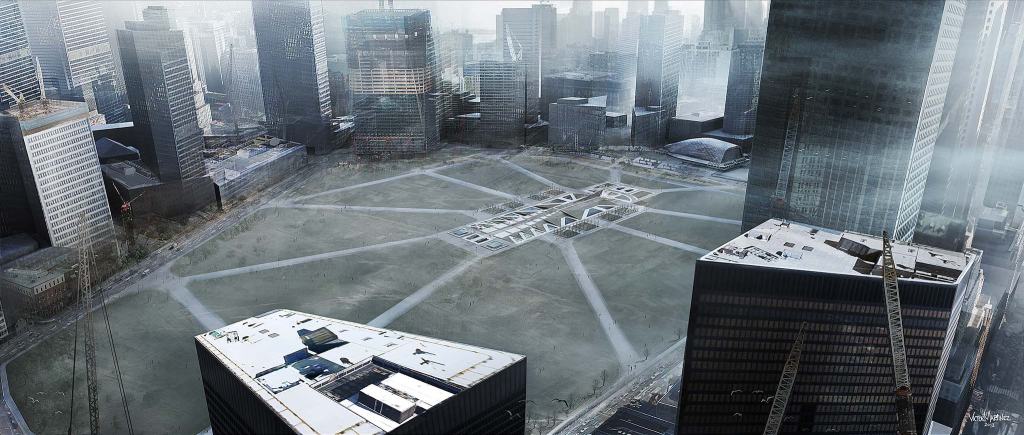
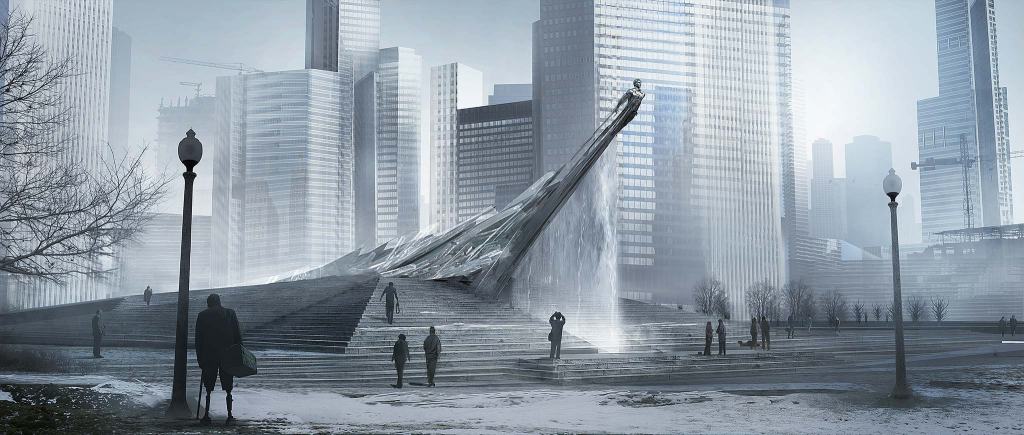
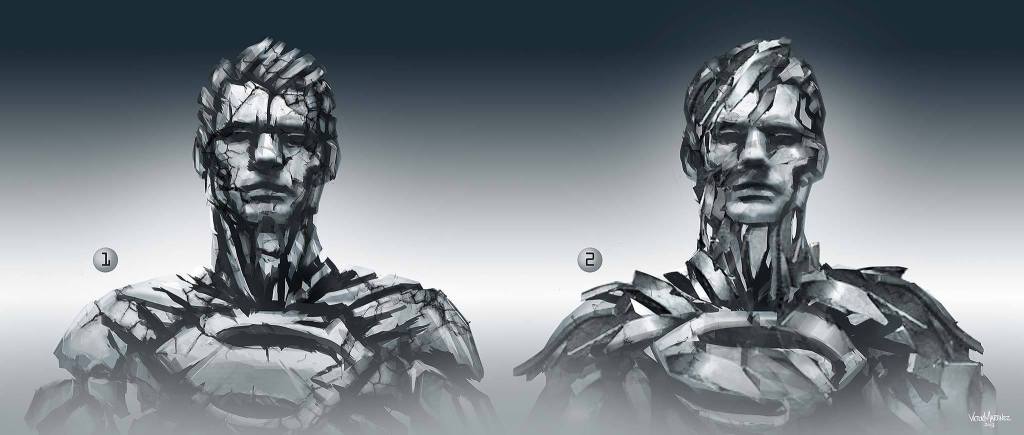
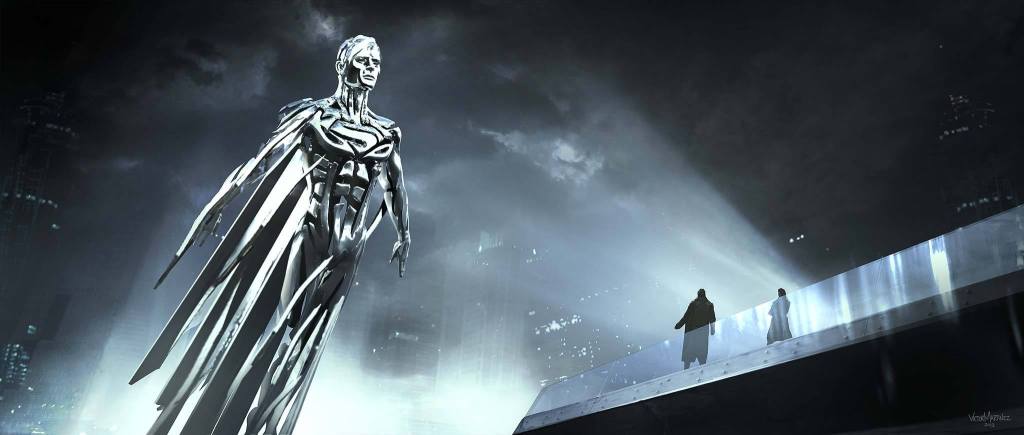
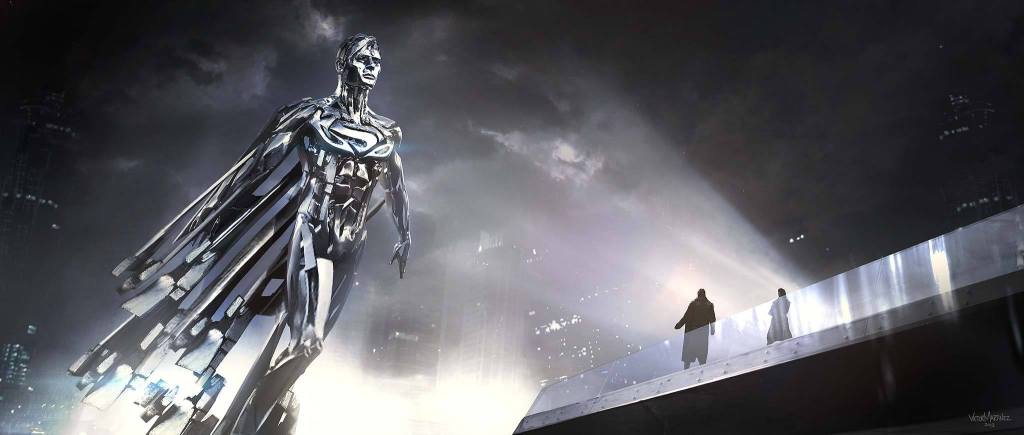
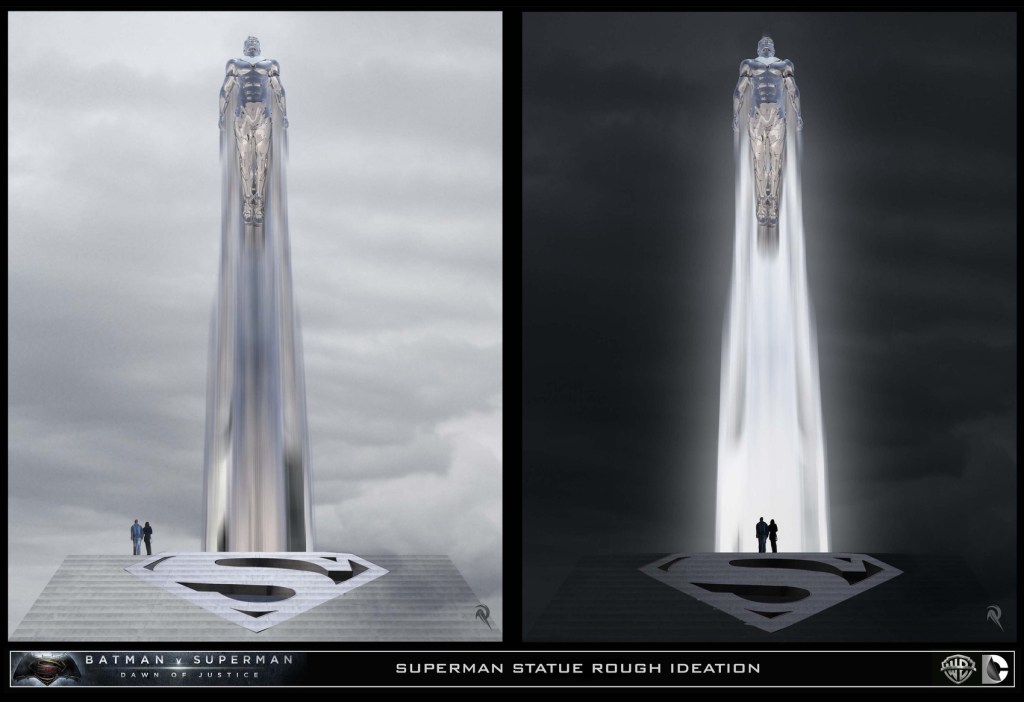
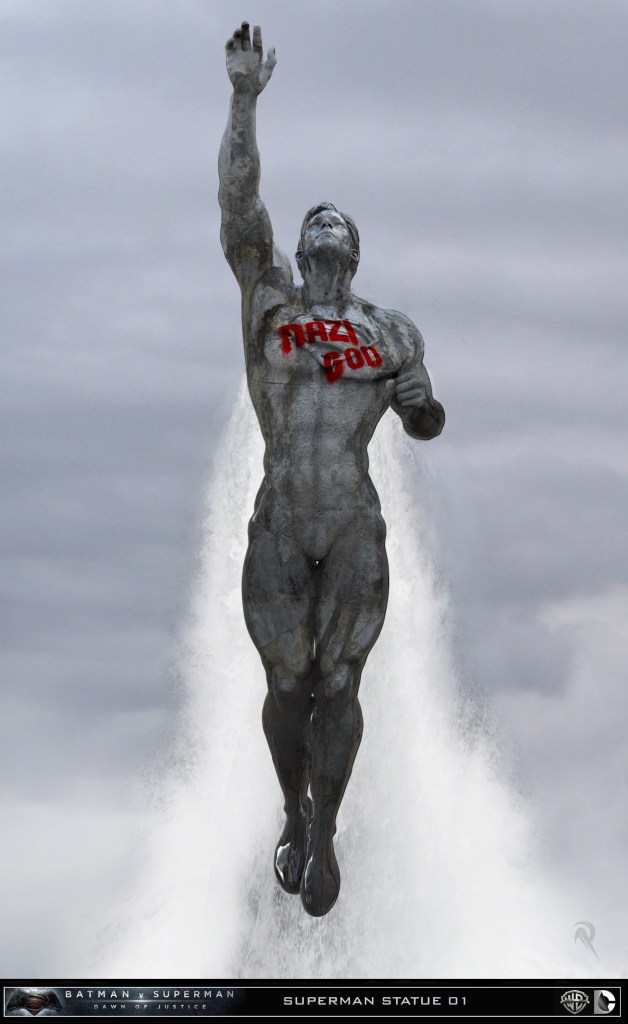
Heroes Park was shot at an outdoor green screen set at the late Michigan Motion Picture Studios along Centerpoint Parkway, Pontiac, Michigan. The statue was partially real but built from artificial materials. The set was ready around 9 June 2014 and was taken down on the 20th after serving its purpose. The vandalism sequence was likely shot between sometime between those days. Victor Martinez and Rob McKinnon posted concept art for the statue and park.
“That statue actually shows humility, just the way he reaches out to people, the way he poses himself. Zack actually posed for us for this. He went on the floor one day and said, ‘Hey, this is how it should be,’ and until he actually posed for it, I just was not completely clear. But I got it in the end.
The whole language for that is very bold and almost bleak. It’s not fun. We tried not to be fancy. The park is taking the whole footprint of where the fight has happened. We get the lines of the streets that used to be there – you only see this on the aerial shots — so somehow there’s a respect of the pattern of what that city used to be.”
Patrick Tatopoulos, Production Designer, Batman v Superman: Dawn of Justice, The Art of the Film, p46-p47, 29 March 2016
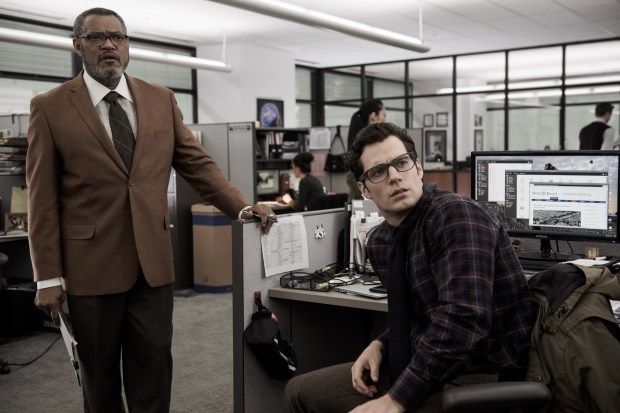
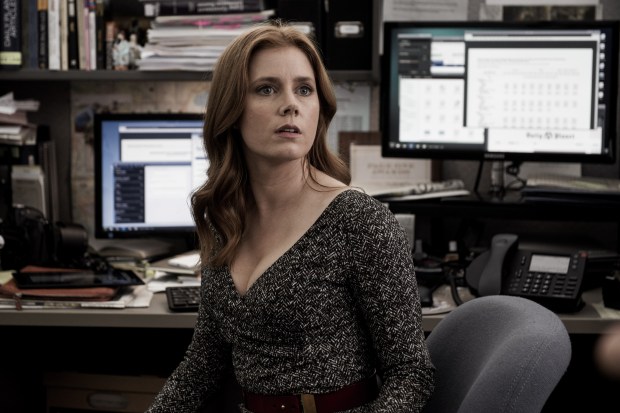
Based on physical evidence and quotes, the Daily Planet was shot in a retrofitted office space at 2000 Centerpoint Parkway, Pontiac, Michigan, in the late Michigan Motion Picture Studios, a former General Motors building just across the street from the location used for LexCorp. Those with a keen eye for set design may notice a significant number of changes since Man of Steel, implying the building has been heavily remodelled. Updates were inspired by old photographs of the Chicago Tribune. A row of televisions across the walls makes current news updates a constant presence in the scenes here. Lois and Clark can see each other from the placement of their desks. Electrician Erica Kim got a photo from inside. The location was sold to Williams International in 2017, when the studio held a garage sale for props.
“Daily Planet necessarily had to be refurbished, as it had been damaged in the attacks in Man of Steel. Our Daily Planet was based on references from the Chicago Tribune — updated with computers but still paperbound. We did not reconfigure it at all like the previous Man of Steel and, in fact, we were lucky to have the entire closed GM plant office systems available to us for rent! The office systems were from the ’90s, but we kept the palette to soft greys, browns, the nooks cluttered with boxes, papers and personal mementos.”
Carolyn Roucks, Set Decor 9 May 2016
“The windows are slightly different, a lot of things are different, but the basic layout at the office is the same. Zack went all the way to say, ‘Well, maybe they moved to another floor.’ The way Zack has set up the desks was so those two (Lois and Clark) can actually interact across the room. Those screens are super important — that’s how they see some of the events happening and moving. So, the whole layout is actually really thought out.”
Patrick Tatopoulos, Production Designer, Batman v Superman: Dawn of Justice: The Art of the Film, p52, 29 March 2016
The boat sequence was shot on the Lake Express passenger ferry on 10 November 2014, which was moored at Navy Pier, 600 East Grand Avenue, Chicago. This was the same day Bruce’s helicopter arrival in Metropolis was filmed. The vessel’s current whereabouts can be tracked on MarineTraffic.com. While filming this sequence, base camp was set up under North Stetson Avenue. Director of photography Larry Fong took this stunning evening photo of the Chicago bay over Lake Michigan and this humorous photo of set photographer Clay Enos.
The rundown Gotham apartment complex was shot at 475 Peterboro Street, Detroit, Michigan. Clark exiting his bus to enter the rundown Gotham apartment was likely shot on 28 October 2014, when the GCPD cruiser was present at the location with the Gotham Transit Authority bus. The interior hallway sequence was likely shot on the 2nd. Bananadoc shot a multitude of photos that day showing Henry Cavill, Paul Miles, and Zack Snyder outside the building. In late October, one base camp was set up in the parking lot behind the Masonic Temple on 500 Temple Street, which can be seen in the foreground of the apartment’s establishing shot. Another base camp was constructed in the parking lot of 3160 2nd Avenue right beside the Peterboro building.
A first look at Henry Cavill in his Clark Kent reporter costume was first posted by the Royal Marines Charity on Twitter on 30 June 2014, around when filming was underway at the late Michigan Motion Picture Studios along Centerpoint Parkway, Pontiac, Michigan. The outfit shows distinct differences from any variation of the trench coat look that Clark wears in the film, namely the navy shirt instead of plaid, and a slightly different coat collar. This suggests the photo may have been taken while filming a deleted scene or a test shoot. Alternatively, Cavill may have donned the outfit specifically to shoot this photo.
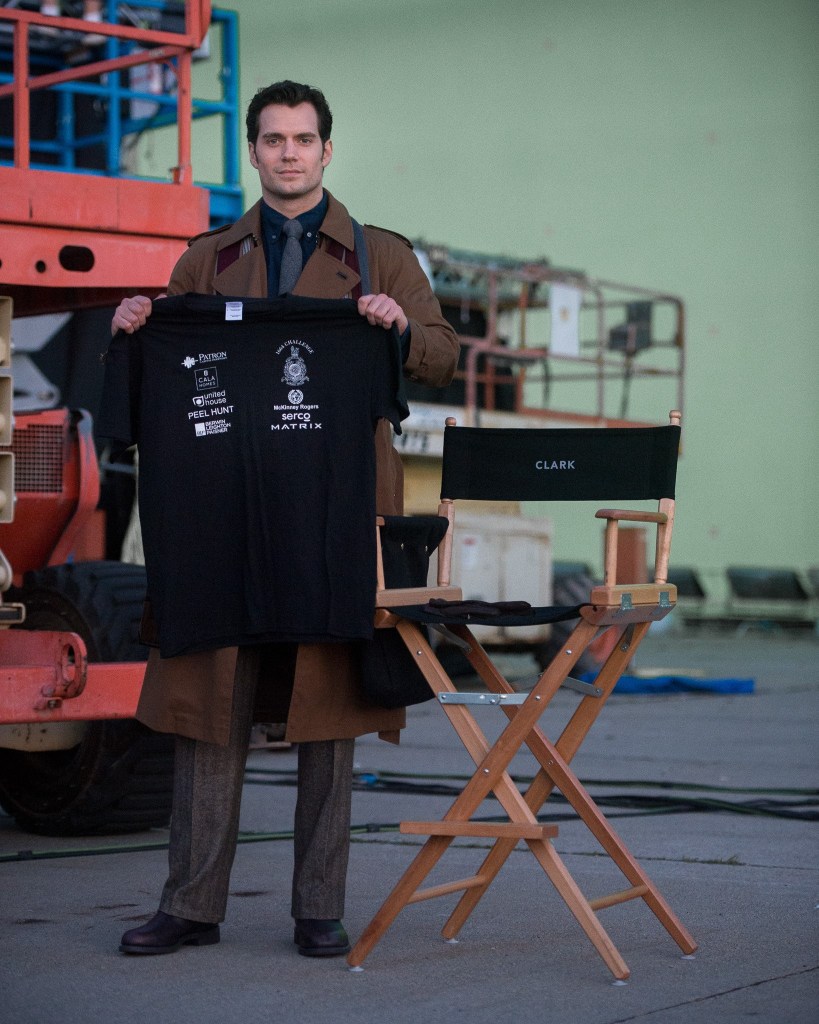
Royal Marines Charity, Twitter, 30 June 2014
DELETED SCENE
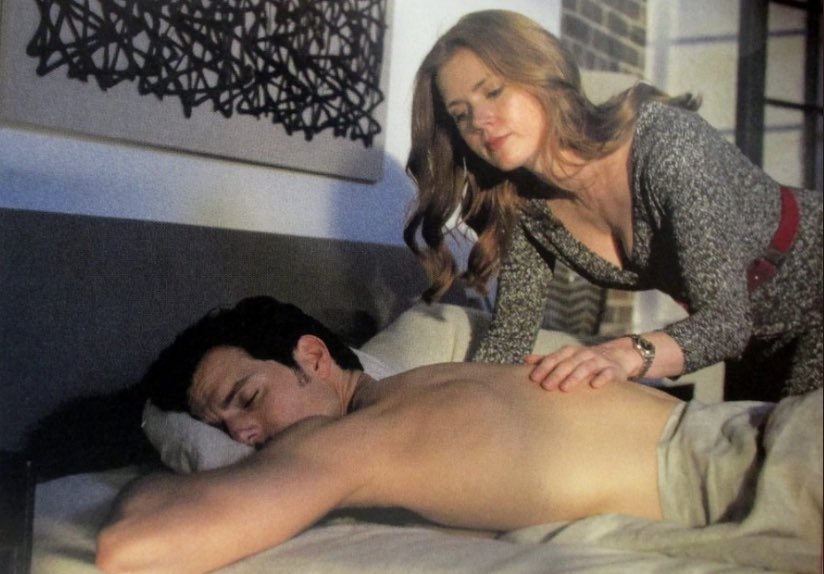
In the art book, The Art of the Film, one photograph shows a deleted scene in which Clark is asleep in bed while Lois touches him on the back. The outfit Lois wears indicates it is the same day as the Daily Planet sequence in this scene. Therefore, it probably took place around here. The film’s director of photography, Larry Fong, hinted the point of the scene on Twitter, saying, “Lois is going to work… and Clark has been going through some rough times.” One theory for the content of this scene is that Lois is comforting Clark after having nightmares about Black Zero, which would tie into Clark’s later mentioning during the mountaintop scene that he, like Jonathan Kent, has been haunted by nightmares involving those he cannot save. This theory, if true, would mean these nightmares have been occurring long before the Capitol bombing.
 Snyderverse Analysis