BATMAN V SUPERMAN: DAWN OF JUSTICE
CAPITOL HEARING

Cut to Lois moving through the crowd gathered outside the Capitol. A US park officer (T J Martinelli) stops her, “Oh, miss…” but Lois quickly shows her press pass, and the officer says to his partner, “Rudy, she’s good to go.” Lois proceeds into the vicinity.
The solemn Superman Theme C variation from Day of the Dead returns, completing this sad imagery of an iconic hero hated and reviled by the paranoid masses.


Low-angle shot of the sky above the Capitol, panning down to follow Superman’s descent as news cameras in the foreground also track his movement. This imagery might be a parallel to Superman’s descent on the military base in Man of Steel. Guns aimed at his front, cameras at his back, both weapons in a sense. Also of note, in MoS, he is silhouetted by the sun, whereas in BvS, the light is obscured by clouds. As he lands, we rise above the cameras to get a good look at the crowd of fans and protesters roaring in adoration and hate, holding signs. This resembles imagery from Watchmen and Grant Morrison’s Action Comics #3 (Vol. 2, 2012). Among the protesters, some of theirs signs read…
EARTH BELONGS TO HUMANS
ALIENS DOOM NATIONS
SUPERMAN = ILLEGAL ALIEN
ALIENS ARE UN-AMERICAN
GOD HATES ALIENS
THIS IS OUR WORLD. NOT YOURS!
TELL US THE TRUTH ABOUT ALIENS!
WHEN INVASION BECOMES REALITY REVOLT BECOMES DUTY
SUPERMAN WAS SENT TO DESTROY
YOU CAN’T BE CHRISTIAN & PRO-ALIEN
THANKS FOR THE “HELP”
RETURN TO SENDER
DEPORT SUPERMAN
SUPERDEATH
Countless civil rights and social activism movements, outrage responses, conspiracy theories, and general phrases related to fear and hate can be alluded to here. Another placard depicts the diamond Superman shield with a swastika inside. Though the social and political parallels are clearly not meant to be subtle, it’s worth noting that rhetoric like “God hates aliens” and similar would absolutely be a thing in a world where Superman exists. Virtually every phrase associated with protest and outrage would be recycled and represented in the post-Superman age.
“I was also always really happy with all the different placards. I remember doing a drawing of the drone and they painted it the colours of Superman, which I thought was a really interesting way of thinking about the way people would think about Superman in the context of having the ability to invade our space in a similar way to the way people were thinking about drone strikes and how drones had this kind of power outside of a manned aircraft, that they were this entity that would come into your life and drop a bomb on you or something, and I thought that was a really interesting way to link Superman to some kind of foreign policy concept in that context.”
Zack Snyder, Batman v Superman Director’s Commentary, 2021, 1:31:13
The supporters appear to be outnumbered, though it is interesting how they blend in so well with the protesters. Among them, some of their signs read…
SUPERMAN SAVES
WE ARE SAFER WITH SUPERMAN
MARRY ME SUPERMAN!


Wide shot of the crowd where Lois emerges, unable to progress any further with the many guards and barricades keeping everyone at bay. Beside her are screaming fans, crying in love for a celebrity with “Superman saves” on their jumpers, and an angry mob, screaming in abject rage at an alien invader. Both camps are difficult to distinguish on first viewing, blurred together in a singular mob of unwanted obsession, but both are juxtaposed against each other as two different yet radical perspectives of Superman. “Get out!” yells the angry man beside Lois to Superman (Sam Logan Khaleghi).
Medium shot on Superman, pushing in as he looks solemnly up at the Capitol building. His shield is prominent here, though dulled, complementing the souring of the magical, iconic imagery of Superman’s descent by the angry protesters behind him. Then he steps forward out of frame.
Medium shot on Lois, dejected and helplessly separated from the man she loves with a look of despair. Recall her old words from the bathroom scene: “I just don’t know if it’s possible… For you to love me and be you.” Now the world has come between them as Clark tries to stand up in defence of the idea Superman represents. The screaming crowd around her also indicates that her voice would be drowned out as one of many, and so Superman would not think to single her out with his honed senses. “Get out! Get out!” further yells the bigot on her right, as if desperate and afraid.

Wide shot of the Capitol steps to watch Superman ascend them, showing respect for existing structures and humbling himself before humanity, rather than flying through the front door or a window. As we pan up to take in the large structure, you may notice a single solitary autumn leaf falling from above. It is both in keeping with the falling motif of the movie and a reminder of the autumn leaves that accompanied the opening logos preceding the Wayne funeral. As such, this is subtle foreshadowing of the death and ideological fall about to occur.


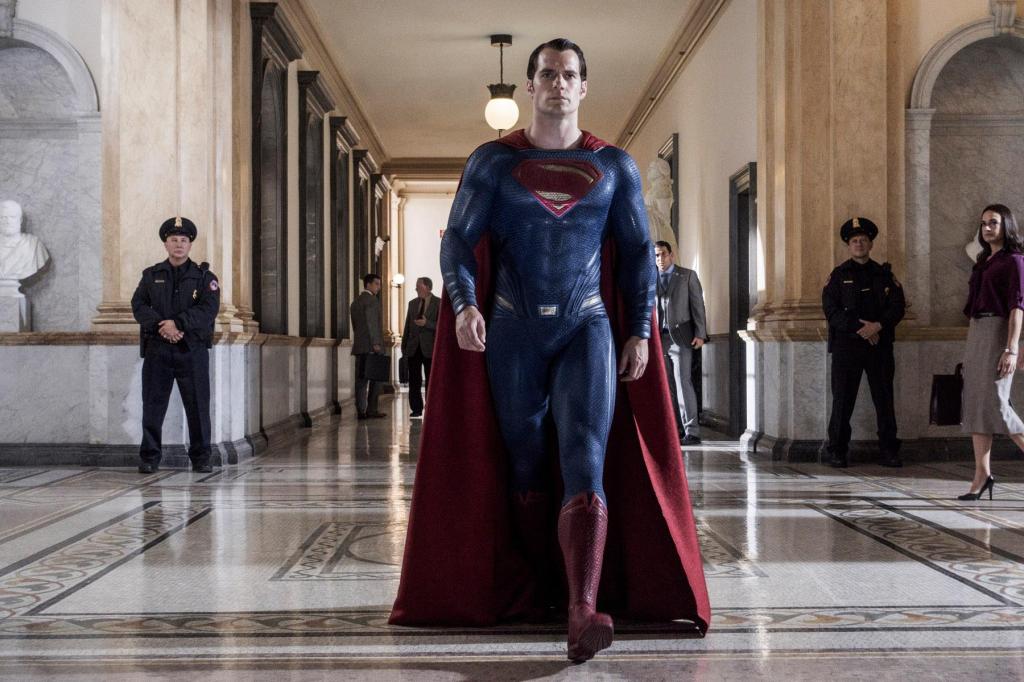
Full waist-level backwards tracking shot of Superman walking with a purpose through the halls of the Capitol building. He passes several people in suits who stand aside and let him pass, staring as this god-like being strolls through the marble hall. This shot might be meant to resemble a nearly identical shot from Man of Steel where the soldiers are leading him down the hall of the military base. This would also corroborate the previous visual parallel to Man of Steel, where soldiers with guns have been replaced by reporters with cameras, and Superman’s surrender to the military has become a surrender to government. In both cases, he is bringing himself down and submitting to humanity.
“A lot of these symmetrical shots, there’s a lot of reference. I always keep in mind in my drawings the way you shoot Superman, like when he’s put in chains coming down the hallway in Man of Steel, I like the similar size and speed and cadence, like he’s captured again, and he’s given himself up again. I think those parallels are really important.”
Zack Snyder, Batman v Superman Director’s Commentary, 2021, 1:28:22


Waist-level shot of the television screens in Bruce’s conference room, where we can see Superman march through a hallway from a dramatic low-angle. Focused in the foreground is Greg’s arm extending from the right, handing Bruce an envelope, which he reaches from the left frame to take. Greg is saying, “Another one came this morning, Mister Wayne.”
Cut to Bruce, looking up from the envelope to focus on the television as the moment of truth finally approaches.


Wide shot of Finch behind the hearing chamber podium amid indistinct conversation with “Senator Purrington”, played by life-long Batman fan and real-life US Senator Patrick Leahy, who has made cameos in Batman Forever (1995), Batman: The Animated Series (1995), Batman & Robin (1997), The Dark Knight (2008), The Dark Knight Rises (2012), and now this film. The name may derive from storyboard artist Jared Purrington. People murmur before we hear the doors opening, and the two Senators cease conversation to face the camera.
Superman Theme C dies down, and the atmosphere falls silent.
Low-angle medium shot on Senator Barrows as he takes his seat behind the podium, reminding us of his existence so we know that Lex has evidently also chosen to terminate him as a liability too.
Static high-angle wide shot of the chamber’s entrance doors. Superman enters at a slow pace while everyone goes quiet. As he approaches down the aisle, we dolly backwards as spectators finish taking their seats. He looks out-of-place among the normally-dressed people. The doors behind him close.
High-angle shot from beside Superman’s shield, looking down at the spectators looking up at him, each established as a person taking in his presence. Notice Superman’s head is out of frame, with emphasis placed on his shield, the centre of focus for the people, rather than him as a person.
Waist-level rear shot between Finch and Purrington, Superman approaching down the aisle in the foreground as the two Senators take their seats.


Waist-level shot of the low door to the speaker’s podium as Superman arrives from the right and gently pushes it open. Though a little detail, Snyder felt this shot was very important, once again likely for how it demonstrates Superman’s gentle respect towards humanity’s structures and customs.
Medium shot on Superman, pulling out as he takes his spot at the podium and stands to wait patiently. Notice how he waits to be addressed before he speaks. He’s going out of his way to be respectful and cooperative. Flanked by the eyes of many spectators, the stage is set.
Shoulder shot from Superman, showing the sitting senators and the group of photographers on the floor between them and Superman, their cameras perpetually focused on him. Two news cameras are in the corners.
Finch begins, “Let me say at the outset that I’m grateful to our witness for coming before us today.” She gestures outward to our right.
Side shot from Superman, turning right as we rack focus to Wallace Keefe sitting in the corner. They make eye contact.
Firmly, Finch continues, “This is how a democracy works. We talk to each other. We act by the consent of the governed, sir.” She says this sternly towards Superman, showing her backbone. This carries from her earlier line, “In a democracy, good is a conversation, not a unilateral decision.” Batman and Superman both make the mistake of never talking their issues out.
Superman’s head is down, eyes closed remorsefully and taking the words, before turning up to look at Finch.
She continues, “I have sat here before to say that shadow interventions will not be tolerated by this Committee. Neither will lies.”
While she says this, Keefe is still staring daggers at the Kryptonian, totally unmoving.
Mercy is also sitting among the spectators. She turns to look over her shoulder at the entrance doors. Lex’s chair, marked with his name and profession, is unoccupied beside her, telling us she is wondering where he is.
Finch continues, “Because today… is a day for truth. Because only by speaking–“ She stops abruptly when she notices something out the corner of her eye. Shoulder shot from Finch on a glass jar of yellow liquid sitting on the desk. The word “tea” is visible on a simple label on the glass. Low-angle on Finch from beside the jar. She looks lost for words.
Purrington turns to Finch in confusion for her sudden silence.
Barrows does the same from her other side.
Return to low-angle on Finch, the jar remaining in the shot as she tries to continue, stammering, “Only by working together can we…” She blinks, looking shaken.
Superman cocks his head, also not quite sure what the problem is.
Keefe in his wheelchair, is also puzzled by Finch’s breakdown.
Finch goes on, “…Can we…”
Cut to Mercy, pushing in as she turns to the stuttering senator.


Finch turns her eyes back to the jar. She reaches over to it and puts her fingers around the rim. “…Can… we create a free and a…” She turns the jar, and soon the label is fully revealed, “Granny’s Peach Tea” written in the same red handwriting as the red text on the Polaroids and the checks.
Shaking, Finch immediately pulls her hand back in disgust, immediately recalling the metaphor she used in her conversation with Lex: “Take a bucket of piss and call it Granny’s Peach Tea.” Just as she described, it is a jar of urine masquerading as peach tea. This vulgar insult comes as a shock to Finch, unable to understand why Lex would send such a message. In truth, this is his “Got you” — a final insult to the woman who crossed him.
Cut to Superman, once again cocking his head and aware that something is amiss. It is deadly silent.
Back to Finch, turning from the jar with a look of alarm.
Cut to Lex’s empty chair, pushing on the nametag, reminding us again that Lex is not here.
Cut to Finch. She shudders, then turns her eyes to her left, towards Keefe.
Sensing her urgency, Superman quickly turns his head to follow her gaze. A moment to steel himself.
Cut to Keefe, sitting quietly. Then his wheelchair explodes. The inferno fills the large space in a fraction of a second.


Cut to the hallway outside as the blast consumes the security officers guarding the scene.
Top-down shot of the Capitol, flying over the building as fire erupts from every window.
Low-angle on the exploding building from the crowd, who duck and scream in terror.
At the diner, Martha turns, gasping from sudden fright and dropping her jug of coffee, smashing on the hard floor. On the television, the camera among the crowd is shaking violently. Martha looks terrified.
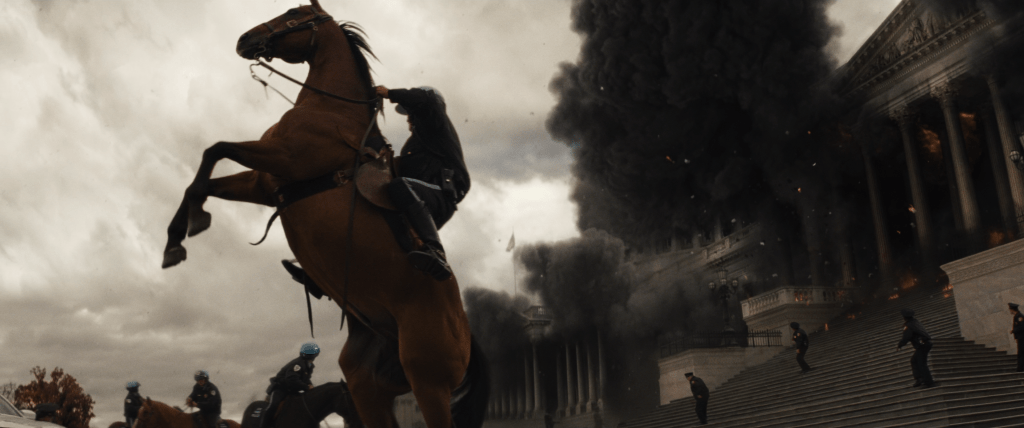
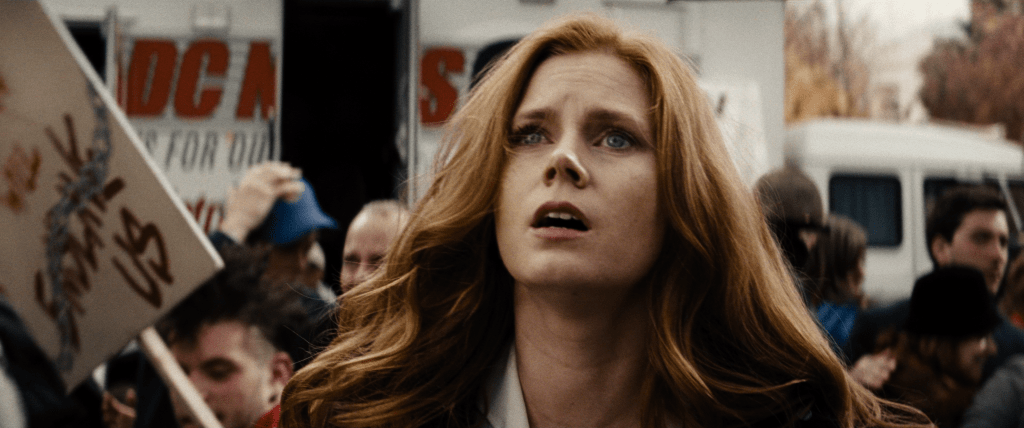

Waist-level shot of the barricades keeping back the crowd at the Capitol. Lois, ducked for cover, now begins to stand, looking up at the destruction in horror. We hear a horse neigh.
Low, solemn strings come in.
Low-angle shot of a police officer’s mount on its hind legs in fright. This is the recurrence of the horse motif, an expression of resolution for the constant foreshadowing of coming death. This shot may also be another visual reference to The Dark Knight Returns (1986). In the foreground, the Capitol is engulfed in smoke. The sound grows distant.
Medium close-up on Lois, still looking up and breathing rapidly in terror. A muffled scream completes the horrifying atmosphere.


Cut to flames in slow-motion. As they clear, we arrive at a slow-motion medium shot on Superman, pushing in. He stands idly in the middle of it all, totally unharmed while everyone around him has perished. His eyes are closed, absorbing the horror of what’s just happened. His head is slightly bowed in shame. He’s surrounded by his failure.
A slow, sorrowful rendition of Superman Theme A on piano comes in over the low strings.
Superman slowly shakes his head before opening his eyes, his expression grim and contemplative. He turns his head, his eyes scanning the devastation, as if he’s struggling to reconcile his intentions with the horrific, unintended consequences of his good intentions.
Finally, we arrive on a close-up, where now Superman’s eyes seem distant, not focused on any one thing, but almost lost in sorrow. The blood vessels around his eyes also dilate, the puffy skin turning red, indicating he’s on the verge of tears. The expression speaks of disappointment, helplessness, and resignation. This shot is often misrepresented as a failed attempt to convey horror, but we can gather from Superman’s expression that he’s consumed by a deep sense of defeat and disillusionment. He came here to set the record straight and earn humanity’s trust, believing the truth would win out. Then, in a split second, his environment had transformed into a fiery tomb, and now he stands indirectly responsible in the carnage, crushing his faith in humanity and himself.
“This shot of Superman inside the burning building, he’s literally moved to tears at the notion that he misjudged so badly what humanity is capable of and how deep the pain is for everyone…”
Zack Snyder, Batman v Superman: Dawn of Justice Watch Party, 29 March 2020
“All these changes that you’re going through, one day you’re gonna think of them as a blessing, and when that day comes, you’re gonna have to make a choice. A choice of whether to stand proud in front of the human race or not.”
Jonathan Kent, Man of Steel
This shot allows us to linger on Superman’s regret in the immediate aftermath of the bombing to feel the weight of this tragedy on him, in turn allowing the horrible reality to sink in. The slow-motion gives him time to display these emotions before he gets to work helping survivors. Samuel Otten pointed out that this visual may be in reference to Jor-El’s words in Man of Steel: “They will join you in the sun.” Here, Superman is surrounded by fire, but he is totally alone. Humanity is nowhere to be seen — only death. Following this, Superman comes to the conclusion that the ideals he stood for are no longer compatible with this world, and Jor-El’s words now ring hollow.


Shoulder shot from Bruce, the entire foreground dominated by the four screens depicting the panicking crowd and smoke rising from Capitol Hill. “We’re back at the nation’s Capitol where something is happening,” says a reporter, her voice also muffled.
Low-angle on Bruce, looking mortified at the events when he looks down, paper rustling in his hands.
The same “screaming” synthesizer resembling the unnerving, agonised scream used earlier in Branding and Quaker Streak And Lube makes its return.
High-angle looking down on the contents of the envelope as Bruce removes and unfolds what appears to be a newspaper clipping Black Zero, with an image showing the ruins of Wayne Tower. We push in on the two messages…
WAYNE TOWER DEVASTATED
Of course, this also has a message drawn in red ink…
“YOU LET YOUR FAMILY DIE”
Wallace’s words can refer both to Bruce’s own parents and his cherished employees. This especially works because of the girl’s mother he could not save during Black Zero and his own mother, which will come into play later.
Medium close-up on Bruce, looking up from the paper. He is trembling with a look of utter hate. If Superman’s continued existence, allowed by Batman’s inaction, causes men to commit such atrocities in an attempt to kill him, then Batman will take things into his own hands and end the threat of Superman before Bruce could not save them from him.
The screaming music reaches its peak. Disturbingly, the PGS subtitles for the movie say we are hearing “child screams”.


Then we cut to black.
The music abruptly ends with the horrific moment.
SCENE OVERVIEW
Superman enters the hearing, prepared to explain himself, only for Wallace Keefe’s wheelchair to explode, killing everyone in the building except the Man of Steel. This sets up Keefe as a bomber indirectly radicalised by Superman. Lex has removed an enemy in Finch, removed Mercy and Barrows as two less witnesses to his scheming (and in turn given himself plausible deniability), denied Superman the opportunity to defend himself, placed him at the centre of a tragedy that will further sway the public against him, demoralised him, and totally radicalised Batman. Lex has effectively killed a dozen birds with one stone and gained a huge win dead-centre in the middle of the film.
SCENE ANALYSIS
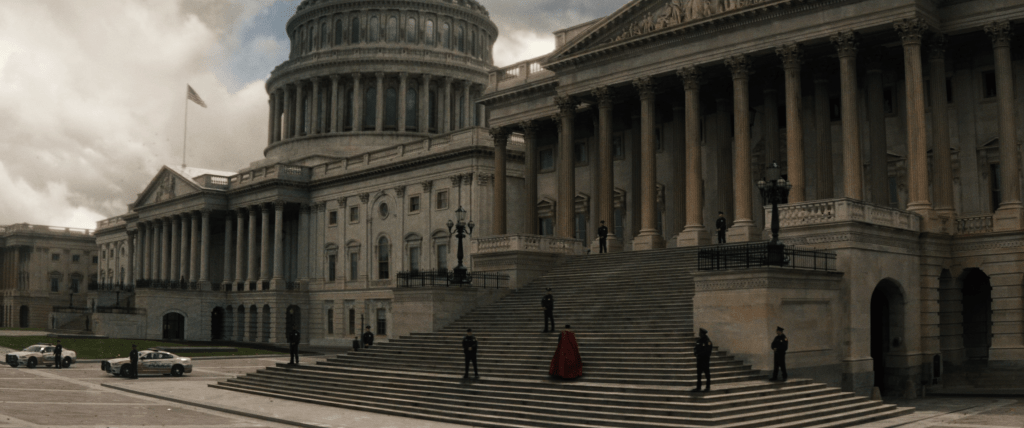
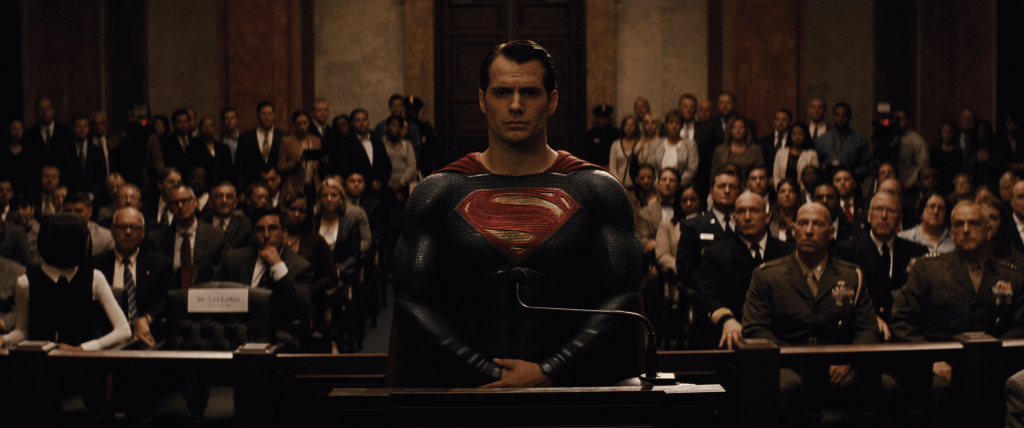
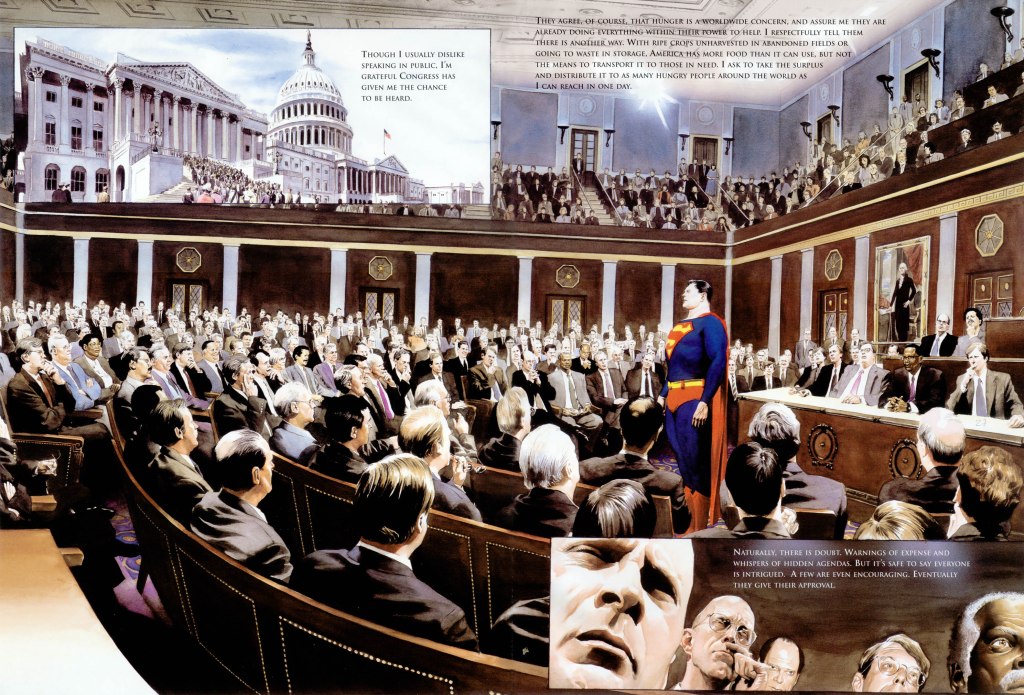
This sequence is referencing yet another page from Superman: Peace on Earth (1998), including with a perfect mirror shot of the drawing of Capitol Hill. In that comic, Superman visited Congress to express his intent to deliver food and supplies to impoverished and starving people across the world. It is worth noting that this leads to tragic incidents with dictatorial and third-world nations creating moral dilemmas for Superman to face. It also bears a similarity to Action Comics #3 (2012), where Superman’s existence leads to crowds of protesters and rioters who hate and fear him.
“This shot of Superman inside the burning building, he’s literally moved to tears at the notion that he misjudged so badly what humanity is capable of and how deep the pain is for everyone, and that reflects exactly the opposite on Bruce, this idea that Superman is responsible for this whole thing.”
Zack Snyder, Batman v Superman: Dawn of Justice Watch Party, 29 March 2020
All of the American iconography in Washington’s landmarks and statues has culminated in a horrific act of desecration. This kind of striking imagery is especially powerful, not only shocking the audience with the haunting sight of an iconic American monument in flames, but shocking the world within the film’s narrative, who will tie this historical carnage to Superman. Truly, Lex Luthor has no limits to how far he will go in pursuit of his goals. What makes the Capitol so significant is it stands as a symbol of American power, as opposed to the Lincoln Memorial (representing freedom), the Washington Monument (representing the founding), or the White House (representing leadership).
“When Chris and I talked about this concept of blowing up the Capitol, we knew we really wanted to have it be iconographic, and we were trying to think what irreversible damage Lex would do to America and/or the persona of Superman by destroying these things that you couldn’t replace. How could we bring [truth, justice, and the American way] down in one cut, and that was the game we were playing with what got destroyed. There’s a lot of stuff in Washington that you can blow up that would have different significance, but it was that.”
Zack Snyder, Full Circle, Batman v Superman: Dawn of Justice commentary, 29 April 2023
The value of conversation is a deeply important part of this film’s narrative and themes. Finch wanted to create conversation to give Superman the chance to present his side of the story, reveal Lex’s deceptive hand in events, and essentially stand up for truth. By destroying the Capitol, Lex has put a stopper in truth and diplomatic resolution, guaranteeing that only emotion prevails, allowing him to manipulate the fearful masses.
By being denied a chance to speak and defend himself, Superman is unwillingly put in Christ’s position, where Jesus refused to defend himself when brought before Pontius Pilate by the Romans. Of course, crowds of people proceeded to demand Christ’s death, just as legions of protesters go on to chant, “Burn him!” while torching effigies of Superman. That is then followed by his “crucifixion.”
“I am reminded that the Capitol Bombing in BvS is possibly the strongest dramatic mid-shift I can think of in a film. Not only does it completely escalate the drama for all the characters, it occurs almost dead fucking centre in the film’s run time. Is it a bit on the nose? Absolutely. But it’s very clear you can break the film’s story into Before and After Bombing segments. I love a strong mid-shift.”
@Only_Grey, Twitter, 18 May 2020
The attention drawn to the little actions of the people in the Capitol — talking amongst themselves, interrupted by Superman’s arrival, scrambling to sit down, and staring in awe as he strolls into the chamber — further humanises the victims and amplifies the tragedy of their deaths.
The first music track in this scene is the tail end of Capitol Montage (Part B) from the previous scene, consisting of Superman Theme C as Superman makes his arrival. This track is not on any commercially-available version of the score.
The second music track in this scene is the first half of Aftermath. It mainly serves to pit Superman and Batman against each other musically — Superman’s component illustrates his sorrowful feelings while Batman’s component (not even quite a recurring motif) illustrates that this was the final straw for him. This track is not on any commercially-available version of the score.

BEHIND THE SCENE
“The approach Julius Lechner’s team took on this one changed a little bit over time. We started off with matching the timing of the previz and procedurally placed a generic smoke simulation for each breaking window. Those 200+ simulations gave us a pretty good idea of not only the big top-down shot but also for all the other ones, since they were all based on the same timing. This procedural approach in the beginning made it easy to move forward and figure out which areas we wanted to do custom simulations for. Later on we replaced those generic simulations step by step with more detailed ones that were tailored for each angle and covering bigger areas rather than one for each window. An important aspect that we tried to achieve for the main fireball was to find a good balance between fire and heavy smoke and push the visual quality of it, which required us to explore new shading techniques for the atmospheric renderings.”
Bryan Hirota, Art of VFX, 11 April 2016
The Senate Committee Chambers were filmed in the interestingly named Wayne County Building, 600 Randolph Street, Detroit. The committee sequences were evidently shot on the 18th and 19th of August 2014. Base camp was set up in the parking lot of 700 Randolph Street, just across the road. @Bananadoc snapped multiple photos of Henry Cavill in-costume outside the South entrance with suit partially concealed, and at base camp, plus some photos of Holly Hunter, Scoot McNairy, and Tao Okamoto. Photographer Randy Chiang took countless photos of Henry Cavill, Tao Okamoto, Holly Hunter, Scoot McNairy, and Jesse Eisenberg around the building. Patrick Leahy was also seen arriving for his cameo.
Careful observation will show that the people caught within the expanding explosion do react to the blast within the final frames of their lives, showing an attention to detail beyond the mere visual effects. In January 2016, the Capitol explosion detail was leaked in advance of release by extras breaking their non-disclosure agreements to one extra who was supposedly cut from the shoot due to being too tall.
The Capitol exterior and crowd of protesters was shot on an outdoor green screen set at the late Michigan Motion Picture Studios along Centerpoint Parkway, Pontiac, Michigan. The building was digitally inserted into the scene, but half of the North wing steps were constructed for real for Henry Cavill to ascend. The sequences here were shot in July 2014 when the crew were filming in Pontiac.
Ralli’s diner was shot at the Hygrade Deli, 3640 Michigan Avenue, Detroit, Michigan, where the owner Stuart Litt and waitress Linda Holmes served as extras, both visible in the scene behind the counter. The humble restaurant was transformed into Ralli’s Diner with a new sign and Kansas-themed interior decoration. The sequences were shot on 28 August 2014 from 2 PM to 2 AM EST. Across the street, Mike’s Famous Ham Place was closed for the duration of the shoot and supposedly helped feed the crew. After shooting, Litt was asked if he wanted to keep the props, which he did. @D3T0N8R snapped several photos for Twitter, including of the vehicles used to kidnap Martha parked out back.
The Wayne Enterprises boardroom was shot in the executive boardroom of the Guardian Building, 500 Griswold Street STE 1600, Detroit, Michigan. Shooting may have occurred around 7 August 2014, when the set’s prop painting of Jeffrey Dean Morgan as Thomas Wayne was spotted by Detroit locals. This was also the first indication that Morgan would be in the film. Art director Lorin Flemming designed the set, and you can find detailed photos of the layout and conceptualisation at her website.
 Snyderverse Analysis